Learning English has become more important than ever in today’s connected world. Whether you’re preparing for IELTS, TOEFL, PTE, OET, TOEIC, CAE, or TOLES, or aiming for global career opportunities, study abroad, work abroad, or international jobs, the ability to communicate confidently in English can transform your future.
However, many learners spend years memorizing grammar rules and vocabulary lists without becoming fluent speakers. This raises an important question: What Is Language Immersion, and why do experts consider it one of the fastest ways to achieve fluency?
The answer lies in how our brains naturally acquire languages. Instead of simply studying English, language immersion encourages learners to experience it in everyday situations. This practical approach helps learners think, speak, and understand English naturally rather than translating every sentence from their native language.
In this article, we’ll explore What Is Language Immersion, why it works faster than traditional learning methods, and how you can start your own immersion journey today.
Read More: How English Immersion Builds Fluency, Confidence, and Natural Expression
What Is Language Immersion?
Language Immersion is a learning method where learners surround themselves with English throughout their daily lives. Rather than limiting learning to classrooms or textbooks, learners regularly interact with English through conversations, videos, podcasts, books, apps, work, and daily activities.
In simple terms, what is language immersion? It means making English a natural part of your everyday routine.
Unlike traditional learning, where students may study English for just one or two hours a week, english language immersion encourages constant exposure. This repeated interaction helps the brain recognize patterns, improve pronunciation, and understand context naturally.
The language immersion method mirrors the way children learn their first language—through continuous listening, observing, speaking, and receiving feedback.
Why Does Language Immersion Work Faster?
Traditional learning often focuses heavily on grammar exercises, vocabulary memorization, and written tests. While these are valuable, they don’t always prepare learners for real conversations.
Immersive english learning works faster because it emphasizes practical communication instead of passive studying.
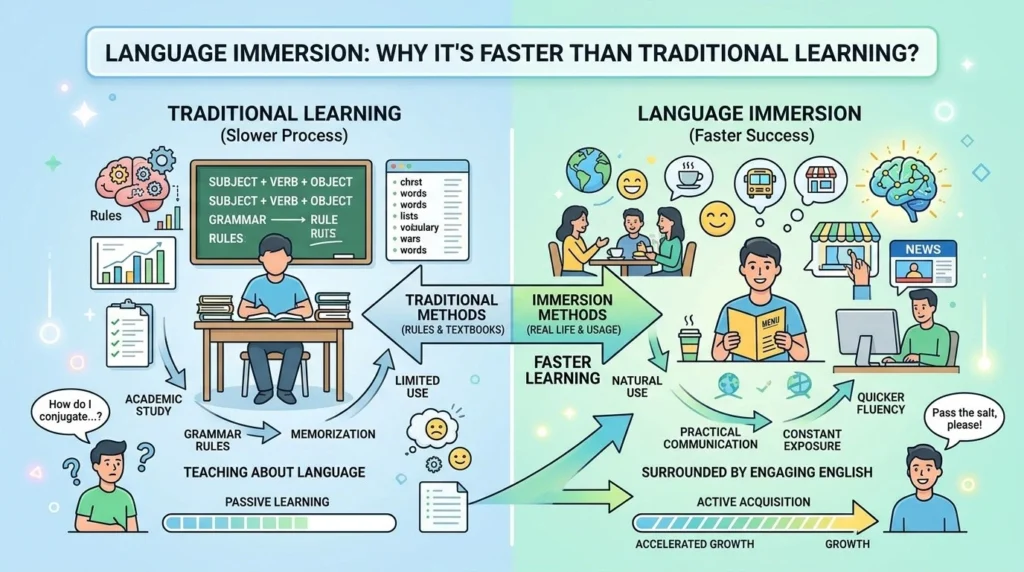
Here are several reasons why:
1. Continuous Exposure Builds Familiarity
The more English you hear and read, the more natural it becomes. Your brain begins recognizing sentence structures without consciously memorizing grammar rules.
Instead of translating every word, you gradually begin to think in english, which significantly improves speaking speed and confidence.
2. Real-Life Context Makes Learning Easier
Learning isolated vocabulary can be difficult to remember. But when words appear naturally in conversations, movies, podcasts, or workplace discussions, your brain connects meaning with context.
This makes vocabulary retention much stronger than traditional memorization.
3. Speaking Becomes Natural
Many learners understand English but hesitate when speaking. Daily english conversation practice removes this fear.
Regular conversations improve pronunciation, confidence, sentence formation, and listening comprehension simultaneously.
The more you speak, the faster your english communication skills improve.
4. Better Listening Skills
Language immersion trains your ears to understand different accents, speaking speeds, and expressions.
This is especially useful for learners preparing for IELTS Speaking Preparation, TOEFL Speaking Practice, PTE Speaking Tips, CAE Speaking Practice, or OET Speaking Preparation, where understanding spoken English is just as important as speaking correctly.
Traditional Learning vs Language Immersion
Traditional learning often includes:
- Memorizing grammar rules
- Completing worksheets
- Learning vocabulary lists
- Taking written exams
- Limited classroom speaking
In contrast, Language Immersion focuses on:
- Daily conversations
- Listening to authentic English
- Reading real-world content
- Watching English videos
- Practicing speaking every day
- Using English in practical situations
While grammar remains important, immersion teaches learners how to use grammar naturally during communication.
The Best Way to Learn English Fast
Many students ask, “What is the best way to learn english fast?”
There isn’t a single shortcut, but combining structured lessons with english language immersion produces faster and more lasting results.
An effective routine includes:
- Listening to English every day
- Reading articles and books
- Watching English videos
- Practicing speaking regularly
- Learning useful vocabulary in context
- Receiving feedback from teachers or speaking partners
This combination creates practical english learning rather than theoretical knowledge.
How to Learn English Fast with Immersion
If you’re wondering how to learn english fast, start by making English part of your daily routine.
Some simple ideas include:
- Change your phone and computer language to English.
- Watch English YouTube videos with subtitles.
- Listen to English podcasts while commuting.
- Read English news articles every morning.
- Keep a journal in English.
- Speak with language partners regularly.
- Practice describing your daily activities in English.
These habits create english immersion at home, even if you don’t live in an English-speaking country.
English Speaking Practice Daily Matters
Fluency develops through repetition.
Doing english speaking practice daily helps you:
- Speak more confidently
- Reduce hesitation
- Improve pronunciation
- Build vocabulary naturally
- Respond faster during conversations
Even 20–30 minutes of speaking every day can produce noticeable improvement within a few months.
The Importance of English Conversation Practice
Many learners spend years studying but rarely speak.
Regular english conversation practice bridges the gap between knowledge and communication.
Conversation teaches learners to:
- Express opinions
- Ask questions naturally
- Handle real-life situations
- Improve listening skills
- Build confidence
The more conversations you have, the more natural English becomes.
English Fluency Training for Real Results
Professional english fluency training combines speaking, listening, pronunciation, vocabulary, grammar, and confidence-building activities.
A well-designed english fluency course focuses on communication rather than memorization.
These courses often include:
- Interactive speaking sessions
- Role-playing activities
- Pronunciation coaching
- Listening exercises
- Real-life conversations
- Personalized feedback
This practical approach accelerates fluency.
English Immersion Program Benefits
Joining an english immersion program provides learners with structured exposure to English every day.
Programs usually include:
- Speaking-focused lessons
- Group discussions
- Presentation practice
- Listening activities
- Vocabulary building
- Real-world communication tasks
The constant interaction creates faster progress compared to occasional classroom learning.
Exam Preparation Through Language Immersion
Many learners preparing for international English exams benefit greatly from immersion.
For example:
- IELTS Speaking Preparation improves through daily conversations.
- TOEFL Speaking Practice becomes easier with regular speaking.
- PTE Speaking Tips become more effective when learners naturally think in English.
- CAE Speaking Practice develops through authentic discussions.
- OET Speaking Preparation improves with role-playing medical scenarios.
Rather than memorizing answers, immersion develops genuine communication skills that examiners value.
How to Become Fluent in English?
Many learners wonder how to become fluent in english.
Fluency doesn’t require knowing every English word.
Instead, fluent speakers:
- Understand everyday conversations
- Respond naturally
- Express ideas clearly
- Continue speaking even when they make small mistakes
Consistency matters more than perfection.
Daily exposure through immersive english learning gradually builds confidence and fluency.
English Speaking Practice in Bangladesh and Nepal
Learners across South Asia increasingly recognize the value of speaking-focused learning.
Demand for english speaking course bangladesh programs has grown as professionals prepare for international education and overseas careers.
Similarly, learners seeking english speaking practice nepal are turning toward conversation clubs, online classes, and immersion-based learning methods to improve real-world communication.
These practical approaches help learners become confident speakers much faster than traditional classroom instruction alone.
Why English Certification Still Matters
Although communication is the ultimate goal, recognized certifications remain valuable.
Preparing for IELTS, TOEFL, PTE, OET, TOEIC, CAE, or TOLES not only improves language proficiency but also opens doors to international education, study abroad admissions, overseas employment, and the international job market.
The English certification benefits include stronger university applications, better employment prospects, and increased credibility with employers worldwide.
Combining English language certification with Language Immersion gives learners both practical communication skills and globally recognized qualifications.

Final Thoughts
If you’ve ever asked yourself, What Is Language Immersion, the answer is simple: it is the process of surrounding yourself with English until it becomes a natural part of your daily life.
Unlike traditional methods that focus primarily on memorization, Language Immersion develops real communication through constant exposure, meaningful conversations, and practical experience.
Whether your goal is to improve your english communication skills, prepare for IELTS, TOEFL, PTE, OET, TOEIC, CAE, or TOLES, pursue global career opportunities, achieve study abroad dreams, secure work abroad opportunities, or simply become a confident English speaker, immersion offers one of the fastest and most effective paths to fluency.
The journey doesn’t require perfection—it requires consistency. By practicing every day, engaging in real conversations, and making English part of your daily routine, you’ll steadily build the confidence and fluency needed to succeed in today’s global world.
Frequently Asked Questions (FAQs)
1. What is Language Immersion?
Language Immersion is a learning approach where learners surround themselves with English through daily conversations, media, reading, listening, and real-life communication instead of relying only on classroom lessons.
2. Is Language Immersion the best way to learn English fast?
Yes. Many language experts consider Language Immersion one of the best way to learn english fast because it encourages constant practice, real communication, and natural language acquisition.
3. Can I create English immersion at home?
Absolutely. You can practice english immersion at home by watching English videos, listening to podcasts, reading books, changing your device language, and engaging in english speaking practice daily with friends or online partners.
4. How does Language Immersion help with IELTS, TOEFL, and PTE?
Language Immersion improves speaking confidence, listening comprehension, vocabulary, and fluency, making IELTS Speaking Preparation, TOEFL Speaking Practice, PTE Speaking Tips, CAE Speaking Practice, and OET Speaking Preparation much more effective.
5. How long does it take to become fluent through Language Immersion?
The timeline varies depending on consistency and practice. Learners who engage in daily english conversation practice, follow an english fluency course, and use immersive english learning techniques often see noticeable improvements within a few months, with long-term fluency developing through regular use.




Leave a Reply