
Learning English is no longer just about memorizing grammar rules or completing workbook exercises. While traditional learning methods build a strong foundation, they often fall short when it comes to speaking naturally and confidently. This is where English Immersion makes a remarkable difference.
Whether you’re preparing for international exams, advancing your career, or simply aiming to communicate comfortably in English, surrounding yourself with the language every day can accelerate your progress. English language immersion creates an environment where learners absorb vocabulary, sentence structures, pronunciation, and expressions in a way that feels natural rather than forced.
Let’s explore how immersion helps you develop fluency, build confidence, and communicate with greater ease.
Read More: What Is Language Immersion and Why Does It Work Faster Than Traditional Learning?
What Is English Immersion?
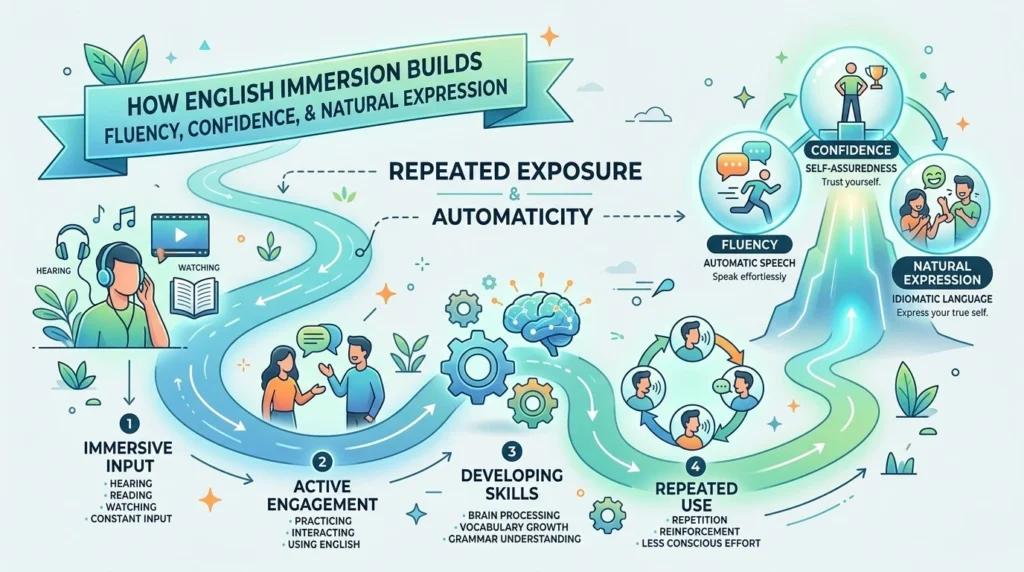
English Immersion is a learning approach where English becomes a regular part of your daily life instead of something you study only during lessons. Rather than translating every sentence from your native language, you begin interacting with English through conversations, videos, podcasts, books, news articles, and real-life situations.
This method encourages natural language acquisition, similar to how children learn their first language. Instead of memorizing isolated words, you learn them within meaningful contexts, making them easier to understand and remember.
The goal isn’t perfection—it’s consistent exposure that gradually transforms English into a language you can use instinctively.
Why Repeated Exposure Matters
One of the biggest reasons learners struggle with speaking is that they don’t hear or use English frequently enough. Language is a skill, and like any skill, it improves with repetition.
When you repeatedly hear common expressions, sentence patterns, and vocabulary, your brain begins recognizing them automatically. Instead of stopping to think about grammar rules, you start responding naturally.
This repeated exposure supports long-term english fluency development because it helps your brain process English faster. Over time, you spend less energy translating and more energy communicating.
From Translation to Thinking in English
Many learners mentally translate every sentence before speaking. This habit slows conversations and often creates hesitation.
With consistent english language immersion, your mind gradually learns to think in English. Everyday phrases become familiar enough that you no longer need to translate them.
For example, instead of translating “I’m looking forward to meeting you,” your brain begins recognizing it as one complete expression.
This shift dramatically improves response time, making conversations feel smoother and more natural.
Building English Speaking Confidence Through Daily Practice
Confidence doesn’t come from knowing every grammar rule. It comes from using the language regularly without fearing mistakes.
Daily exposure allows learners to become comfortable with English in different situations. Watching interviews, joining speaking groups, listening to podcasts, and having short conversations all contribute to stronger english speaking confidence.
Every successful interaction reinforces your ability to communicate, reducing anxiety over time.
Even making small mistakes becomes part of the learning process rather than something to avoid.
How Immersion Improves English Speaking Fluency
Fluency is the ability to communicate ideas smoothly without long pauses or constant searching for words.
Many learners mistake fluency for speaking quickly. In reality, english speaking fluency is about expressing thoughts clearly and naturally.
Immersion improves fluency by helping you:
- Learn common sentence structures naturally.
- Expand your vocabulary in context.
- Improve pronunciation through listening.
- Develop better rhythm and intonation.
- Respond more quickly during conversations.
The more English you hear and use, the more automatic your speech becomes.
Developing Natural English Speaking Skills
One challenge for many learners is sounding overly formal or textbook-like.
Immersion exposes you to authentic conversations, helping you develop natural english speaking habits. You’ll hear native speakers use contractions, everyday vocabulary, conversational fillers, and natural expressions.
Instead of memorizing scripted dialogues, you begin understanding how English is actually spoken in real situations.
This makes your conversations sound more relaxed, engaging, and authentic.
Strengthening English Communication Skills
Strong English communication skills involve much more than grammar.
Effective communicators know how to:
- Express opinions clearly.
- Ask thoughtful questions.
- Listen actively.
- Adapt their tone to different situations.
- Respond appropriately during conversations.
English immersion gives learners continuous opportunities to observe these communication patterns and apply them in everyday interactions.
The result is more confident and meaningful communication.
The Role of English Conversation Practice
No amount of reading or listening can replace actual speaking.
Regular english conversation practice helps learners reinforce everything they absorb through immersion.
Speaking partners, online language exchanges, discussion clubs, and conversation classes provide valuable opportunities to use new vocabulary immediately.
The more frequently learners participate in conversations, the more naturally they begin expressing themselves.
Consistency matters far more than lengthy study sessions.
English Immersion for Professional Success
Today’s workplaces often require employees to communicate confidently with international clients, colleagues, and stakeholders.
Business english communication becomes significantly easier when learners experience English daily rather than only studying business vocabulary.
Immersion helps professionals improve:
- Meeting participation
- Presentation delivery
- Email communication
- Networking conversations
- Client interactions
As a result, learners build stronger professional english speaking skills, allowing them to communicate more confidently in global work environments.
How Immersion Supports English Proficiency Exams
Speaking tests evaluate more than vocabulary. Examiners also assess fluency, pronunciation, coherence, and confidence.
That’s why immersion is especially valuable for students preparing for international English exams.
IELTS Speaking Confidence
Students working toward IELTS Speaking Confidence often struggle with nervousness during interviews.
Listening to authentic conversations, practicing daily speaking, and thinking in English help reduce hesitation while improving spontaneity.
Regular IELTS Speaking Practice also familiarizes learners with common question types, making exam responses feel more natural.
PTE Speaking Preparation
For candidates preparing for the Pearson Test of English, immersion enhances both pronunciation and response speed.
Frequent PTE Speaking Practice strengthens automatic speech production, leading to better PTE Speaking Fluency during timed speaking tasks.
TOEFL Speaking Preparation
Academic English requires learners to organize ideas quickly.
Daily listening and TOEFL Speaking Practice improve comprehension, note-taking, and structured responses while building overall speaking confidence.
TOEIC Speaking Preparation
Professionals taking workplace-focused English assessments benefit from immersion because it reflects real communication scenarios.
Consistent TOEIC Speaking Practice develops practical speaking abilities that extend beyond the exam into everyday professional communication.
OET Speaking Preparation
Healthcare professionals preparing for occupational English exams can strengthen patient communication through immersion.
Regular OET Speaking Preparation using authentic dialogues helps learners become more comfortable with medical consultations, explanations, and professional interactions.
Simple Ways to Create an English Immersion Environment
You don’t need to move abroad to experience English immersion.
Try incorporating these habits into your daily routine:
- Listen to English podcasts while commuting.
- Watch TV shows without translating every sentence.
- Read English articles each morning.
- Change your phone and apps to English.
- Keep a daily journal in English.
- Join online conversation groups.
- Speak with language partners several times each week.
- Describe your daily activities aloud in English.
- Learn vocabulary through real contexts instead of word lists.
Small, consistent actions produce impressive long-term improvements.
Consistency Is More Powerful Than Perfection
Many learners become discouraged because they expect rapid progress.
The reality is that fluency develops gradually.
Every conversation, podcast, article, or video contributes to your understanding of the language. Some days you may notice significant improvement, while other days may feel slow.
That’s completely normal.
The learners who become fluent are usually those who continue exposing themselves to English consistently rather than seeking perfect performance.

Final Thoughts
Becoming fluent isn’t about memorizing thousands of vocabulary words or mastering every grammar rule. It’s about using English so frequently that it becomes part of your everyday thinking.
English Immersion provides that opportunity by surrounding learners with meaningful language experiences every day. Through repeated exposure, learners improve english communication skills, develop stronger english speaking confidence, achieve greater english speaking fluency, and communicate with more natural expression.
Whether you’re preparing for IELTS Speaking Practice, building business english communication skills, working on PTE Speaking Fluency, completing TOEFL Speaking Practice, focusing on TOEIC Speaking Practice, or advancing your OET Speaking Preparation, immersion remains one of the most effective paths to lasting improvement.
The more English becomes part of your daily life, the less you have to think about speaking—and the more naturally your words begin to flow.
Frequently Asked Questions (FAQs)
1. What is English Immersion, and why is it effective?
English Immersion is a learning method that surrounds you with English through daily listening, reading, speaking, and writing. It works because repeated exposure helps your brain recognize language patterns naturally, leading to faster fluency and better communication.
2. Can I practice English language immersion without living in an English-speaking country?
Yes. You can create an immersive environment by watching English videos, listening to podcasts, reading books, joining online conversation groups, changing your device language, and practicing speaking every day.
3. How does English immersion improve speaking confidence?
Frequent exposure reduces hesitation and makes familiar words and phrases easier to recall. As you use English more often, your english speaking confidence grows because conversations begin to feel more natural.
4. Is English immersion helpful for IELTS, PTE, TOEFL, TOEIC, and OET speaking exams?
Absolutely. Regular immersion supports IELTS Speaking Practice, PTE Speaking Practice, TOEFL Speaking Practice, TOEIC Speaking Practice, and OET Speaking Preparation by improving fluency, pronunciation, vocabulary, and spontaneous speaking ability.
5. How long does it take to become fluent through English immersion?
The timeline varies depending on your current level and daily practice. Learners who engage in consistent English immersion for 30–60 minutes each day typically notice steady improvements in fluency, confidence, and natural communication over several months.




Leave a Reply