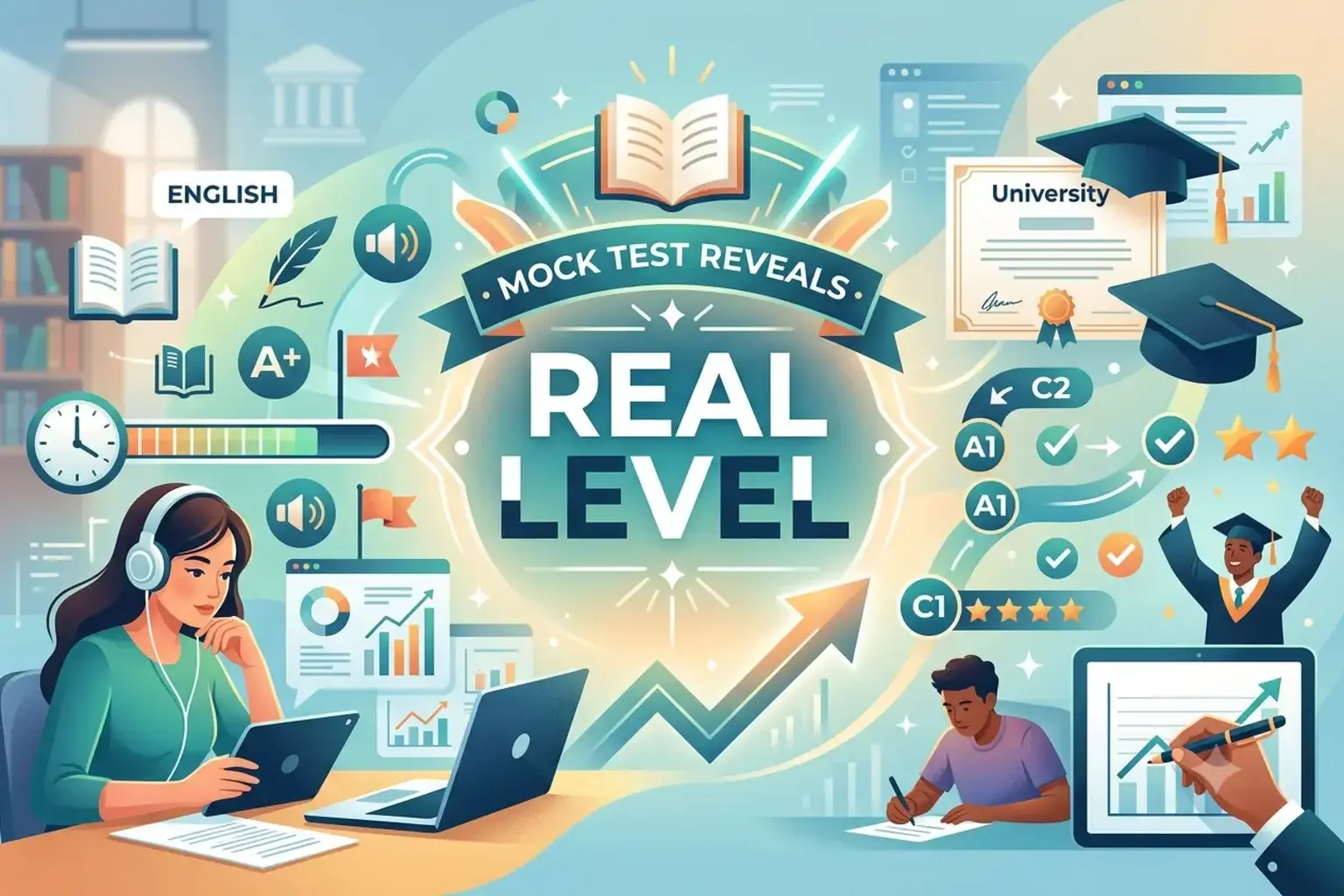
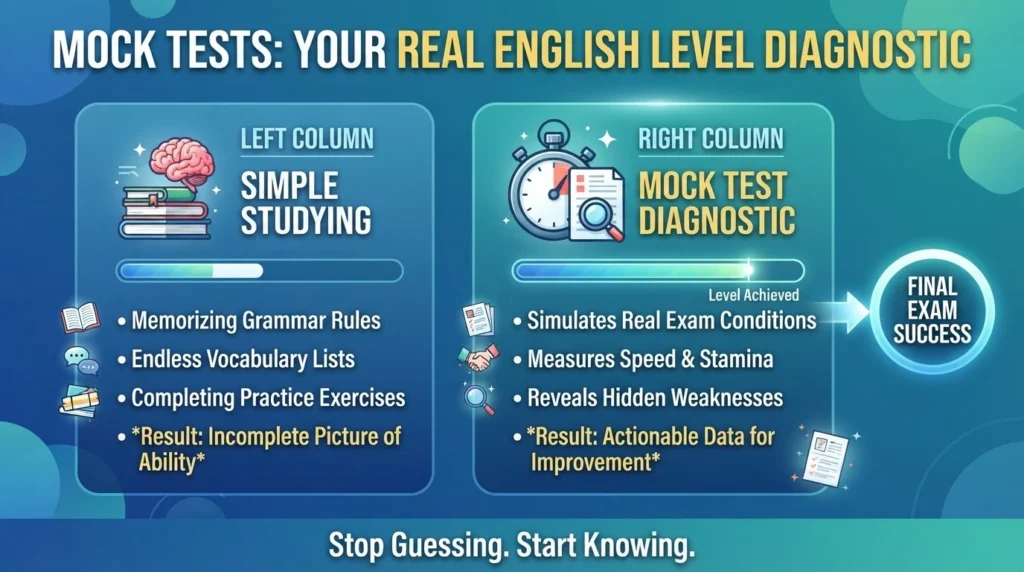
Preparing for an English proficiency exam is about more than studying grammar rules, memorising vocabulary, or completing endless practice exercises. While all of these activities are valuable, they don’t always tell you how you’ll perform under real exam conditions.
This is where Mock Tests become one of the most effective tools in your preparation journey.
Many learners wait until the last few weeks before taking an english mock test, treating it as a final rehearsal. In reality, mock tests are much more than a practice run. They are a powerful diagnostic tool that helps you understand your current ability, identify weak areas, refine your strategy, and improve your score before the actual exam.
Whether you’re preparing for IELTS, TOEFL, PTE, OET, Cambridge English, or TOEIC, regular mock testing can transform the way you study. Instead of guessing what needs improvement, you’ll have clear evidence of where to focus your efforts.
Let’s explore why Mock Tests should become an essential part of your English exam preparation.
Read More: How Integrated English Practice Improves IELTS, TOEFL, PTE and OET Scores Faster
Why Studying Alone Isn’t Enough
Many learners spend weeks reading textbooks, watching English videos, or completing grammar exercises. While these activities improve language knowledge, they don’t recreate the pressure of a real english language test.
During the actual exam, you must:
- Manage strict time limits.
- Understand unfamiliar topics.
- Stay focused for several hours.
- Handle exam stress.
- Apply multiple language skills at once.
Without experiencing these conditions beforehand, even well-prepared candidates may underperform.
A mock test bridges the gap between learning English and performing successfully in an English proficiency test.
Mock Tests Show Your Real Starting Point
One of the greatest advantages of Mock Tests is that they provide an honest picture of your current level.
Many students either overestimate or underestimate their ability.
Some believe they’re ready because they’ve completed many lessons.
Others lack confidence despite having strong language skills.
A well-designed Diagnostic test removes the guesswork.
It shows:
- Your strongest skills.
- Your weakest sections.
- Common mistakes.
- Areas requiring immediate attention.
- Estimated readiness for the actual exam.
Instead of relying on assumptions, you begin your preparation with accurate information.
They Help You Focus on What Matters Most
Imagine spending two weeks studying grammar when your biggest challenge is actually listening comprehension.
Or practising writing every day when speaking is lowering your overall score.
Without a proper english skills assessment, it’s easy to waste valuable study time.
Mock tests reveal exactly where improvement is needed.
For example:
- Strong reading but weak listening.
- Excellent vocabulary but slow writing speed.
- Good grammar but limited speaking confidence.
This targeted approach makes exam preparation much more efficient.
Better Time Management Under Pressure
One of the biggest reasons learners lose marks isn’t lack of English ability.
It’s poor time management.
Many candidates run out of time because they:
- Spend too long on difficult questions.
- Overthink writing tasks.
- Read passages too slowly.
- Panic during speaking sections.
Regular Mock Tests develop essential time management skills.
The more often you practise under realistic timing conditions, the easier it becomes to pace yourself during the real exam.
Instead of constantly checking the clock, you develop a natural sense of timing.
Mock Tests Build Exam Confidence
Confidence comes from familiarity.
The first time you experience an exam format should never be on the actual test day.
Every completed mock test reduces uncertainty.
You’ll become familiar with:
- Question formats.
- Instructions.
- Timing.
- Navigation (for computer-based exams).
- Mental endurance.
By exam day, the process feels familiar rather than intimidating.
This confidence often leads to better performance.
AI Is Making Mock Tests Smarter
Technology has changed the way learners prepare.
Today, many platforms offer an AI powered mock test experience that goes far beyond simply providing a score.
Modern AI systems can:
- Analyse speaking performance.
- Evaluate pronunciation.
- Highlight grammar patterns.
- Recommend personalised study plans.
- Identify repeated errors.
Some platforms even function as an adaptive English test, adjusting question difficulty according to your performance.
This creates a more accurate picture of your actual language proficiency.
Instead of receiving only a score, learners receive meaningful feedback they can immediately apply.
Score Prediction Helps You Prepare Better
One of the most motivating features of modern mock testing is the Score predictor.
Although no prediction is guaranteed, it provides a realistic estimate of your likely exam performance based on current ability.
For example:
- Your estimated IELTS band.
- Likely TOEFL performance.
- Expected PTE score.
- Approximate Cambridge level.
Knowing where you stand helps you set realistic goals while measuring score improvement over time.
Rather than hoping for better results, you can track measurable progress.
Every Major Exam Benefits from Mock Testing
Different exams have different formats, but they all reward preparation.
IELTS
An IELTS practice test or IELTS academic mock test familiarises candidates with all four modules.
Regular IELTS exam practice also supports IELTS score improvement by highlighting recurring mistakes before the real exam.
TOEFL
Completing a TOEFL iBT mock test prepares learners for integrated tasks that combine reading, listening, speaking, and writing.
Consistent TOEFL exam practice builds both confidence and endurance.
PTE
A PTE practice test is especially useful because of the computer-based format.
Students aiming for PTE score improvement become more comfortable with automated scoring systems and timed responses.
OET
Healthcare professionals benefit greatly from an OET mock test and regular OET practice test sessions.
These simulate real healthcare communication while improving professional English.
Cambridge English
Candidates preparing for advanced exams should complete a CAE mock test alongside a Cambridge English Advanced practice test.
These are invaluable during CAE preparation, helping learners understand advanced-level expectations.
TOEIC
Business professionals preparing for workplace English exams should include a TOEIC mock test and frequent TOEIC practice test sessions as part of their TOEIC preparation.
Track Progress Instead of Guessing
One mock test is useful.
Several are transformational.
Regular testing allows you to track progress over weeks or months.
You may notice:
- Faster reading speed.
- Better listening accuracy.
- Improved grammar.
- More confident speaking.
- Higher writing scores.
Watching steady improvement keeps motivation high.
It also confirms that your study methods are working.
Learn Better Exam Strategies
Mock tests don’t simply improve English.
They improve your english exam strategy.
You’ll learn when to:
- Skip difficult questions.
- Return later.
- Allocate writing time.
- Review answers.
- Stay calm under pressure.
These practical test taking strategies often make a significant difference on exam day.
Even candidates with similar English ability can receive different scores simply because one uses better exam techniques.
Mock Tests Reduce Exam-Day Surprises
Nothing increases anxiety like uncertainty.
Regular practice removes many unknowns.
You’ll know:
- How long each section feels.
- Which question types challenge you.
- How your concentration changes over time.
- Which pacing strategies work best.
Combined with practical exam day preparation tips, this familiarity helps reduce stress and improve focus.
Business English Learners Benefit Too
Not every learner is preparing for university admission.
Many professionals take a business english test to demonstrate workplace communication skills.
Mock tests help these candidates practise:
- Professional vocabulary.
- Workplace scenarios.
- Business writing.
- Formal speaking tasks.
- Practical communication.
The diagnostic feedback is just as valuable in professional contexts as it is in academic exams.
Make Mock Tests Part of Your Study Routine
Rather than waiting until the final week, include mock tests throughout your preparation.
A simple schedule might look like this:
- Week 1: Complete a full Diagnostic test.
- Week 2–3: Focus on weak areas.
- Week 4: Take an online mock test.
- Week 5–6: Review mistakes and practise targeted skills.
- Week 7: Complete another full mock test.
- Final week: Take one final practice exam under real conditions.
This cycle of testing, reviewing, and improving creates consistent progress without wasting study time.

Final Thoughts
Success in an English exam isn’t just about how much you’ve studied—it’s about how well you can apply your knowledge under real test conditions. That’s why Mock Tests are one of the smartest investments you can make during English exam preparation.
They provide an accurate snapshot of your current level, highlight strengths and weaknesses through a thorough english skills assessment, improve your english exam strategy, and help you build the confidence needed for exam day. Whether you’re using an AI powered mock test, an adaptive English test, or a traditional online mock test, the feedback you receive can guide your preparation far more effectively than guesswork.
Most importantly, mock tests help you track progress, measure score improvement, and walk into your English proficiency test knowing exactly what to expect. Instead of wondering if you’re ready, you’ll have the evidence to prove it.
FAQs
1. Why are Mock Tests important before an English proficiency exam?
Mock Tests simulate real exam conditions, helping you identify strengths, weaknesses, and areas for improvement. They are an excellent tool for effective English exam preparation and reducing exam-day anxiety.
2. How does a Diagnostic test improve my preparation?
A Diagnostic test provides a detailed english skills assessment, showing which language skills need the most attention. This allows you to create a targeted study plan instead of spending time on areas you’ve already mastered.
3. Can AI powered mock tests predict my actual exam score?
Many AI powered mock test platforms include a Score predictor that estimates your likely performance based on current ability. While predictions aren’t guaranteed, they offer a useful benchmark and help monitor score improvement.
4. Which English exams benefit from mock tests?
Mock tests are valuable for almost every major english language test, including IELTS practice test, TOEFL iBT mock test, PTE practice test, OET mock test, CAE mock test, and TOEIC mock test. Each helps learners become familiar with exam formats and improve performance.
5. How often should I take an online mock test?
A good approach is to complete an online mock test every two to three weeks during your preparation. This allows you to track progress, evaluate the effectiveness of your study plan, refine your test taking strategies, and steadily build confidence before the final exam.




Leave a Reply