

Preparing for an English proficiency exam can feel overwhelming. Whether you’re working towards IELTS preparation, TOEFL preparation, PTE Academic preparation, or OET preparation, there’s a common mistake many learners make—they treat each language skill as a separate subject.
One day is for reading. Another is for listening. Speaking gets pushed to weekends, and writing is often left until the last few weeks before the exam.
While this approach may seem organised, it rarely reflects how language actually works.
In real conversations, lectures, workplaces, and exams, listening, reading, speaking, and writing constantly interact. That is why the most effective english proficiency test preparation focuses on integrating all four skills instead of studying them in isolation.
If your goal is to improve faster, retain more, and feel confident on exam day, integrated practice can make a remarkable difference.
Read More: Fluency vs Accuracy: What English Proficiency Tests Really Reward
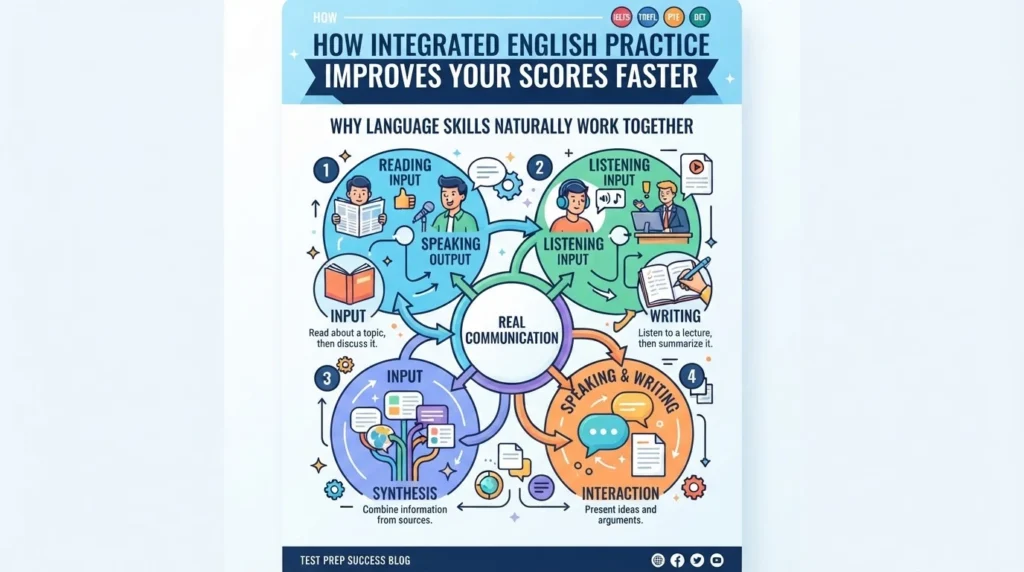
Why Language Skills Naturally Work Together
Think about how you use English every day.
You listen to someone speak, process what they mean, respond verbally, perhaps read an email later, and write a reply.
Rarely do you use only one language skill.
Modern English exams are designed around this reality.
For example:
- You may listen to an academic lecture before answering questions.
- You might read several passages before writing an essay.
- You may summarise spoken information in writing.
- Speaking tasks require ideas you’ve developed through reading and listening.
When learners train these skills together, the brain creates stronger language connections, making recall faster and communication more natural.
This is exactly why integrated english proficiency test preparation produces better long-term results than isolated practice.
How Integrated Practice Helps Every Major English Exam
Although every exam has its own format, they all assess your overall ability to communicate effectively.
IELTS Preparation
Successful IELTS preparation requires much more than memorising templates.
For example, reading quality articles improves vocabulary that later appears naturally in writing and speaking.
Listening to interviews and discussions also helps learners understand sentence structure, pronunciation, and natural expressions that improve speaking performance.
Instead of studying each module separately, connecting them builds stronger language habits.
TOEFL Preparation
Academic English dominates TOEFL preparation.
Students often need to read academic texts, listen to lectures, take notes, and answer integrated questions.
Practising these skills together improves comprehension while reducing the mental effort required during the actual test.
Instead of switching between different “study modes,” learners become comfortable processing information the way the exam expects.
PTE Academic Preparation
One reason many students struggle with PTE Academic preparation is the integrated nature of the tasks.
For instance, “Repeat Sentence” combines listening, pronunciation, memory, and speaking.
“Summarise Written Text” blends reading with writing.
The more learners practise multiple skills simultaneously, the more comfortable these question types become.
OET Preparation
Healthcare professionals preparing for OET need practical communication skills rather than textbook English.
Effective OET preparation combines reading patient notes, listening to consultations, speaking professionally, and writing referral letters.
Since these situations mirror real medical communication, integrated learning feels much more relevant and useful.
Better Vocabulary Through Multiple Inputs
Many learners spend hours memorising vocabulary lists.
Unfortunately, isolated vocabulary often disappears after a few days.
Integrated practice changes that.
Imagine learning the word “diagnosis.”
You first read it in an article.
Later, you hear it during a medical podcast.
Then you use it in speaking practice.
Finally, you include it in a writing task.
By encountering the same word repeatedly across different activities, it becomes part of your active vocabulary instead of remaining something you simply recognise.
This natural repetition strengthens memory without making learning feel repetitive.
Improved Grammar Without Endless Exercises
Grammar worksheets certainly have their place.
However, grammar becomes much easier when learners repeatedly see and hear correct sentence patterns.
Reading exposes you to accurate grammar.
Listening reinforces natural sentence rhythm.
Speaking allows you to practise producing those structures.
Writing helps identify areas that still need improvement.
Instead of memorising rules in isolation, learners begin recognising patterns automatically.
Over time, grammatical accuracy improves with much less conscious effort.
Speaking Becomes More Natural
One of the biggest frustrations students face during english proficiency test preparation is speaking confidently.
Many learners know the grammar.
They know the vocabulary.
Yet they hesitate during conversations.
Why?
Because they haven’t received enough meaningful language input.
Speaking depends heavily on listening and reading.
The more authentic English you consume, the easier it becomes to produce natural responses.
Integrated practice provides learners with ideas, sentence structures, vocabulary, pronunciation, and confidence—all before they even start speaking.
Writing Improves Faster
Strong writing isn’t created by memorising essay templates alone.
Excellent writers are usually excellent readers.
Reading exposes learners to:
- Better organisation
- Logical paragraph development
- Academic vocabulary
- Linking expressions
- Natural grammar
Listening also contributes by improving understanding of how ideas connect.
When learners combine reading, listening, discussion, and writing practice, essays become more coherent and much easier to produce under exam conditions.
Better Time Management During Exams
Integrated learning doesn’t just improve language ability.
It also improves efficiency.
Instead of constantly switching between unrelated study materials, learners practise skills that reinforce one another.
For example, spending an hour reading an academic article can improve:
- Reading speed
- Vocabulary
- Grammar awareness
- Speaking ideas
- Writing content
One activity supports several exam skills simultaneously.
This makes study sessions far more productive, especially for working professionals and busy students.
Real Communication Is the Best Preparation
The highest scores don’t usually come from students who memorise the most.
They come from learners who genuinely understand English.
Integrated practice encourages real communication rather than artificial exam techniques.
Instead of asking,
“How do I answer Question 3?”
Learners begin asking,
“How can I explain this idea clearly?”
That mindset shift leads to stronger performance across every section of the exam.
A Practical Weekly Integrated Study Plan
You don’t need eight hours a day to benefit from integrated learning.
A focused routine can produce excellent results.
Here’s a simple example:
Monday
- Read a news article.
- Highlight new vocabulary.
- Discuss the topic aloud for five minutes.
Tuesday
- Listen to a podcast on a similar topic.
- Write a short summary.
Wednesday
- Complete speaking practice using both the article and podcast.
Thursday
- Write an essay using vocabulary collected during the week.
Friday
- Review mistakes.
- Repeat difficult speaking questions.
- Read another short article.
Each activity supports the others, making progress feel much faster than studying individual skills separately.
Why Integrated Learning Builds Long-Term Confidence
Many learners achieve good practice scores but struggle on exam day because they’ve prepared each skill independently.
Integrated learning creates flexibility.
When unexpected topics appear, learners already have experience listening, reading, speaking, and writing about unfamiliar ideas.
Instead of relying on memorised answers, they communicate naturally.
This confidence often translates into higher scores across every section of the exam.
Whether you’re beginning IELTS preparation, planning your TOEFL preparation, working through PTE Academic preparation, or focusing on OET preparation, integrated practice develops genuine English ability rather than short-term test tricks.

Final Thoughts
Every major English exam is designed to assess how well you use English in real-life situations—not how well you memorise isolated exercises.
That’s why integrated english proficiency test preparation consistently delivers better results.
When listening, reading, speaking, and writing support one another, vocabulary grows naturally, grammar becomes intuitive, speaking gains confidence, and writing becomes clearer.
Rather than dividing your study time into disconnected sections, build a learning routine where every activity strengthens multiple skills at once.
The result isn’t just a better exam score—it’s lasting English proficiency that continues helping long after the test is over.
FAQs
1. Why is integrated English practice better than studying each skill separately?
Integrated practice reflects how English is used in real life. By combining listening, reading, speaking, and writing, learners strengthen vocabulary, grammar, comprehension, and communication simultaneously, making english proficiency test preparation more effective.
2. Does integrated learning help with IELTS preparation?
Yes. IELTS preparation benefits greatly from integrated learning because ideas, vocabulary, and grammar developed through reading and listening naturally improve speaking and writing performance.
3. How does integrated practice improve PTE Academic preparation?
Many PTE Academic preparation tasks already combine multiple skills, such as listening and speaking or reading and writing. Practising integrated activities helps learners adapt more quickly to the exam format.
4. Is integrated practice useful for OET preparation?
Absolutely. OET preparation focuses on practical healthcare communication. Combining reading medical documents, listening to consultations, speaking with patients, and writing referral letters closely matches real workplace situations.
5. Can integrated learning improve TOEFL preparation in less time?
Yes. TOEFL preparation often includes integrated tasks that require reading, listening, note-taking, and writing. Studying these skills together improves efficiency, strengthens comprehension, and helps learners become more confident during the exam.




Leave a Reply