
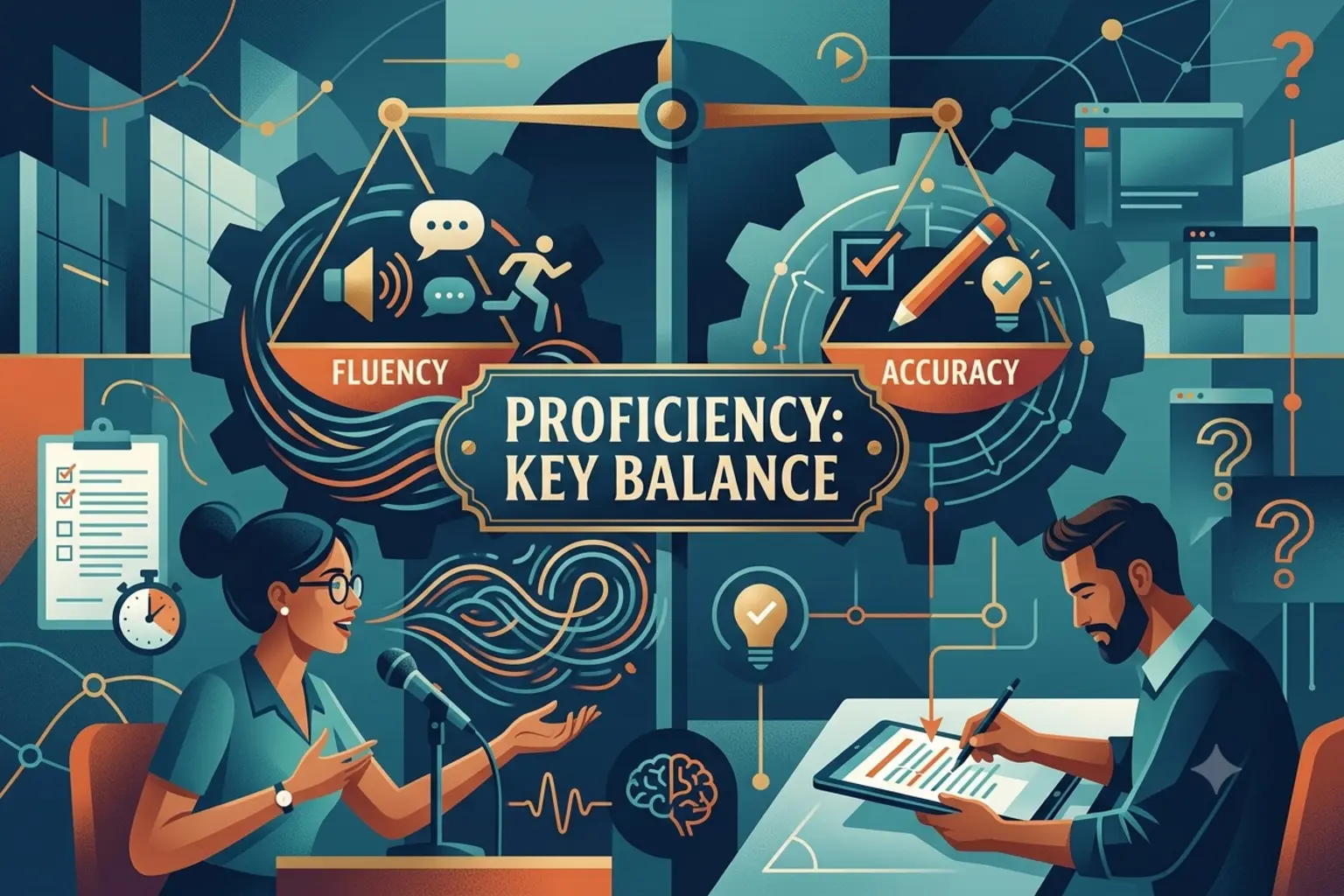
If you’ve ever prepared for an English exam, you’ve probably wondered: Should I focus on speaking fluently, or should I slow down and make sure every sentence is grammatically correct?
It’s a common question, and one that causes unnecessary stress for many learners.
The truth is that English proficiency tests are not designed to reward perfection. They are designed to measure how effectively you communicate. That means both Fluency vs Accuracy matter—but not always in the way many students believe.
Many learners spend months memorising grammar rules, fearing every mistake. Others focus only on speaking quickly, believing confidence alone will earn a high score. Unfortunately, both approaches miss the balance that examiners are actually looking for.
Read More: How Integrated English Practice Improves IELTS, TOEFL, PTE and OET Scores Faster
Whether you’re preparing for IELTS Speaking, TOEFL Speaking, OET Speaking, the CAE speaking test, TOEIC Speaking, or another recognised english language assessment, understanding how fluency and accuracy work together can significantly improve your performance.
Let’s explore what examiners really reward and how you can build both skills without sacrificing one for the other.
What Does Fluency Really Mean?
When people hear the word “fluency,” they often imagine someone speaking rapidly without pausing.
But speed isn’t fluency.
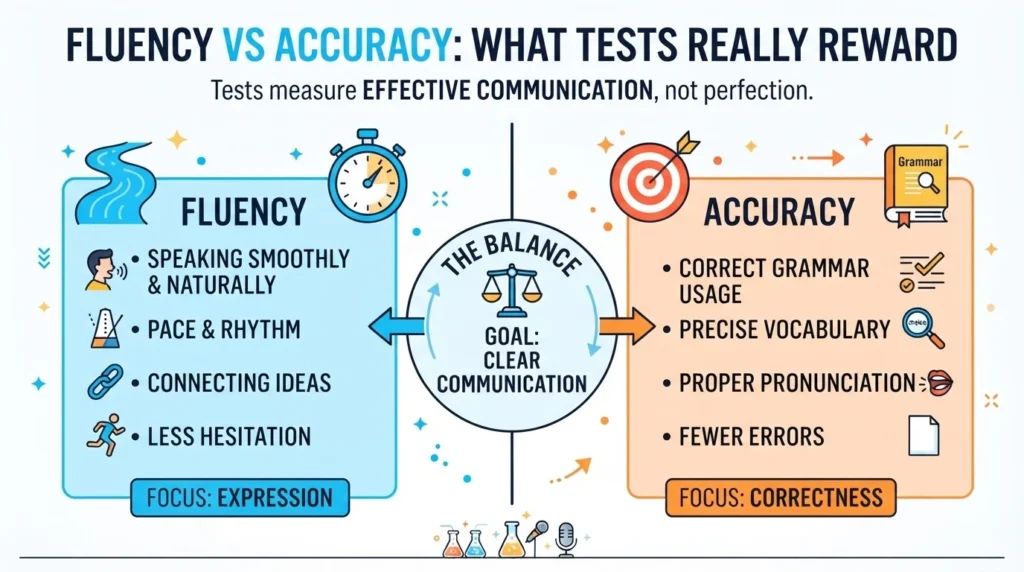
In every major English Proficiency Tests, fluency refers to your ability to express ideas naturally, maintain a conversation, and communicate without excessive hesitation.
A fluent speaker:
- Organises ideas clearly.
- Speaks at a comfortable pace.
- Uses natural pauses rather than stopping after every sentence.
- Recovers smoothly after making small mistakes.
- Keeps the conversation moving.
This is why english fluency is closely linked to confidence rather than perfection.
Examiners want to see whether you can communicate effectively, not whether you sound like a native speaker.
What Does Accuracy Mean?
Accuracy focuses on how correctly you use English.
This includes:
- Grammar
- Vocabulary
- Sentence structure
- Pronunciation
- Word choice
Good english accuracy doesn’t mean producing flawless English.
Instead, it means making relatively few mistakes while still expressing your ideas clearly.
Even advanced speakers occasionally make grammatical slips during spontaneous conversations.
What matters is whether those mistakes interfere with understanding.
Fluency vs Accuracy: Why Both Matter
The debate around Fluency vs Accuracy often creates a false choice.
In reality, examiners are looking for balance.
Imagine these two candidates.
Candidate A
Speaks slowly.
Thinks carefully before every sentence.
Makes very few grammar mistakes.
But struggles to keep the conversation flowing.
Candidate B
Speaks confidently.
Shares ideas naturally.
Occasionally makes small grammar mistakes.
Keeps communicating without hesitation.
In many cases, Candidate B receives the higher score because communication remains effective.
Modern english proficiency tests reward meaningful communication more than grammatical perfection.
How IELTS Speaking Assesses Fluency and Accuracy
The IELTS speaking assessment uses four scoring categories.
These include:
- Fluency and coherence
- Lexical resource
- Pronunciation
- Grammatical range and accuracy
Notice that grammar is only one part of the assessment.
Many students become obsessed with avoiding Grammar mistakes in IELTS speaking, but forget that hesitation, lack of ideas, or unnatural speech can also lower their score.
Students aiming for IELTS band 7 speaking are expected to communicate confidently, even if occasional errors appear.
Those targeting IELTS band 8 speaking usually demonstrate both natural conversation and strong grammatical control.
The best IELTS speaking tips therefore encourage regular conversation practice rather than memorising perfect answers.
This balanced approach benefits learners preparing through IELTS preparation India as well as candidates taking the exam in IELTS UAE, IELTS Thailand, IELTS Myanmar, or IELTS Japan.
Cambridge Speaking Values Communication
The Cambridge speaking assessment follows a similar philosophy.
Whether you’re preparing for C1 Advanced speaking or the CAE speaking test, examiners assess how effectively you interact with your partner and express your ideas.
The official Cambridge speaking criteria include:
- Grammar
- Vocabulary
- Discourse management
- Pronunciation
- Interactive communication
Notice again that communication is central.
A candidate who speaks naturally while interacting confidently often performs better than someone who produces perfect grammar but struggles to engage in conversation.
This emphasis reflects real-life communicative competence, not textbook memorisation.
What About TOEFL, PTE, OET and TOEIC?
Every major exam measures communication slightly differently, but they all reward practical English.
TOEFL Speaking
TOEFL Speaking focuses heavily on expressing opinions, summarising information, and responding to academic tasks.
Candidates preparing through TOEFL China programmes often discover that organising ideas clearly is just as important as grammatical accuracy.
PTE Speaking
Many learners enrolled in PTE coaching India or studying through platforms popular in PTE Indonesia and the PTE Philippines spend considerable time on pronunciation software.
While pronunciation matters, regular pte speaking practice should also develop confidence, fluency, and spontaneous responses.
OET Speaking
Healthcare professionals preparing for OET Speaking need clear, professional communication.
The OET speaking criteria reward empathy, clarity, and effective interaction with patients—not robotic grammar.
TOEIC Speaking
Similarly, the TOEIC speaking test measures workplace communication.
Employers value speakers who communicate efficiently, solve problems, and explain ideas clearly.
Fluency Doesn’t Mean Ignoring Grammar
One common misunderstanding about fluency vs grammar is that grammar no longer matters.
It absolutely does.
Grammar provides structure.
Without it, communication quickly becomes confusing.
However, grammar should support communication—not replace it.
For example:
❌ Yesterday I going office because meeting important.
Although understandable, too many grammatical errors reduce clarity.
Now compare:
✅ Yesterday I went to the office because I had an important meeting.
This sentence is accurate and natural.
The goal is not perfect grammar.
The goal is communication that listeners understand easily.
Why Learners Often Lose Fluency
Many students pause constantly because they are mentally checking every grammar rule before speaking.
Instead of communicating, they are translating.
This creates:
- Long silences
- Hesitation
- Broken sentences
- Reduced confidence
Ironically, trying too hard to avoid mistakes often creates a lower speaking score.
The brain simply cannot monitor every grammar rule while maintaining a natural conversation.
Building Fluency and Accuracy Together
Fortunately, you don’t have to choose between fluency and accuracy.
You can improve both simultaneously.
Read Every Day
Reading exposes you to natural sentence patterns, vocabulary, and grammar without memorising isolated rules.
Listen to Authentic English
Podcasts, interviews, and conversations improve rhythm, pronunciation, and natural expressions.
Speak Regularly
Daily speaking—even for ten minutes—helps develop automatic language production.
Don’t stop every time you make a mistake.
Keep communicating.
Record Yourself
Listening to your own speech helps identify repeated grammar problems while improving english speaking confidence.
Get Constructive Feedback
Teachers or speaking partners can help you correct recurring errors without interrupting your fluency.
What Examiners Really Want
Across almost every english language assessment, examiners ask themselves one essential question:
“Can this person communicate effectively in English?”
That question includes:
- Clear organisation
- Logical ideas
- Appropriate vocabulary
- Understandable grammar
- Natural pronunciation
- Comfortable interaction
Notice that perfection is never the objective.
Instead, the focus is on effective communication skills.
This reflects how English works in universities, workplaces, hospitals, and everyday conversations.
Practical Habits That Improve Scores
If you’re preparing for any of the major English Proficiency Tests, build study habits that develop both fluency and accuracy.
A practical weekly routine might include:
- Reading one article every day.
- Listening to English podcasts during your commute.
- Recording two speaking responses daily.
- Reviewing one grammar topic each week.
- Writing short summaries using new vocabulary.
- Having regular conversations with a teacher or language partner.
Over time, these connected activities improve both english communication skills and grammatical control naturally.

Final Thoughts
The debate around Fluency vs Accuracy often encourages learners to choose one over the other. Fortunately, the best performers in English Proficiency Tests understand that success comes from balancing both.
Grammar matters because it supports clear expression. Fluency matters because it allows you to communicate ideas naturally and confidently. When these two skills develop together, your speech becomes more authentic, your confidence grows, and your performance improves across exams such as IELTS Speaking, TOEFL Speaking, OET Speaking, the CAE speaking test, TOEIC Speaking, and other recognised assessments.
Rather than chasing perfect grammar or trying to speak at lightning speed, focus on becoming a confident communicator. Read widely, listen actively, speak regularly, and learn from your mistakes. That balanced approach reflects the language assessment criteria used by examiners and prepares you not only for a higher score but also for real-world communication beyond the exam.
FAQs
1. Which is more important in English proficiency tests: fluency or accuracy?
Neither is more important on its own. English proficiency tests assess a balance of Fluency vs Accuracy, rewarding candidates who communicate naturally while maintaining good grammatical control.
2. Can I still achieve a high IELTS Speaking score if I make grammar mistakes?
Yes. Occasional Grammar mistakes in IELTS speaking are acceptable, especially if they do not affect understanding. Candidates aiming for IELTS band 7 speaking or IELTS band 8 speaking should focus on clear, confident communication alongside strong grammar.
3. How do Cambridge speaking exams assess communication?
The Cambridge speaking assessment uses the Cambridge speaking criteria, which evaluate grammar, vocabulary, pronunciation, discourse management, and interactive communication. Strong communicative competence is essential for success in C1 Advanced speaking and the CAE speaking test.
4. Does fluency matter in PTE, TOEFL, OET and TOEIC speaking exams?
Absolutely. PTE speaking practice, TOEFL Speaking, OET Speaking, and the TOEIC speaking test all reward candidates who communicate confidently, organise ideas clearly, and maintain understandable speech while demonstrating appropriate grammatical accuracy.
5. How can I improve both fluency and accuracy at the same time?
The best approach is to combine reading, listening, speaking, and writing regularly. Integrated practice strengthens english fluency, improves english accuracy, builds english speaking confidence, and develops the effective communication skills that examiners value across all major English assessments.




Leave a Reply