
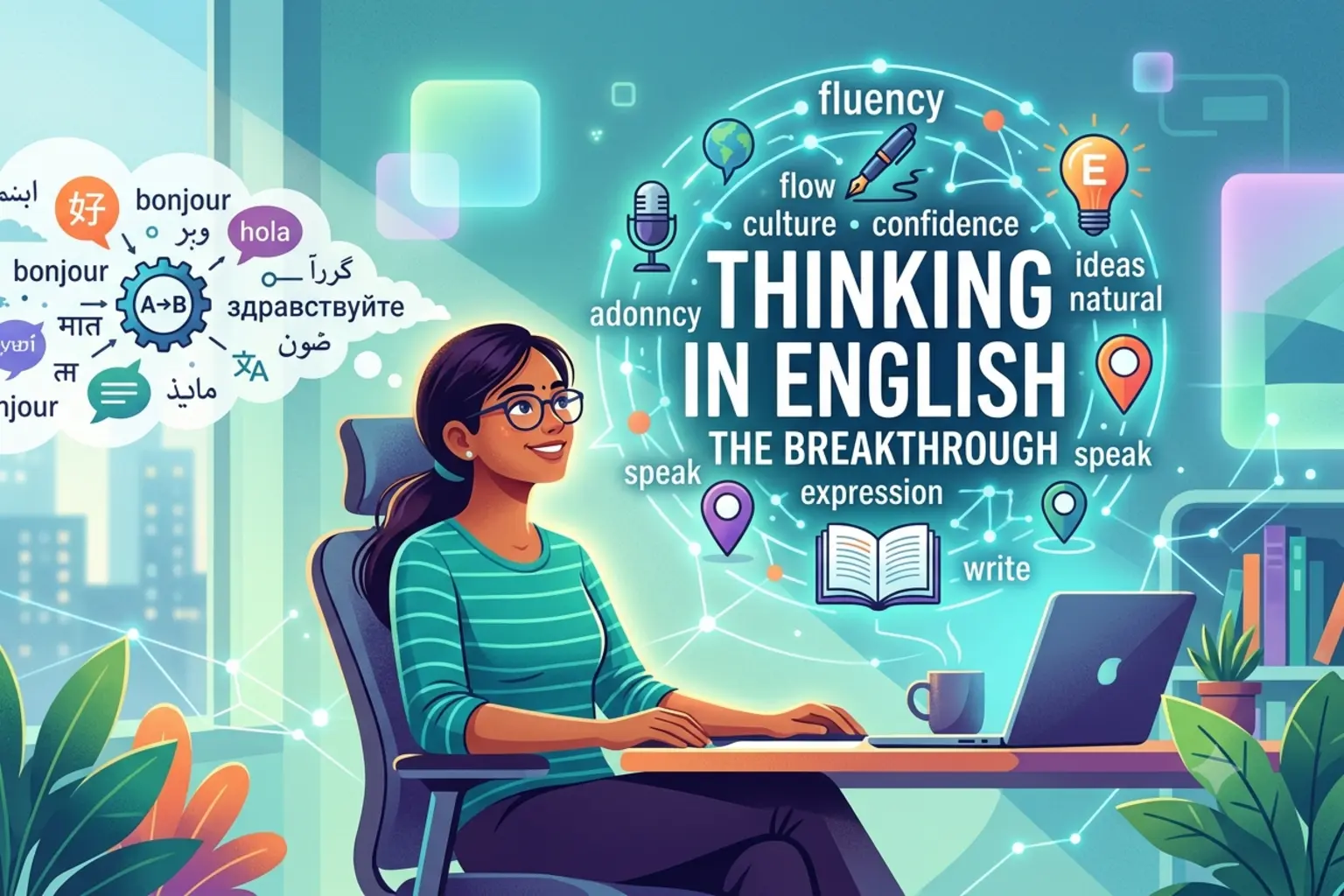
Learning English is often described as a journey, but for many ESL Learners, there comes a defining moment that changes everything. It isn’t mastering grammar rules or memorizing thousands of vocabulary words. The real breakthrough happens when you stop translating every sentence in your native language and start Thinking in English.
This shift may seem subtle, but it completely transforms the way you communicate. Conversations become smoother, responses become faster, and your confidence grows naturally. Instead of mentally converting words from one language to another, your brain begins processing English directly.
If you’ve ever wondered how to speak English without translating, you’re not alone. It’s one of the biggest challenges for language learners, but it’s also one of the most rewarding milestones.
Read More: Why Adult ESL Learners Struggle with Fluency Even After Years of English Study
Why Translation Slows Down Your English
When beginners first learn English, translating feels like the safest strategy. You hear an English sentence, convert it into your native language, think of a reply, translate it back into English, and finally speak.
While this process helps during the early stages of bilingual language learning, it creates several problems later on.
For example:
- Conversations become slow.
- You hesitate before speaking.
- You lose your train of thought.
- Pronunciation suffers because you’re focusing on translation rather than communication.
- Confidence decreases during real-life conversations.
Strong ESL speaking skills require immediate understanding, not constant mental conversion.
Native speakers don’t translate English before speaking. They simply think and respond. That’s the habit every learner should develop.
What Does Thinking in English Actually Mean?
Thinking in English doesn’t mean knowing every word in the dictionary.
Instead, it means your brain begins associating English words directly with ideas, emotions, objects, and experiences.
Imagine seeing a dog.
Instead of thinking:
Dog → “Perro” → “Dog”
your brain immediately recognizes the image as “dog.”
This direct connection is exactly how children learn their first language and how successful learners improve english language fluency.
The goal is to think directly in english, bypassing your first language altogether.
Why Your Brain Needs Direct English Connections
Modern research into cognitive language learning and second language acquisition suggests that fluency develops faster when learners create direct associations instead of relying on translation.
Every time you stop translating in your head, your brain strengthens English pathways.
Over time, this produces:
- Faster recall
- Better listening comprehension
- More natural speaking
- Improved memory retention
- Greater english speaking fluency
The less your brain depends on translation, the more automatic English becomes.
Language Immersion Makes the Difference
One of the fastest ways to build direct English thinking is through language immersion.
Immersion doesn’t necessarily mean moving abroad.
It simply means surrounding yourself with English throughout the day.
Examples include:
- Listening to English podcasts
- Watching YouTube without subtitles
- Reading simple articles
- Thinking about your daily routine in English
- Changing your phone settings to English
- Writing a daily journal
These small habits gradually replace translation with automatic understanding.
Eventually, English becomes the language your brain expects.
Practical Exercises to Think in English
If you’re wondering how to think in english, the good news is that it can be practiced every day.
1. Describe Your Environment
Look around your room and describe everything you see.
For example:
“The window is open.”
“My laptop is on the desk.”
“I’m drinking coffee.”
This simple activity builds instant word associations.
These are excellent think in english exercises because they remove the pressure of conversation.
2. Narrate Your Daily Activities
While cooking, walking, or driving, describe your actions.
“I’m making breakfast.”
“I need to buy vegetables.”
“I’m replying to emails.”
This creates natural speaking habits while improving conversational english.
3. Use Pictures Instead of Translation
When learning new vocabulary, avoid translating.
Instead, connect the English word directly with an image.
For example:
Apple → 🍎
Mountain → 🏔️
Happy → 😊
Your brain remembers concepts much faster than translated definitions.
4. Ask Yourself Questions
Practice internal conversations.
“What should I cook today?”
“Where did I leave my keys?”
“What movie should I watch?”
This exercise develops spontaneous thinking in English without needing another speaker.
5. Read Aloud
Reading aloud strengthens both comprehension and pronunciation.
It also improves rhythm, intonation, and overall english communication skills.
The more familiar your brain becomes with English sentence structures, the less it depends on translation.
How Thinking in English Improves Speaking Confidence
One of the biggest benefits of Thinking in English is increased english speaking confidence.
When you’re no longer translating every sentence:
- You respond more naturally.
- Conversations become enjoyable.
- Mistakes become less stressful.
- Speaking feels automatic.
Many learners mistakenly believe confidence comes after fluency.
In reality, confidence grows alongside fluency.
Each successful conversation reinforces your belief that you can communicate effectively.
This is exactly how to speak english confidently in real-world situations.
Benefits for Professional Communication
Direct English thinking is especially valuable in the workplace.
Professionals often need fast responses during meetings, presentations, interviews, and negotiations.
Strong professional english communication depends on quick thinking rather than careful translation.
Whether you’re developing business english speaking skills or improving professional english communication skills, thinking directly in English allows you to:
- Explain ideas clearly.
- Participate confidently in meetings.
- Build stronger workplace relationships.
- Handle unexpected questions.
This is why many international companies value employees with excellent advanced english communication abilities.
Thinking in English for Exam Success
Students preparing for English proficiency exams also benefit enormously from reducing translation.
During IELTS speaking practice, candidates must answer immediately.
Those who mentally translate often hesitate, lose fluency, and produce shorter responses.
Improving IELTS speaking confidence begins with practicing direct thinking.
Useful IELTS speaking strategies include:
- Answering practice questions without planning in your first language.
- Speaking continuously for one or two minutes.
- Recording yourself.
- Listening and correcting your responses.
These habits naturally improve IELTS speaking fluency.
The same applies to PTE speaking practice.
Many students searching for PTE repeat sentence tips focus only on memory.
However, understanding English directly significantly improves sentence recall and pronunciation.
Developing natural English processing also strengthens PTE speaking fluency.
Healthcare professionals preparing for OET speaking preparation benefit as well because role-play scenarios require spontaneous communication rather than translated responses.
Similarly, professionals preparing for TOEIC speaking skills assessments improve performance when they think directly instead of translating.
Stop Translating in Your Head—One Conversation at a Time
Many learners worry because they still stop translating in your head only occasionally.
That’s perfectly normal.
The transition doesn’t happen overnight.
Some days you’ll think naturally.
Other days you’ll return to translation.
Progress isn’t measured by perfection.
It’s measured by how often your brain chooses English first.
With consistent exposure, those moments become longer and more frequent until English becomes your default language for communication.

The Real Secret to English Fluency
Grammar matters.
Vocabulary matters.
Pronunciation matters.
But none of these alone creates effortless communication.
The biggest leap happens when ESL Learners begin Thinking in English instead of translating every thought.
This simple shift transforms your english conversation skills, strengthens english communication skills, improves english language fluency, and develops lasting ESL speaking skills.
Whether your goal is everyday conversational english, stronger business english speaking skills, exam success, or professional growth, learning to think directly in english is the breakthrough that makes every other skill easier.
Keep practicing daily, immerse yourself in meaningful English input, and remember that every small step brings you closer to speaking naturally. Over time, you’ll discover that English is no longer something you translate—it’s simply something you think.
Frequently Asked Questions (FAQs)
1. Why is Thinking in English important for ESL learners?
Thinking in English helps ESL Learners respond faster, improve ESL speaking skills, reduce hesitation, and build natural english speaking fluency by eliminating the need for constant mental translation.
2. How can I stop translating in my head while speaking English?
To stop translating in your head, practice describing your surroundings, narrating daily activities, reading aloud, and using visual associations instead of translating vocabulary. Regular language immersion also helps your brain process English directly.
3. What are the best think in English exercises?
Some effective think in english exercises include talking to yourself in English, keeping an English journal, asking yourself daily questions, describing pictures, and listening to English content without translating each sentence.
4. Does Thinking in English improve IELTS and PTE speaking scores?
Yes. Developing the habit of Thinking in English improves IELTS speaking confidence, supports effective IELTS speaking strategies, enhances PTE speaking fluency, and complements PTE repeat sentence tips by increasing comprehension and reducing hesitation.
5. How long does it take to think directly in English?
The timeline varies depending on practice and exposure. With consistent language immersion, daily speaking practice, and regular use of english fluency tips, many learners begin to think directly in english within a few months, although complete automaticity develops gradually over time.




Leave a Reply