
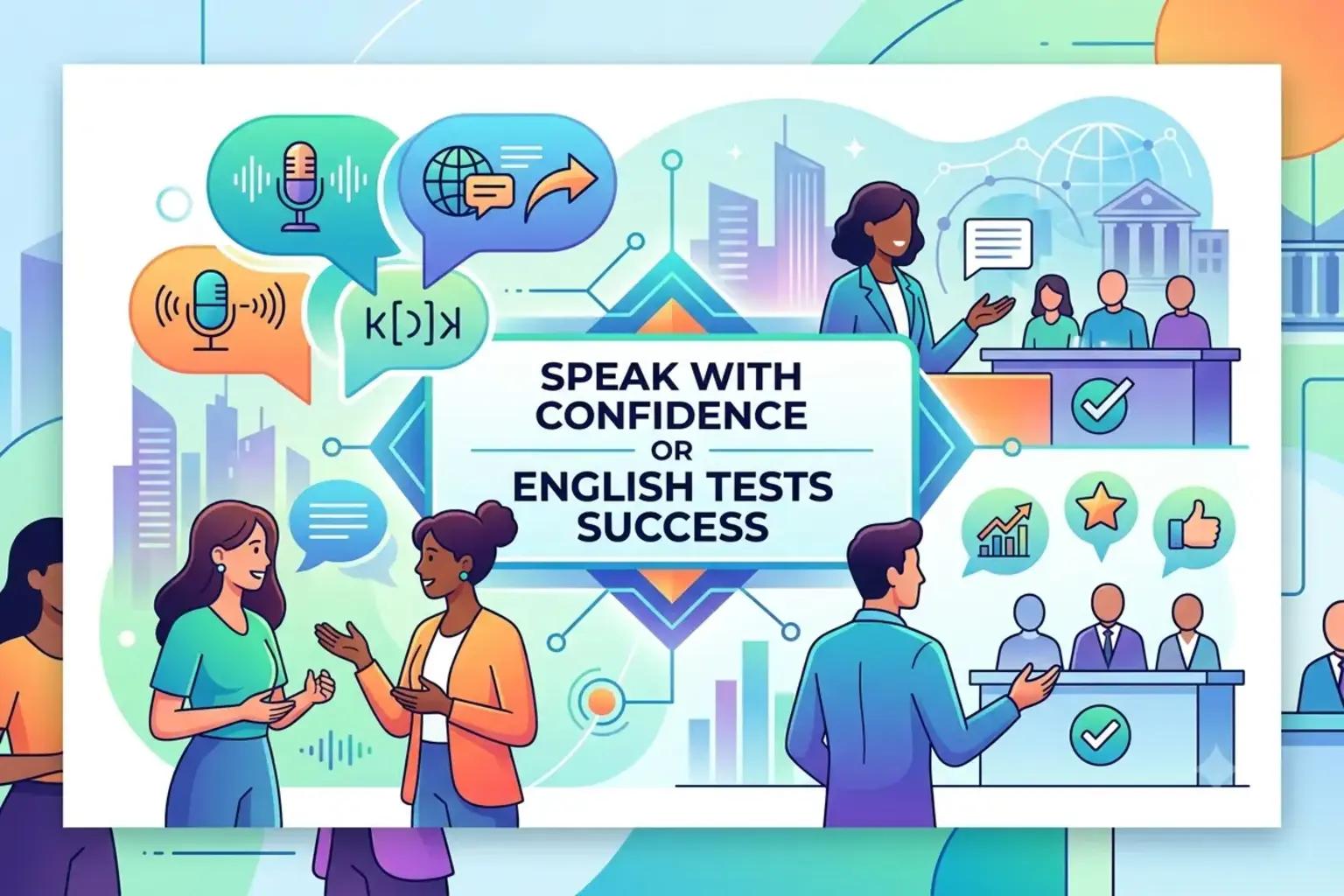
If you’ve ever felt nervous before speaking English in an exam, you’re not alone. Many learners understand grammar, know plenty of vocabulary, and perform well in reading and listening, yet lose confidence the moment they have to speak. This is especially true for exams like IELTS Speaking, TOEFL Speaking, PTE Speaking, and OET role play, where your ability to communicate clearly is evaluated in real time.
The good news is that examiners are not looking for a perfect British or American accent. They want to hear clear, natural English that is easy to understand. That’s why developing Speaking Confidence is just as important as improving grammar and vocabulary.
Whether you’re preparing for higher education, immigration, professional registration, or career advancement, building confidence in spoken English can significantly improve your overall test performance.
Read More: Why Adult Learners Need a Different Strategy for English Test Preparation
Why Speaking Confidence Matters More Than You Think
Many learners assume that speaking tests are simply about answering questions correctly. In reality, examiners also observe how comfortably and naturally you communicate.
A confident speaker is more likely to:
- Express ideas clearly
- Speak without long pauses
- Recover quickly from mistakes
- Use a wider range of vocabulary
- Maintain a natural conversation
On the other hand, nervousness often leads to hesitation, repetition, incomplete answers, and avoidable grammar mistakes.
Strong Speaking Confidence doesn’t mean never making errors. It means communicating effectively even when you don’t know every word.
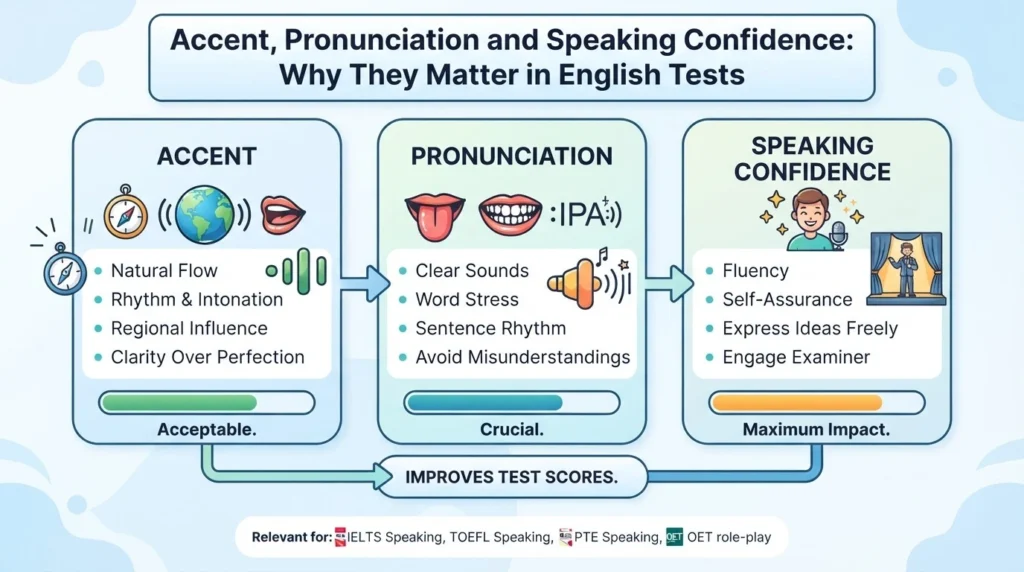
Accent Is About Clarity, Not Perfection
One of the biggest misconceptions among English learners is that they must sound like a native speaker.
Fortunately, this isn’t true.
English is an international language spoken by people from countless countries and cultures. Examiners in IELTS Speaking, TOEFL Speaking, and PTE Speaking are trained to assess communication—not imitation.
Your accent is not a problem unless it makes your speech difficult to understand.
Instead of trying to copy someone else’s accent, focus on:
- Clear pronunciation
- Natural rhythm
- Appropriate stress
- Correct intonation
- Consistent speech
A clear Indian, Egyptian, Japanese, Indonesian, or Lebanese accent is perfectly acceptable if listeners can understand you easily.
Pronunciation Plays a Bigger Role Than Many Learners Realise
Good english pronunciation improves both confidence and communication.
Mispronouncing key words can sometimes change their meaning completely.
For example:
- Ship and sheep
- Live and leave
- Rice and rise
Small pronunciation differences can affect how clearly your message is understood.
Learning how to improve english pronunciation involves much more than repeating difficult sounds.
It includes:
- Word stress
- Sentence rhythm
- Connected speech
- Intonation
- Listening carefully to natural English
Improving these areas helps your speech sound smoother and easier to follow.
Why Fluency Matters More Than Speaking Quickly
Many learners confuse fluency with speed.
In reality, english fluency means speaking naturally without constantly stopping to translate every sentence in your head.
Fluent speakers:
- Organise ideas logically
- Use everyday vocabulary comfortably
- Correct small mistakes naturally
- Continue speaking without panic
Speaking extremely fast often reduces clarity.
Instead, aim for a comfortable pace where your ideas flow naturally.
This is especially important during the IELTS Speaking Test, where examiners value coherent communication over rushed answers.
Grammar Still Supports Good Speaking
Confidence alone isn’t enough.
Most speaking exams assess your grammatical range and accuracy, meaning they expect you to use different sentence structures correctly.
Rather than memorising complicated grammar rules, practise using:
- Past experiences
- Future plans
- Opinions
- Comparisons
- Conditionals
- Cause and effect
Using grammar naturally during conversation creates a much stronger impression than forcing advanced structures into every answer.
Different Speaking Tests Require Different Skills
Although all English speaking exams measure communication, each one has its own format.
IELTS Speaking
The IELTS Speaking interview is a face-to-face conversation with an examiner.
Success depends on:
- Natural conversation
- Expanding answers
- Speaking confidently
- Clear pronunciation
Working with an experienced IELTS speaking trainer can help learners become familiar with common question types and improve response organisation.
TOEFL Speaking
TOEFL Speaking often combines reading, listening, and speaking within strict time limits.
Candidates must:
- Organise ideas quickly
- Speak clearly under pressure
- Summarise information accurately
Many students attending TOEFL preparation classes discover that time management is just as important as language ability.
PTE Speaking
Unlike IELTS, PTE Speaking is computer-based.
The microphone evaluates pronunciation, fluency, and speech clarity.
Speaking naturally without unnecessary pauses is extremely important for achieving a higher score.
OET Role Play
Healthcare professionals preparing for OET role play need practical communication rather than academic speaking.
The assessment focuses on:
- Empathy
- Clear explanations
- Professional language
- Patient interaction
- Active listening
For doctors, nurses, dentists, and pharmacists, real-life communication skills often matter more than sophisticated vocabulary.
Pronunciation Training Builds Confidence
Many learners avoid speaking because they worry about saying words incorrectly.
Regular pronunciation practice gradually removes this fear.
An english pronunciation course usually focuses on:
- Individual sounds
- Word stress
- Sentence rhythm
- Connected speech
- Listening discrimination
Similarly, an accent improvement course helps learners reduce pronunciation habits that interfere with clarity.
Neither course aims to erase your identity.
Instead, they help you become easier to understand.
Practice Speaking Every Day
Improving english speaking skills doesn’t require hours of study every day.
Ten to fifteen minutes of focused speaking practice can make a noticeable difference.
Useful daily activities include:
- Describing your day aloud
- Reading newspaper articles aloud
- Recording yourself
- Answering IELTS Speaking questions
- Summarising podcasts
- Practising with a language partner
Listening to your recordings helps you identify repeated pronunciation mistakes and areas for improvement.
Build Real Communication Skills
Speaking exams measure more than memorised answers.
They reward genuine communication skills.
Strong english communication skills include:
- Active listening
- Asking for clarification
- Explaining ideas clearly
- Supporting opinions
- Speaking naturally
When learners focus only on memorising model answers, they often struggle when examiners ask unexpected follow-up questions.
Real communication always sounds more natural.
Confidence Comes from Repetition
Confidence is rarely something people are born with.
It develops through repeated successful experiences.
The more frequently you speak English, the less intimidating it becomes.
A structured english fluency course can provide:
- Guided speaking practice
- Personalised feedback
- Regular conversations
- Vocabulary expansion
- Pronunciation correction
Over time, these small improvements combine to create noticeable confidence during exams.
Preparing Around the World
English speaking exams are taken by learners across the globe for education, migration, and employment.
Candidates seeking IELTS Egypt, IELTS Indonesia, IELTS Japan, IELTS Lebanon, IELTS Malaysia, IELTS Morocco, IELTS Thailand, IELTS Vietnam, and IELTS classes Sri Lanka often come from different educational backgrounds, but they share similar challenges.
Most learners struggle with:
- Speaking anxiety
- Pronunciation concerns
- Limited speaking practice
- Fear of making mistakes
Regardless of where you prepare, the solution remains the same: consistent practice, constructive feedback, and regular exposure to spoken English.
Public Speaking Confidence Helps in English Tests
Developing Public speaking confidence also benefits language exams.
Simple activities such as giving short presentations, participating in discussion groups, or explaining topics aloud improve:
- Voice projection
- Organisation of ideas
- Eye contact
- Natural pacing
- Overall confidence
These skills transfer directly into speaking tests, making conversations feel more comfortable and spontaneous.

Final Thoughts
Excellent speaking scores are not reserved for people with perfect accents or native-level English. They belong to learners who communicate clearly, organise their thoughts effectively, and speak with confidence.
Whether you’re preparing for IELTS Speaking, TOEFL Speaking, PTE Speaking, OET role play, or even the CAE Speaking Test, remember that success comes from regular speaking practice, clear english pronunciation, strong communication skills, and steady improvement—not perfection.
If you combine consistent daily practice with expert guidance through an accent improvement course, english pronunciation course, or english fluency course, you’ll gradually develop the confidence needed to perform at your best.
Every conversation you have today brings you one step closer to speaking confidently on exam day.
Frequently Asked Questions (FAQs)
1. Does my accent affect my IELTS Speaking score?
Not necessarily. In IELTS Speaking, examiners assess whether your speech is clear and easy to understand. A regional or international accent is perfectly acceptable if it does not reduce intelligibility.
2. How can I improve my English pronunciation quickly?
The best way to improve english pronunciation is through regular listening, shadowing native speakers, recording yourself, and enrolling in an english pronunciation course if you need structured guidance. Daily practice is more effective than occasional long sessions.
3. Is fluency more important than grammar in speaking exams?
Both are important. Examiners assess fluency as well as grammatical range and accuracy. Aim to speak naturally while using correct grammar instead of trying to produce overly complex sentences.
4. Can public speaking improve my exam performance?
Yes. Developing Public speaking confidence helps reduce anxiety, improves idea organisation, and makes it easier to communicate clearly during IELTS Speaking, TOEFL Speaking, PTE Speaking, and OET role play assessments.
5. Which course is better for improving speaking confidence?
The right choice depends on your needs. An accent improvement course focuses on speech clarity, an english pronunciation course improves pronunciation and rhythm, while an english fluency course develops overall speaking ability through regular conversation and practical communication practice.




Leave a Reply