

Preparing for an English language exam as an adult is very different from preparing as a school or university student. Most Adult Learners have full-time jobs, family responsibilities, financial commitments, and very limited study time. After a long day at work, sitting down with grammar books for several hours is rarely realistic.
This is why traditional study methods often fail working professionals. Success in English Test Preparation requires a smarter strategy rather than simply studying longer. Adult learners need focused study plans, efficient revision methods, practical language exposure, and modern technology that helps them learn faster.
Whether you’re preparing for an immigration requirement, career growth, university admission, or professional licensing, understanding how adults learn differently can make your preparation more effective and much less stressful.
Read More: How Mock Tests Reveal Your Real English Level Before the Final Exam
Why Adult Learners Face Different Challenges
Children and teenagers generally have structured study routines built into their daily lives. Adults, on the other hand, must fit learning into an already busy schedule.
Common challenges include:
- Full-time employment
- Family responsibilities
- Irregular work shifts
- Mental fatigue after work
- Limited attention span during evenings
- Long gaps since previous academic study
Many adults also struggle with confidence. They may understand English reasonably well but hesitate when speaking or writing because they fear making mistakes.
This makes English Test Preparation much more than memorising vocabulary—it becomes a process of rebuilding study habits while improving language skills.
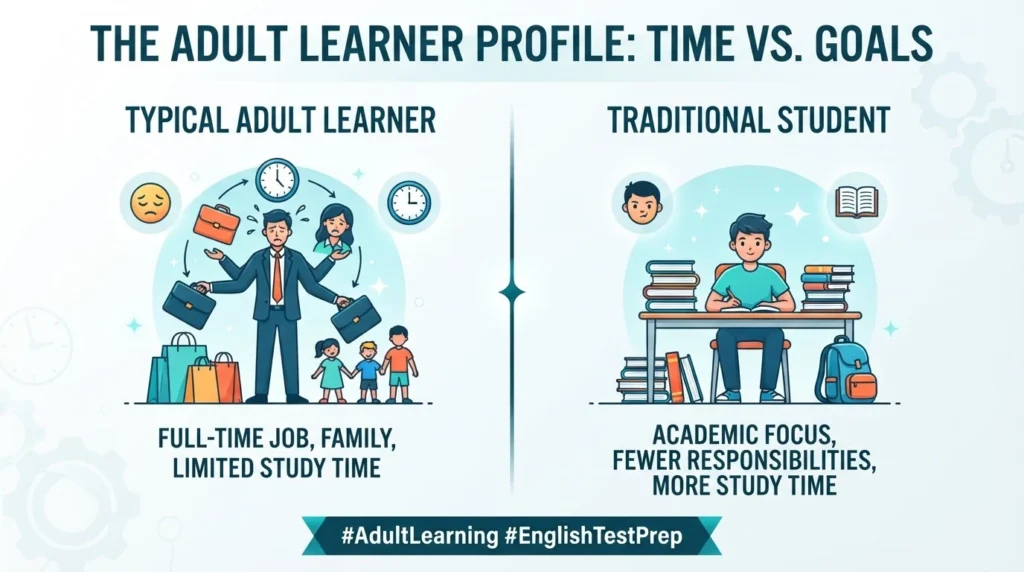
Limited Study Time Requires Smarter Learning
Many learners believe they need three or four hours every day to achieve a high score. In reality, consistency is more important than marathon study sessions.
For Adult Learners, shorter, focused sessions often produce better results.
Instead of studying for four hours once a week, consider:
- 30 minutes before work
- 20 minutes during lunch
- 30 minutes in the evening
- Listening practice during commuting
- Speaking practice while walking
These small sessions accumulate into meaningful progress over time.
The goal isn’t to study more—it’s to study better.
Work Pressure Changes Everything
Professional responsibilities don’t stop because an exam is approaching.
Unexpected meetings, deadlines, travel, overtime, and stress frequently interrupt study schedules.
Instead of expecting perfect consistency, successful adult learners build flexible study plans.
For example:
Monday:
- Vocabulary review
Tuesday:
- Listening practice
Wednesday:
- Speaking exercises
Thursday:
- Writing task
Friday:
- Grammar revision
Weekend:
- Full mock test
Missing one session doesn’t destroy the entire week’s progress.
Flexible planning reduces stress while maintaining momentum.
Identify Skill Gaps Instead of Studying Everything
One of the biggest mistakes adults make is treating every language skill equally.
Some learners already read English fluently but struggle with speaking.
Others write well but lose marks in listening.
Before beginning english proficiency test preparation, identify your weakest areas.
Ask yourself:
- Do I understand native speakers?
- Can I write essays quickly?
- Is my grammar accurate?
- Do I hesitate while speaking?
- Is my vocabulary sufficient?
Once you know your weaknesses, spend around 60–70% of your study time improving them.
Targeted learning produces much faster results than trying to improve everything equally.
Different Exams Require Different Strategies
Every English exam measures different skills.
Someone preparing for IELTS for Australia PR may focus heavily on achieving a minimum band score across all modules.
A candidate applying for an IELTS for UK work visa might simply need to meet a required score for immigration.
Healthcare professionals completing OET preparation for nurses need medical vocabulary and patient communication rather than general academic writing.
Similarly, candidates taking the TOEFL often benefit from a structured TOEFL study schedule, while improving TOEFL time management is essential because every section has strict time limits.
Those preparing for Pearson exams frequently focus on PTE score improvement, especially if they narrowly missed their target score.
The smartest learners tailor their preparation to the exam rather than using generic English materials.
Technology Has Changed How Adults Learn
Today’s learners have access to resources that simply didn’t exist a few years ago.
Modern AI tools for IELTS preparation help learners receive instant feedback, personalised practice, vocabulary suggestions, and speaking evaluations.
Instead of waiting days for a teacher to review writing, learners can receive immediate corrections and continue improving.
Similarly, many candidates now use ChatGPT for IELTS preparation to:
- Generate speaking questions
- Practise interview conversations
- Improve essay structure
- Learn vocabulary naturally
- Receive grammar explanations
- Create personalised study plans
AI cannot replace experienced teachers entirely, but it can significantly increase practice opportunities between lessons.
Faster Revision Beats Endless Learning
Adult learners often continue studying new topics without revising previous ones.
Unfortunately, forgetting is natural.
Revision is where long-term learning happens.
A practical revision cycle looks like this:
Day 1:
Learn new vocabulary.
Day 3:
Review the same words.
Day 7:
Use them in sentences.
Day 14:
Include them in speaking practice.
Day 30:
Use them in writing.
This spaced repetition strengthens memory while reducing the need for last-minute cramming.
Mock Tests Build Confidence
Many learners postpone practice tests until the final week.
This creates unnecessary anxiety.
Mock tests help you:
- Understand timing
- Reduce exam fear
- Identify weak areas
- Improve accuracy
- Build stamina
If you’re following online IELTS preparation, aim to complete one full mock test every week.
After each test, spend more time reviewing mistakes than celebrating correct answers.
Learning from errors accelerates improvement.
Intensive Preparation Can Still Work
Some adults only discover they need an English score a month before their application deadline.
While longer preparation is always preferable, focused learning can still produce excellent results.
A realistic IELTS preparation in 30 days plan includes:
Week 1:
Understand the exam format and identify weaknesses.
Week 2:
Strengthen grammar, vocabulary, and listening.
Week 3:
Complete multiple timed practice tests.
Week 4:
Focus almost entirely on revision and mock exams.
The key is quality, not quantity.
Avoid trying to learn every grammar rule in one month.
Instead, master the concepts that appear most frequently.
Learning Around the World Looks Different
Adult learners preparing for English exams come from many different educational backgrounds.
For example:
Students seeking IELTS preparation India often balance competitive exams and full-time employment.
Many professionals pursuing IELTS preparation Indonesia study while working in international industries.
Learners completing IELTS preparation Nepal frequently prepare for overseas education and migration opportunities.
Similarly, candidates searching for IELTS preparation Egypt often combine work commitments with evening study programmes.
Despite these regional differences, adult learners everywhere share the same challenge: finding enough time to study efficiently.
Build Habits Instead of Relying on Motivation
Motivation changes daily.
Habits remain.
Instead of asking yourself whether you feel like studying, make learning part of your routine.
Examples include:
- Reading one English article every morning
- Listening to English podcasts during commuting
- Learning five new words daily
- Writing one short paragraph each evening
- Speaking English for ten minutes every day
Small habits become significant improvements after several months.
Consistency almost always beats intensity.

Final Thoughts
The biggest mistake adult learners make is trying to prepare like teenagers. Busy professionals have different responsibilities, different learning styles, and different priorities.
Effective English Test Preparation for Adult Learners should focus on efficiency rather than long study hours. By identifying skill gaps, using modern resources such as AI tools for IELTS preparation and ChatGPT for IELTS preparation, following structured revision methods, and building sustainable habits, adults can achieve impressive results without sacrificing work or family life.
Whether your goal is IELTS for Australia PR, IELTS for UK work visa, OET preparation for nurses, PTE score improvement, or completing a disciplined TOEFL study schedule, success comes from studying smarter, not simply studying longer.
The journey may require discipline, but with the right strategy, even the busiest adult learner can confidently achieve their target score.
Frequently Asked Questions (FAQs)
1. Why do adult learners need a different approach to English Test Preparation?
Adult learners often balance work, family, and other responsibilities, leaving limited study time. A flexible, targeted approach that focuses on weak areas, efficient revision, and practical learning methods is usually more effective than traditional long study sessions.
2. Can AI tools really improve IELTS preparation?
Yes. AI tools for IELTS preparation can provide instant feedback on writing, generate speaking questions, explain grammar, and personalise study plans. When combined with regular practice and expert guidance, they can significantly improve learning efficiency.
3. Is IELTS preparation in 30 days realistic?
It depends on your current English level and target score. If you already have a solid foundation, a focused IELTS preparation in 30 days plan with daily practice, revision, and mock tests can help you achieve meaningful improvement.
4. How can working professionals stay consistent with exam preparation?
Instead of relying on long study sessions, working professionals should schedule shorter daily study blocks, review regularly, use commute time for listening practice, and complete weekly mock tests. Consistency is more valuable than occasional intensive studying.
5. Should I prepare differently for IELTS, TOEFL, PTE, or OET? Absolutely. Every exam assesses English differently. While IELTS and TOEFL focus on academic communication, OET preparation for nurses requires healthcare-specific language skills, and PTE score improvement often depends on mastering the exam’s computer-based format. Your preparation strategy should match the specific requirements of your chosen test.




Leave a Reply