

Choosing an English test can feel confusing, especially when every exam seems important. One friend may suggest IELTS. A university may ask for TOEFL. A healthcare recruiter may recommend OET. A corporate employer may mention TOEIC. Then there are other options like PTE, CAE, TOLES and Cambridge English Advanced. For many students and professionals, the real question is simple: Which English test should I take?
The answer depends on your goal.
English tests are not all designed for the same purpose. Some are better suited for academic admissions. Some are useful for migration. Some are designed for healthcare professionals. Some are more relevant to workplace communication. If you choose the wrong test, you may waste time, money and effort preparing for an exam that does not match your career path.
This guide explains how TOEIC, IELTS, TOEFL, OET and related tests fit different career goals, so you can make a smarter choice.
Read More: How English Proficiency Tests Can Strengthen Your Global Career Prospects
Start with Your Destination, Not the Test
Many candidates begin by asking, “Which test is easier?” That is not always the right starting point. A better question is: “Which test is accepted for my goal?”
Your goal may be:
- Studying abroad
- Applying for immigration
- Getting a healthcare job abroad
- Joining a global corporate role
- Building workplace communication skills
- Applying for legal or professional certification
- Proving advanced English ability

Before you begin IELTS preparation, TOEFL preparation, OET exam practice or TOEIC exam practice, check the exact requirement of the university, employer, immigration department or professional regulator. A test may be popular, but that does not mean it is accepted everywhere for every purpose.
IELTS: Best Known for Study, Migration and Professional Pathways
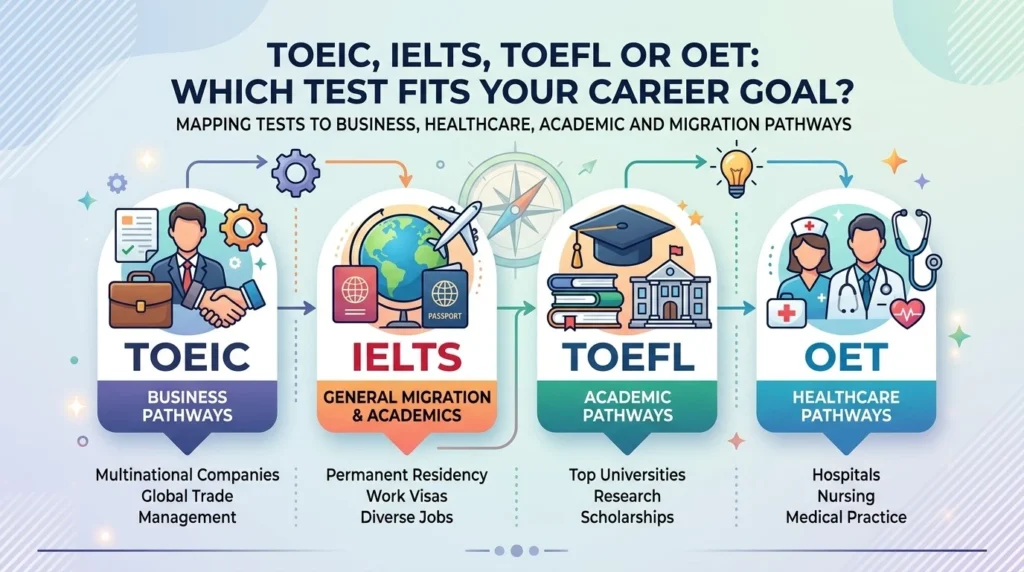
IELTS is one of the most widely recognized English proficiency tests in the world. It is accepted by many universities, immigration authorities, employers and professional bodies. IELTS comes in different formats, mainly IELTS Academic and IELTS General Training.
IELTS Academic is usually used for higher education and professional registration. IELTS General Training is often used for migration and work-related pathways in certain countries.
For students planning to study abroad, IELTS is often a strong choice because it tests listening, reading, writing and speaking in a balanced way. The speaking test is conducted with an examiner, which some candidates find more natural than speaking into a computer.
For migration, IELTS for immigration is a common pathway in countries such as Canada, Australia, New Zealand and the UK, depending on the visa category and current rules. Candidates should always confirm which IELTS version is required because Academic and General Training serve different purposes.
IELTS is a good choice if your goal is university admission, immigration, professional registration or broad international acceptance. However, because the test includes general and academic topics, candidates need to prepare across many subject areas, not just their professional field.
TOEFL: Strong for Academic and University Goals
TOEFL is strongly associated with academic admissions, especially for universities in the United States, though it is accepted by many institutions worldwide. It is designed to test how well candidates can use English in academic settings.
TOEFL is especially useful for students who need to understand lectures, read academic passages, write structured responses and speak about campus or academic topics. The test often combines skills. For example, you may read a passage, listen to a lecture, and then speak or write based on both sources.
This makes TOEFL useful for students preparing for university life because real academic communication is also integrated. You may listen to a professor, read research material, join a discussion and write an assignment based on several sources.
TOEFL preparation should therefore include academic reading, lecture listening, note-taking, integrated speaking and structured writing. It is not enough to practise general conversation. Candidates must learn to process academic information quickly and respond clearly.
TOEFL is a good choice if your main goal is university admission, especially in academic environments where integrated English skills matter.
TOEIC: Best for Workplace and Business Communication
TOEIC is different from IELTS and TOEFL because it is more workplace-focused. The TOEIC exam is commonly used by companies, training institutions and organizations to assess English communication for professional environments.
TOEIC is especially relevant for candidates who want to work in business, hospitality, aviation, customer service, international trade, corporate roles or multinational companies. It measures English used in everyday workplace situations such as meetings, emails, phone calls, office announcements, business travel and client communication.
If your goal is not university admission or immigration, but workplace readiness, TOEIC may be more relevant. It helps employers understand whether you can function in an English-speaking professional environment.
For example, a company may use TOEIC to assess whether employees can participate in meetings, understand instructions, read workplace documents, or communicate with international clients.
TOEIC is a good choice if your goal is corporate employability, professional communication or workplace English improvement.
OET: Designed for Healthcare Professionals
OET is the Occupational English Test. It is designed specifically for healthcare professionals such as nurses, doctors, dentists, pharmacists, physiotherapists, radiographers and other allied healthcare workers.
The OET exam tests English in healthcare contexts. Instead of writing essays on general topics, candidates may write referral, discharge or transfer letters. Instead of speaking about social issues, they may participate in role plays with a patient, caregiver or relative.
This makes OET highly relevant for healthcare professionals seeking registration or employment abroad. A nurse preparing for OET practises the kind of communication used in real nursing situations. A doctor preparing for OET practises consultation language, patient reassurance, history-taking and explanation of treatment.
Many nurses compare OET vs IELTS for nurses. IELTS is widely accepted and respected, but it is a general English test. OET is healthcare-specific. For nurses who feel more confident discussing patient care than abstract topics, OET may feel more practical.
However, the right choice depends on the nursing board, medical council or immigration pathway. Some regulators accept both IELTS and OET, while others may have specific score requirements. Always check the latest rules before booking the test.
OET is a good choice if your career goal is healthcare registration, healthcare migration or medical employment abroad.
PTE: A Digital Option for Study and Migration
PTE is another popular English proficiency test, especially for students and migration candidates who prefer a computer-based format. It uses automated scoring and tests speaking, writing, reading and listening through integrated tasks.
PTE can be useful for study abroad and migration pathways where it is accepted. Many candidates like PTE because of its digital format and result timelines. However, PTE preparation requires comfort with the computer interface, microphone, timing and task structure.
PTE may suit candidates who are comfortable speaking into a computer and handling fast-paced test formats. But as with all exams, acceptance should be checked first.
CAE and Cambridge English Advanced
CAE, also known as Cambridge English Advanced, is a high-level English qualification. It is designed for candidates who want to show advanced English ability for academic or professional purposes.
Cambridge English Advanced can be useful for students, professionals and institutions that value long-term proof of strong English competence. It tests reading, writing, listening, speaking and use of English at an advanced level.
CAE is a good option if your goal is to demonstrate high-level English ability, especially where Cambridge qualifications are accepted or preferred.
TOLES: For Legal English Careers
TOLES is the Test of Legal English Skills. It is a specialized exam designed for legal professionals and law students. Unlike general English exams, TOLES focuses on legal vocabulary, contract language, drafting, commercial law communication, and professional legal English.
If you are planning a legal career, especially in international law firms, corporate legal departments or cross-border legal work, TOLES may be useful. It is not a general migration or university admission test, but it can support professional credibility in legal English.
Mapping the Right Test to Your Career Goal
Here is a simple way to think about test selection:
If your goal is undergraduate or postgraduate study abroad, consider IELTS, TOEFL or PTE, depending on university acceptance.
If your goal is immigration, IELTS or PTE may be relevant, depending on the country and visa category.
If your goal is healthcare registration or medical employment abroad, consider OET or IELTS, depending on the regulator.
If your goal is corporate communication or workplace English, TOEIC may be a strong fit.
If your goal is advanced English certification, Cambridge English Advanced or CAE may be suitable.
If your goal is legal English, TOLES is the more specialized option.
The smartest choice is not the most popular exam. It is the exam that matches your destination, profession and timeline.
How to Decide: A Practical Checklist
Before choosing a test, ask yourself these questions:
What is my main goal: study, work, migration or professional registration?
Which country am I applying to?
Which institutions or regulators accept the test?
What minimum score do I need?
Do I need an overall score or section-wise scores?
Am I more comfortable with paper-based, computer-based or face-to-face testing?
How much preparation time do I have?
Do I need academic English, workplace English or profession-specific English?
This checklist can prevent costly mistakes. For example, a nurse should not choose a test only because a friend took it. A business professional should not prepare for a heavily academic test if the employer wants workplace communication. A student should not assume every university accepts every test.
Preparation Should Match the Test
Once you choose the right test, your preparation should match the exam format.
IELTS preparation should include essay writing, speaking practice, reading question types and listening tasks.
TOEFL preparation should include academic note-taking, integrated speaking, lecture listening and structured writing.
OET preparation should include healthcare role plays, clinical writing, patient communication and medical reading.
TOEIC preparation should include workplace vocabulary, business listening, email comprehension and office communication.
CAE preparation should focus on advanced grammar, vocabulary, writing, speaking and comprehension.
TOLES preparation should focus on legal vocabulary, contract terms and legal drafting.
A focused preparation plan saves time and improves confidence.
Final Thought
There is no single best English test for everyone. TOEIC, IELTS, TOEFL, OET, PTE, CAE and TOLES all serve different purposes. The right test depends on where you want to go and what you want English to help you achieve.
If your goal is academic study, IELTS, TOEFL or PTE may be the right path. If your goal is healthcare, OET may be the more relevant choice. If your goal is workplace communication, TOEIC may fit better. If your goal is advanced certification or legal English, CAE or TOLES may be more appropriate.
So, when you ask, “Which English test should I take?” do not begin with difficulty. Begin with your career goal.
The right test should not only help you get a score. It should help you move closer to the future you are preparing for.
FAQs
1. Which English test should I take for studying abroad?
For studying abroad, IELTS, TOEFL and PTE are commonly used. The right choice depends on the university, country and course requirements. Always check the official admission page before booking your test.
2. Is OET better than IELTS for nurses?
OET vs IELTS for nurses depends on the regulator and destination country. OET is healthcare-specific and may feel more relevant for nurses, while IELTS is a general English test with broad acceptance. Many nurses prefer OET because it uses patient-care scenarios.
3. Is TOEIC useful for jobs?
Yes. TOEIC is useful for workplace communication and is often used by companies to assess English ability in business and professional settings. It is especially relevant for corporate roles, customer service, hospitality, aviation and international business.
4. Is TOEFL only for university admission?
TOEFL is mainly used for academic admissions, especially in university contexts. However, TOEFL preparation also builds academic communication skills that can support research, postgraduate study and long-term career growth.
5. What is the difference between IELTS, TOEFL, PTE, CAE, OET, TOEIC and TOLES?
IELTS, TOEFL and PTE are commonly used for study and migration pathways. OET is for healthcare professionals. TOEIC focuses on workplace communication. CAE or Cambridge English Advanced proves advanced English ability. TOLES is designed for legal English.




Leave a Reply