

The modern job market doesn’t care much about borders. Businesses are expanding across continents, remote work has connected talent with global corporations, and thousands of students look across oceans every year to pursue higher education. However, as the world becomes a tightly knit global village, one major barrier remains for anyone trying to bridge the gap between their hometown and an international boardroom: communication.
English has cemented its status as the global lingua franca of commerce, science, and academia. While you might know you can speak, read, and write well, simply stating “fluent in English” on a resume rarely cuts it anymore. Employers, universities, and immigration departments need standardized, objective proof.
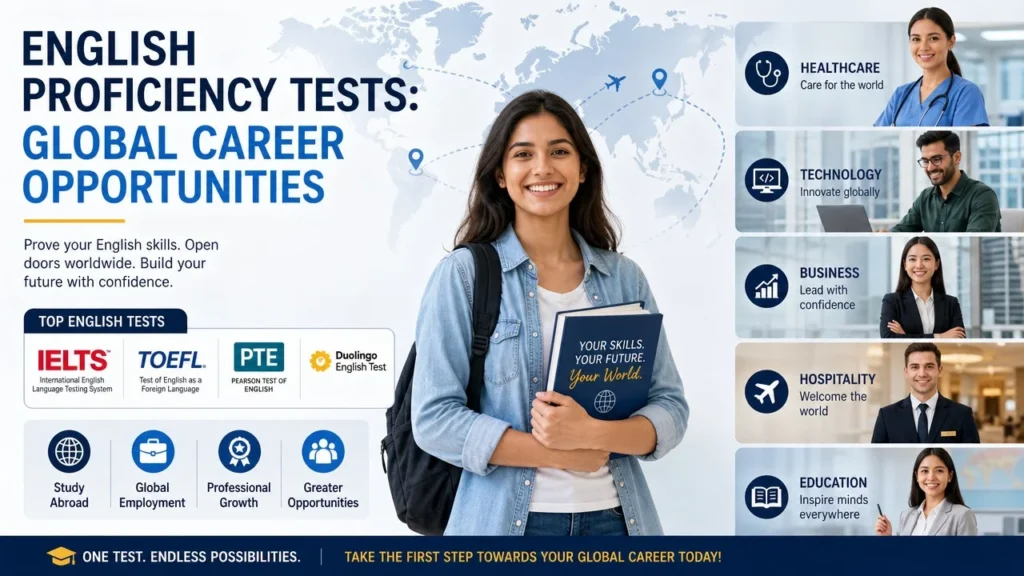
This is where taking English Proficiency Tests becomes less of a bureaucratic hurdle and more of a strategic career launchpad. Standardized exams like IELTS, TOEFL, PTE, OET, TOEIC, CAE, and TOLES are not just tests; they are globally recognized keys that unlock massive global career opportunities, seamless study abroad admissions, and lucrative work abroad opportunities.
Let’s look at exactly how these certifications can fundamentally reshape your professional trajectory.
Read More: TOEIC, IELTS, TOEFL, or OET: Which Test Fits Your Career Goal?
The Strategic Advantage of English Language Certification
In a stack of hundreds of resumes, a verified English language certification acts as an instant filter of credibility. It tells hiring managers that you possess the practical, real-world communication skills required to thrive in high-stakes environments.
Investing the time and effort into a recognized test provides several distinct advantages:
- Bypassing the Resume Filter: Many multinational applicant tracking systems (ATS) screen for specific certifications. Having a credential like the CAE (C1 Advanced) or a high TOEFL score immediately elevates your application.
- Demonstrating High Executive Function: Preparing for these exams requires discipline, time management, and deep focus. Succeeding in them signals to employers that you are capable of handling rigorous professional standards.
- Smoothing the Immigration Path: For countries like Canada, Australia, the UK, and New Zealand, language proficiency is tied directly to visa points. A top-tier score can be the deciding factor in securing your right to work abroad.

Navigating the Alphabet Soup: Which Test Matches Your Goals?
Not all English exams are created equal. Different sectors and regions prioritize different certificates. Choosing the right one depends heavily on whether your immediate target is academia, corporate climb, or a specialized niche like healthcare or law.
+——————+———————————-+—————————————–+
| Test Name | Primary Focus Area | Target Audience |
+——————+———————————-+—————————————–+
| IELTS | Global General & Academic | Migrants, Students, Global Professionals|
| TOEFL | Academic (Primarily US-focused) | International Education Seekers |
| PTE Academic | Fast, Computer-Based Assessment | Tech-forward Students & Job Seekers |
| OET | Healthcare Specific | Doctors, Nurses, Medical Professionals |
| TOEIC | Corporate & Business English | Multinational Corporate Employees |
| CAE | Advanced General/Academic | Long-term UK/European Career Tracks |
| TOLES | Legal English | Corporate Lawyers & Legal Executives |
+——————+———————————-+—————————————–+
1. The Heavy Hitters of International Education and Work: IELTS & TOEFL
The IELTS (International English Language Testing System) and TOEFL (Test of English as a Foreign Language) are the twin titans of language testing.
- IELTS is widely favored across the UK, Australia, New Zealand, and Canada. It offers two tracks: Academic (for university admissions) and General Training (for migration and work). It tests real-world conversation alongside reading and writing stamina.
- TOEFL has historically been the gold standard for study abroad aspirations in the United States. It evaluates how well you combine your listening, reading, speaking, and writing skills to perform academic tasks.
Securing high scores on either test dramatically expands your study abroad admissions options, paving the way for international internships and post-graduate overseas employment.
2. The Agile Contender: PTE Academic
The PTE (Pearson Test of English) has rapidly gained traction in the international job market. Because it is entirely computer-based and scored by AI algorithms, it removes human bias and offers incredibly fast turnaround times for results. It is widely accepted by universities worldwide and approved for all Australian, UK, and New Zealand visa applications, making it a favorite for fast-tracked work abroad strategies.
3. The Corporate Benchmark: TOEIC
If your goal is to climb the corporate ladder within an established multinational, the TOEIC (Test of English for International Communication) is tailored for you. Unlike academic tests, TOEIC measures English skills used in daily workplace activities (meetings, travel, phone calls). Many corporations in Asia and Europe use TOEIC scores to determine promotions, international transfers, and assignments to global teams.
4. Specialized Tracks: OET & TOLES
For professionals in highly regulated fields, general English proficiency isn’t enough. You need to prove you can handle technical vocabulary without making critical mistakes.
- OET (Occupational English Test): Designed specifically for healthcare professionals. If you are a doctor or nurse aiming for international jobs in the UK, Australia, or the US, the OET simulates real medical scenarios—like conducting a patient consultation—ensuring you are clinically safe to practice in English.
- TOLES (Test of Legal English Skills): The legal world moves on precise wording. TOLES is highly valued by commercial law firms, corporate legal departments, and international courts, proving that you can draft contracts and handle negotiations accurately.
Accelerating Your Climb in the International Job Market
Beyond visas and college admissions, achieving a high score on an English proficiency test has a direct, positive impact on your day-to-day career trajectory.
Unlocking Higher Earning Potential
Data across the global recruitment landscape consistently shows that bilingual or multilingual professionals who can cleanly operate in English command significantly higher salaries than their peers. An English certification acts as a concrete justification for a premium salary package during job negotiations.
Seamless Cross-Border Collaboration
When you work for a global corporation, your team might be spread across Singapore, London, and San Francisco. Clear communication prevents costly operational misunderstandings, speeds up project delivery, and builds stronger interpersonal trust across cultural divides.
Access to Leadership Roles
Upper management positions in multinational firms require diplomacy, public speaking, and persuasive writing. By proving your linguistic competence early, you signal to executive leadership that you are capable of representing the company on a global stage, making you a prime candidate for international relocations and promotions.
Concrete Action Steps to Prepare Successfully
Familiarity with English is not the same as test-taking fluency. Even native speakers can struggle with these exams if they don’t understand the format. To maximize your investment, follow a structured preparation plan:
- Diagnose Your Target: Look at the explicit immigration or university requirements for your destination country. Do they require a specific band score per section (e.g., an IELTS 7.0 in writing)?
- Take a Diagnostic Test: Establish your baseline under realistic timed conditions before buying expensive prep materials.
- Immerse Yourself Daily: Switch your media consumption—podcasts, news articles, and business journals—entirely to English. Pay close attention to how arguments are structured.
- Practice Active Output: Write essays or record yourself speaking, then review your performance against the official test rubrics.
Final Thoughts: Investing in Your Future Self
Preparing for English Proficiency Tests requires an investment of time, energy, and money. However, when viewed through the lens of long-term career planning, it is one of the highest-yield investments you can make.
Whether your dream is to land a tech job in Silicon Valley, practice medicine in London, or secure study abroad admissions at a world-class university, these certifications prove you have what it takes to communicate effectively. Don’t let your skills stay hidden behind a language barrier—give yourself the credential that proves your readiness to lead on the global stage.
Frequently Asked Questions (FAQ)
1. How long are scores for tests like IELTS, TOEFL, and PTE valid?
For the vast majority of academic admissions, professional registrations, and immigration visas, scores for IELTS, TOEFL, and PTE are valid for two years from the date of your test. After two years, you will typically need to retake the exam to prove your language skills are still up to date.
2. Can I use an Academic IELTS score for immigration or work visa purposes?
It depends entirely on the country and the visa category. While universities require the Academic version, immigration departments often mandate the General Training format for residency or work visas. Always double-check the exact visa guidelines of your destination country before booking your test date.
3. Is the PTE Academic accepted by corporate employers as widely as TOEIC or IELTS?
Yes, PTE Academic is growing rapidly in corporate acceptance, particularly in tech-forward regions and countries like Australia, New Zealand, and the UK. While TOEIC remains a classic benchmark for general corporate workforce evaluation in some regions, PTE is highly respected for verifying functional, everyday communication skills.
4. What happens if I score high overall but fail to meet the minimum score in one specific section?
Most elite universities and immigration systems require “minimum band scores” across all four sub-sections (Listening, Reading, Writing, Speaking). If your overall score is high but your writing or speaking falls below their specific threshold, your application may still be rejected. Some testing organizations now allow “One Skill Retake” options in select regions, allowing you to re-do just one section.
5. If I am already working in an international job, do I still need a specialized test like TOLES or OET?
If you are already working in a general corporate role, a specialized test may not be necessary. However, if your career path transitions into specialized legal consulting or clinical healthcare delivery in an English-speaking country, regulatory boards will almost always require TOLES or OET to legally practice and mitigate professional liability.




Leave a Reply