
IELTS Writing Task 2 asks you to write an essay of at least 250 words. It is the most important part of the Writing test because it carries more marks than Task 1. To achieve a high score, you need more than good English. You need to answer the question clearly, organise your ideas logically, support them with examples, and use a suitable range of vocabulary and grammar.
A strong IELTS essay is not about using very complicated words. It is about being clear, relevant, well-structured, and accurate.
Read More: IELTS Writing Task 1: How to Describe Charts, Graphs, Maps, and Processes
Common IELTS Essay Types
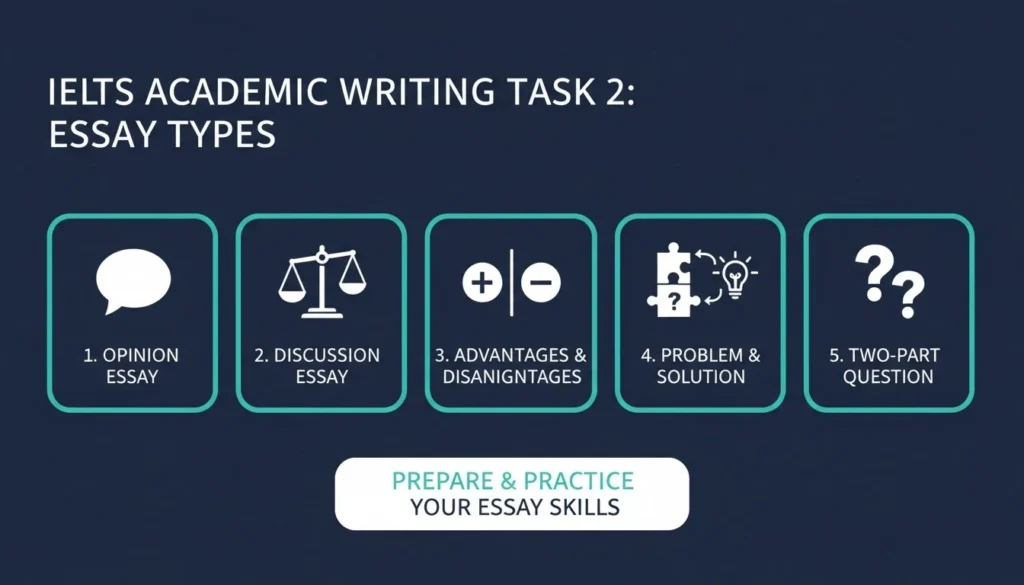
IELTS Task 2 questions usually fall into a few common types:
| Essay Type | What You Must Do |
| —————————- | —————————————- |
| Opinion essay | Say whether you agree or disagree |
| Discussion essay | Discuss both views and give your opinion |
| Advantages and disadvantages | Explain benefits, drawbacks, or both |
| Problem and solution | Describe problems and suggest solutions |
| Two-part question | Answer two connected questions |
Before writing, identify the essay type. This helps you decide your structure. Many students lose marks because they write a general essay instead of answering the exact question.
For example, if the question asks, “To what extent do you agree or disagree?”, you must give a clear opinion. If it asks, “Discuss both views and give your opinion,” you must cover both sides and include your own view.
The Best Structure for Task 2
A simple four-paragraph structure works well for most IELTS essays:
| Paragraph | Purpose |
| ———– | ———— |
| Paragraph 1 | Introduction |
| Paragraph 2 | Main idea 1 |
| Paragraph 3 | Main idea 2 |
| Paragraph 4 | Conclusion |
This structure is clear and easy for the examiner to follow. Some essays may need five paragraphs, especially discussion essays, but beginners should first master the four-paragraph format.
Writing a Strong Introduction
Your introduction should do two things:
1. Paraphrase the question
2. Give your thesis statement or position
Do not copy the question word for word. Use your own words while keeping the original meaning.
Question:
Some people believe that children should start learning a foreign language at primary school rather than secondary school. Do the advantages outweigh the disadvantages?
Introduction:
Many people argue that foreign language education should begin at primary school instead of being delayed until secondary school. Although this approach may create some pressure for younger learners, I believe the benefits are greater because early language learning improves confidence and pronunciation.
This introduction is effective because it introduces the topic, shows the writer’s position, and previews the main ideas.
What Is a Thesis Statement?
A thesis statement is the sentence that tells the examiner your main answer to the question. It usually appears at the end of the introduction.
A good thesis statement is:
– Clear
– Direct
– Relevant to the question
– Not too general
Weak thesis:
This essay will discuss this issue.
Stronger thesis:
I believe that the advantages of early language learning outweigh the disadvantages because it develops confidence and long-term communication skills.
Your thesis helps control the whole essay. Every body paragraph should connect back to it.
Building Strong Body Paragraphs
A good body paragraph should contain one main idea. The PEEL method is useful:
| Step | Meaning |
| ——- | —————————- |
| Point | State the main idea |
| Explain | Explain what it means |
| Example | Give an example |
| Link | Connect back to the question |
Example body paragraph:
One major advantage of learning a foreign language at a young age is that children often develop better pronunciation. Young learners are usually more willing to copy sounds and experiment with speech, which can help them sound more natural later in life. For example, a child who starts learning English at the age of six may find it easier to imitate English rhythm and intonation than a teenager who begins much later. Therefore, early language education can support stronger speaking skills in the long term.
This paragraph is clear because it has one main idea, explanation, example, and link.
Using Examples Effectively
Examples make your essay more convincing. They do not need to be complex or based on exact statistics. They can be realistic and general.
Useful phrases include:
– For example,
– For instance,
– A good example of this is
– This can be seen in
– In many countries,
Avoid examples that are too personal, such as “my cousin” or “my friend,” unless they are written in a more general way. IELTS essays should sound formal and academic.
Writing a Clear Conclusion
The conclusion should summarise your answer and restate your position. Do not introduce a completely new idea.
Example conclusion:
In conclusion, although teaching young children another language may create some additional pressure, the long-term benefits are more significant. Early language learning can improve pronunciation, confidence, and communication skills, making it a valuable part of primary education.
A good conclusion is short, clear, and connected to the question.
Coherence and Cohesion
Coherence means your ideas are logical and easy to follow. Cohesion means your sentences and paragraphs connect smoothly.
Useful linking words include:
– Firstly,
– In addition,
– However,
– As a result,
– For this reason,
– On the other hand,
– In conclusion,
Do not overuse linking words. A high-scoring essay feels natural, not mechanical. Also use referencing words such as this, these, such problems, and this approach to avoid repetition.
Vocabulary Range
To score well, you need a suitable range of vocabulary. This does not mean using rare words everywhere. It means choosing precise words for the topic.
For education essays, useful words include:
– curriculum
– academic performance
– learning environment
– communication skills
– long-term development
– pressure on students
– practical knowledge
Avoid memorised phrases that sound unnatural. It is better to write a clear sentence accurately than a complicated sentence full of errors.
Common Mistakes to Avoid
Many IELTS candidates lose marks because they:
– Do not answer all parts of the question
– Give an unclear opinion
– Write memorised introductions
– Include too many ideas with little explanation
– Use examples that do not support the point
– Write conclusions with new arguments
– Repeat the same vocabulary too often
– Use informal language
– Write fewer than 250 words
– Spend too long planning and run out of time

Final Advice
A high-scoring IELTS Task 2 essay is clear, organised, and focused. First, understand the question. Then choose two strong ideas and plan your paragraphs before writing. Use a clear introduction, focused body paragraphs, relevant examples, and a short conclusion.
The best IELTS essays do not try to impress with difficult language. They answer the question directly, develop ideas fully, and guide the reader smoothly from beginning to end.