Choosing between IELTS Academic and IELTS General Training is one of the first important decisions for IELTS test takers. Both tests assess your English ability across four skills: Listening, Reading, Writing, and Speaking. However, they are designed for different purposes. Taking the wrong version can delay your university application, visa process, professional registration, or migration plan.
The good news is that the choice is usually simple once you understand your goal. IELTS Academic is mainly for higher education and professional registration. IELTS General Training is usually for migration, work experience, and everyday English purposes.
Read More: IELTS Listening Test Guide: Format, Question Types, Tips & Common Mistakes
What Is IELTS Academic?
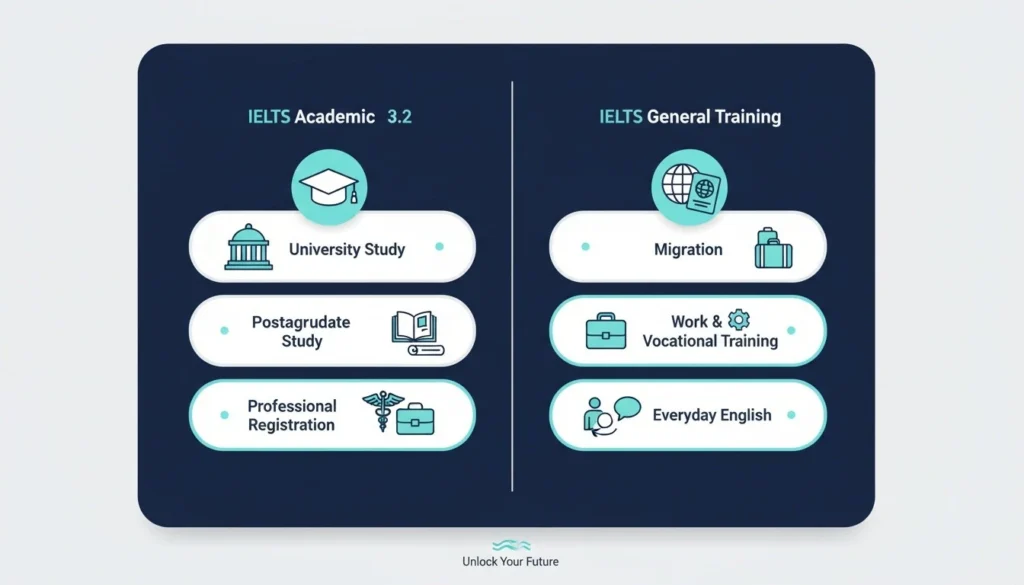
IELTS Academic is designed for people who want to study at undergraduate or postgraduate level, or who need English proof for a professional body. It tests whether you can understand and use English in an academic environment.
You may need IELTS Academic if you are applying for:
– A university degree
– A postgraduate course
– A foundation or pathway programme
– Professional registration in fields such as medicine, nursing, pharmacy, teaching, or engineering
– Some skilled work or licensing routes where academic English is required
Academic IELTS focuses on the kind of English you are likely to meet in lectures, textbooks, seminars, research discussions, reports, and formal essays. This does not mean every topic is extremely difficult, but the style is more formal and educational.
What Is IELTS General Training?
IELTS General Training is designed for people who need English for migration, employment, training programmes, or everyday life in an English-speaking country. It tests practical English skills used in social and workplace situations.
You may need IELTS General Training if you are applying for:
– Migration to countries such as the UK, Canada, Australia, or New Zealand
– Some work visa routes
– Secondary education or vocational training
– Workplace English requirements
– General language proof for non-academic purposes
General Training IELTS is more focused on real-life communication. You may read notices, advertisements, workplace documents, letters, instructions, and short articles. The Writing section also includes practical communication, such as writing a letter.
What Is the Same in Both Tests?
IELTS Academic and IELTS General Training both test four skills:
| Section | Academic | General Training |
| ——— | ————– | —————- |
| Listening | Same test | Same test |
| Reading | Different test | Different test |
| Writing | Different test | Different test |
| Speaking | Same test | Same test |
The Listening test is the same for both versions. It has four parts and 40 questions. You listen to conversations, monologues, academic discussions, and lectures.
The Speaking test is also the same for both versions. It is a face-to-face or video-call style interview with an examiner and includes three parts: personal questions, a short individual talk, and a discussion.
The main differences are in Reading and Writing.
How the Reading Sections Differ
Both Reading tests last 60 minutes and include 40 questions, but the content is different.
IELTS Academic Reading
Academic Reading uses longer and more formal texts. These may come from books, journals, magazines, newspapers, or educational sources. The topics are suitable for test takers entering university or professional environments.
You may need to understand:
– Academic arguments
– Research-based information
– Complex descriptions
– Opinions and evidence
– Diagrams, charts, or technical explanations
The language is usually more advanced than General Training Reading.
IELTS General Training Reading
General Training Reading uses texts from everyday and workplace contexts. These may include advertisements, notices, handbooks, company policies, instructions, and general articles.
You may need to understand:
– Public information
– Workplace rules
– Travel or community notices
– Job-related documents
– General interest articles
General Training Reading is still challenging, but the texts are usually more practical and less academic.
How the Writing Sections Differ
Both Writing tests last **60 minutes** and include two tasks. Task 2 is an essay in both tests, but Task 1 is different.
IELTS Academic Writing
In Academic Writing Task 1, you describe visual information. This may be a:
– Line graph
– Bar chart
– Pie chart
– Table
– Map
– Process diagram
You must summarise the main features, compare data, and write in a clear academic style.
In Academic Writing Task 2, you write an essay responding to an argument, opinion, problem, or discussion question.
IELTS General Training Writing
In General Training Writing Task 1, you write a letter. The letter may be formal, semi-formal, or informal.
For example, you may write to:
– Request information
– Make a complaint
– Apologise
– Invite someone
– Explain a situation
– Apply for something
In General Training Writing Task 2, you also write an essay. The essay may feel slightly more general or everyday in topic, but it still requires clear structure, relevant ideas, and accurate English.
Which Test Should You Take?
The best way to decide is to check the official requirement of the organisation you are applying to. Do not guess. Universities, employers, immigration departments, and professional bodies can have very specific rules.
Choose IELTS Academic if your goal is university study, postgraduate study, or professional registration.
Choose IELTS General Training if your goal is migration, practical employment, vocational training, or general English proof.
If you are unsure, contact the university, employer, visa authority, or professional body before booking the test.

Final Advice
IELTS Academic and IELTS General Training are both respected English tests, but they are not interchangeable for every purpose. The Listening and Speaking sections are the same, while the Reading and Writing sections are different.
Before you begin preparation, confirm which version you need. Then practise with materials designed for that exact test. Academic students should focus on academic reading passages, data description, and formal essays. General Training students should focus on practical reading texts, letter writing, and clear essay structure.
Choosing the right IELTS test from the beginning saves time, money, and stress — and helps you prepare with a clear target.