
The IELTS Listening test is one of the most important parts of the IELTS exam because it checks how well you understand spoken English in everyday, academic, and social situations. Whether you take IELTS Academic or IELTS General Training, the Listening test is the same. Both versions include four parts, 40 questions, and a range of accents, including British, Australian, New Zealand, North American, and other international English accents.
The test lasts about 30 minutes, with extra time depending on whether you take the paper-based or computer-delivered version. In the paper-based test, you usually get time at the end to transfer your answers. In the computer-delivered test, you type answers directly as you listen.
Must Read: IELTS Academic vs IELTS General Training: Which Test Should You Take?
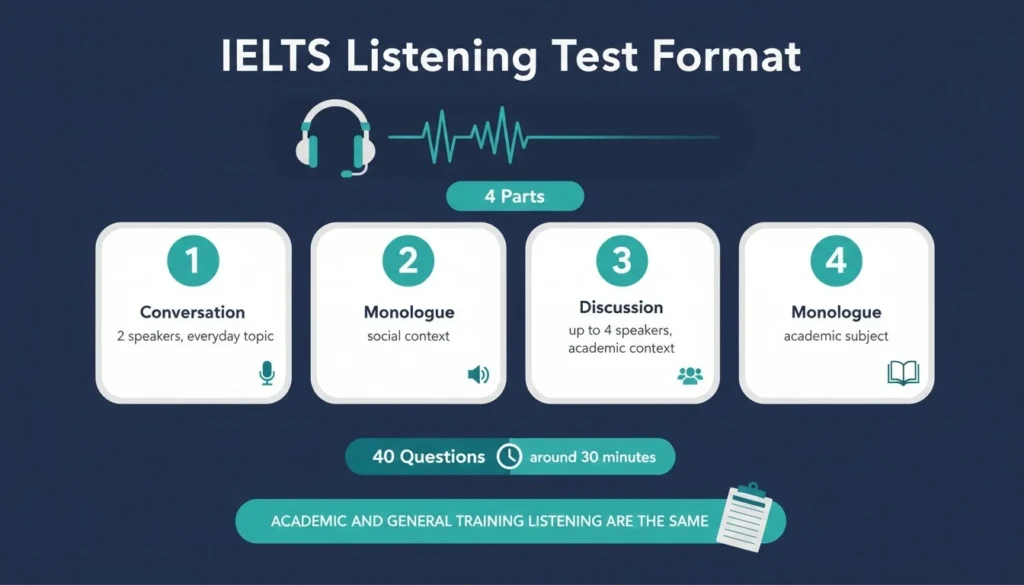
IELTS Listening Test Format
The IELTS Listening test is divided into four parts. Each part becomes slightly more challenging.
| Part | Situation | Speakers | Common Context |
| ——– | ——————— | ——————– | ————————————— |
| Part 1 | Everyday conversation | Two speakers | Booking, enquiry, form completion |
| Part 2 | Everyday monologue | One speaker | Tour guide, announcement, local service |
| Part 3 | Academic discussion | Two or more speakers | Students discussing a project or course |
| Part 4 | Academic lecture | One speaker | University-style talk or presentation |
Part 1 is usually a conversation between two people. For example, someone may be booking a hotel room, registering for a course, or asking about a service. This section often tests names, numbers, dates, addresses, and simple details.
Part 2 is a monologue in a general social situation. You may hear a speech about a museum, a community event, a public facility, or travel information.
Part 3 is usually a discussion between students or between a student and a tutor. This section tests your ability to follow opinions, suggestions, agreement, disagreement, and academic planning.
Part 4 is a lecture or formal academic talk. It is often the most difficult section because there is no break in the middle, and the vocabulary is more advanced.
Common IELTS Listening Question Types
IELTS Listening uses several question types. You should practise all of them because each one tests a slightly different skill.
1. Multiple Choice
In multiple choice questions, you choose the correct answer from a list of options. Sometimes one answer is correct, and sometimes you must choose more than one. These questions often include **distractors**, which are words or ideas that sound correct at first but are later changed or corrected by the speaker.
2. Form, Note, Table, Flow-Chart, or Summary Completion
These are often called gap-fill questions. You complete missing information using words or numbers from the recording. These questions are common in Part 1 and Part 4.
For example:
Date of appointment: ________
Main topic of lecture: ________
You must follow the word limit carefully. If the instruction says **“NO MORE THAN TWO WORDS AND/OR A NUMBER,”your answer must not be longer than that.
3. Sentence Completion
You complete sentences using information from the audio. These questions test both listening and grammar because your answer must fit the sentence correctly.
4. Matching
Matching questions ask you to connect people, places, opinions, or features with the correct option. These are common in Part 2 and Part 3.
5. Map, Plan, or Diagram Labelling
You listen to directions and label a map, building plan, or diagram. You need to understand words such as **opposite, next to, beside, at the end of, on the left, behind, near, entrance, corridor, and reception**.
Spelling Rules and Answer Accuracy
Spelling matters in IELTS Listening. If your spelling is wrong, the answer may be marked incorrect, even if you understood the audio.
Be especially careful with:
– Names: Steven / Stephen
– Places: Manchester / Manchestor
– Double letters: accommodation, committee, successful
– Plurals: student/students
– Numbers: 15 / 50
– Dates: 14th March / March 14
– Hyphenated words: part-time, well-known
Also remember that grammar matters. If the sentence needs a plural noun, write the plural form. For example, if the recording says “books” and you write “book,” the answer may be wrong.
Distractors: The Biggest IELTS Listening Trap
A distractor is a word, number, or idea that seems like the answer but is not the final correct answer.
For example, a speaker might say:
“I was going to book the appointment for Tuesday, but actually Wednesday is better.”
Here, Tuesday is the distractor. The correct answer is Wednesday.
Distractors are common with dates, times, prices, names, opinions, and choices. To avoid this mistake, keep listening until the speaker finishes the idea.
Time-Management Tips
Good time management can improve your score.
Before each recording starts, quickly read the questions. Underline keywords such as names, dates, places, and question words. Try to predict the type of answer needed. Is it a number, a noun, a place, a date, or an adjective?
During the recording, do not panic if you miss one answer. Move on immediately. If you keep thinking about a missed answer, you may lose the next two or three.
After each section, check spelling, word limits, and grammar. Make sure your answer fits the sentence and follows the instruction exactly.
Common IELTS Listening Mistakes
Many students lose marks because they:
– Ignore the word limit
– Spell words incorrectly
– Write singular instead of plural
– Fall for distractors
– Stop listening after hearing the first possible answer
– Spend too long on one missed question
– Forget to check units, such as pounds, dollars, metres, or kilometres
– Do not practise different English accents

Final Advice
The IELTS Listening test rewards focus, accuracy, and practice. You do not need to understand every single word. Instead, you need to listen for key information, follow changes in meaning, and write answers carefully.
Practise with real IELTS-style recordings, review your mistakes, and build your spelling accuracy. Most importantly, train yourself to listen actively. The more familiar you become with the format, question types, and common traps, the more confident you will feel on test day.
Ready for structured practice? See the IELTS Academic course.