
The TOEIC Speaking test measures whether you can communicate effectively in spoken English in realistic situations. It is very different from having an informal conversation with a teacher. Candidates must respond to several structured tasks while working within strict preparation and speaking times.
The current test contains 11 questions, lasts approximately 20 minutes and is scored from 0 to 200.
Read More: TOEIC Reading: Strategies for Parts 5, 6 and 7
Questions 1–2: Read a Text Aloud
For the first two questions, you receive preparation time and then read a text aloud.
The objective is not to sound like a native speaker. Your speech should be intelligible, appropriately paced and natural enough for the listener to follow comfortably.
During preparation, identify punctuation, divide long sentences into phrases, notice difficult words and decide where your voice should rise or fall.
Avoid reading every word with equal stress.
Meaningful words deserve more emphasis.
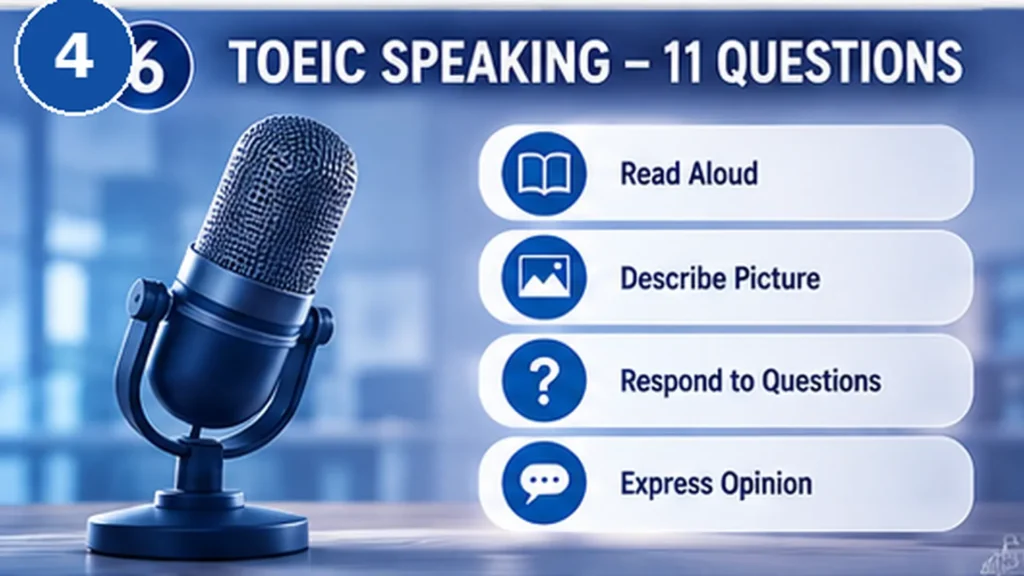
Questions 3–4: Describe a Picture
Candidates receive preparation time and then describe a picture.
Organisation is more useful than trying to mention every tiny detail.
A reliable structure is:
Overview → foreground → background → people → actions → final observation.
For example:
“This picture appears to have been taken in an office. In the foreground, two people are discussing a document. Behind them, another employee is working at a computer…”
Use language you can control accurately.
A shorter, clear description is better than attempting complicated sentences that collapse halfway through.
Questions 5–7: Respond to Questions
These tasks test your ability to answer spoken questions spontaneously.
Do not answer with unnecessary complexity.
If asked which type of transport you normally use, state your answer immediately and then add a reason or detail.
“I usually travel by train because the station is close to my home. It is also faster than driving during rush hour.”
Direct answers sound much stronger than several seconds of hesitation.

Questions 8–10: Use Information Provided
Here you examine information and answer questions based on it.
The information might resemble a timetable, programme or schedule. Practise extracting names, times, dates, locations, sequence and changes or exceptions.
Do not memorise the entire document. Understand its layout so you can locate information rapidly.
Question 11: Express an Opinion
The final task requires a longer response.
A simple structure works extremely well:
Opinion → Reason 1 → Example → Reason 2 → Example → Conclusion.
For instance:
“I believe flexible working hours benefit employees. First, they allow people to avoid busy commuting periods…”
Your opinion itself is not being judged as right or wrong. What matters is how clearly and effectively you communicate and support it.
Fluency does not mean speaking quickly
Candidates sometimes race through responses because they believe speed equals fluency.
It does not.
Good fluency means maintaining communication with manageable pauses.
Use transition phrases such as:
– first;
– for example;
– another reason is;
– in addition;
– because of this;
– overall.
These give your response structure while giving you time to think.
Record yourself
Speaking preparation must involve actual speaking.
Use your phone or computer to record timed responses.
Then ask:
Was I understandable?
Did I answer the question directly?
Did I finish within the time?
Did I repeat the same vocabulary?
Were my sentences complete?
Repeat the same task and try to improve it.
Do not memorise entire model speeches. Instead, memorise structures and useful language patterns.
The best TOEIC Speaking preparation develops the ability to organise ideas rapidly and express them clearly under time pressure. That skill also transfers directly to meetings, interviews, presentations and everyday international communication.