
The TOEIC Reading section tests far more than the ability to understand individual sentences. Candidates must combine grammar, vocabulary, text organisation, scanning, inference and time management.
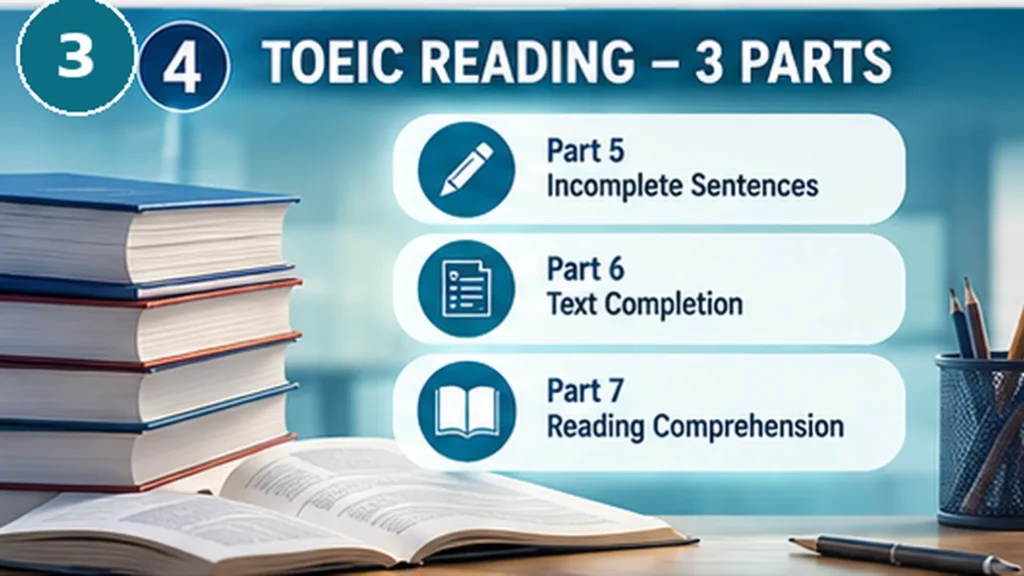
The section contains 100 questions and lasts 75 minutes. It consists of Part 5 Incomplete Sentences, Part 6 Text Completion and Part 7 Reading Comprehension. Unlike Listening, candidates work through the Reading section at their own pace.
That freedom makes time management extremely important.
Read More: TOEIC Listening: Complete Guide to Parts 1–4 and How to Improve Your Score
Part 5: Incomplete Sentences
Part 5 tests grammar and vocabulary through individual sentences containing a blank.
Some questions are mainly grammatical:
“The documents must be _____ before Friday.”
Options might include:
submit
submitted
submitting
submission
The structure “must be” tells us that a past participle is required, so submitted is correct.
Other questions depend on vocabulary or collocation.
Important grammar areas include verb tense, passive voice, subject-verb agreement, pronouns, relative clauses, prepositions, conjunctions, word forms, articles and comparatives.
Do not spend excessive time translating the entire sentence. First determine what kind of word or structure the blank requires.
Part 6: Text Completion
Part 6 moves from isolated sentences to short texts.
Candidates may encounter emails, notices, letters or other workplace-related writing. Correct answers can depend on grammar, vocabulary or the logic of the complete passage.
Watch for connectors.
However signals contrast.
Therefore introduces a consequence.
In addition adds information.
Because introduces a reason.
A sentence may be grammatically correct but logically inappropriate. Always ask: Does this answer fit what the writer is trying to communicate?
Part 7: Reading Comprehension
Part 7 usually requires the greatest amount of time.
Candidates read texts and answer comprehension questions. The material can include messages, advertisements, notices, emails and other practical forms of communication.
Questions may test main purpose, specific details, vocabulary in context, inference, intended audience and relationships between pieces of information.
Some questions involve information distributed across more than one text.
The key skill is evidence-based reading.
Do not choose an answer simply because it sounds logical in real life. The correct answer must be supported by the text.

Should you read the questions first?
Often, yes.
A useful sequence is:
1. Identify the type of document.
2. Read the question.
3. Identify keywords.
4. Scan the document for relevant information.
5. Read that section carefully.
6. Select the answer supported by the passage.
Questions about overall purpose may require broader reading, so experienced candidates alternate between scanning and close reading.
Learn paraphrasing
Correct TOEIC Reading answers frequently express the text’s meaning using different words.
Text:
“Employees are entitled to complimentary parking.”
Question:
“What benefit is available to employees?”
Answer:
“They may park without charge.”
You need to recognise that complimentary means free of charge and are entitled to indicates a benefit or right.
This is why vocabulary study should include synonyms and common workplace expressions.
Manage your 75 minutes
Many candidates spend too much time on Parts 5 and 6 and then rush through Part 7.
Avoid perfectionism.
If one vocabulary question is consuming too much time, choose your best answer and continue. Make earlier grammar questions increasingly automatic so more time remains for comprehension.
Read English outside TOEIC books
Practice tests teach format, but wider reading builds speed.
Useful material includes professional emails, advertisements, company websites, travel information, newsletters, schedules and short business articles.
While reading, ask:
Who wrote this?
Who is it for?
Why was it written?
What action is expected?
Strong TOEIC readers continually change reading speed. They skim to understand structure, scan to locate information and read closely only where detailed comprehension is necessary.