

Email is one of the most common tools used in modern workplaces. It supports communication between colleagues, customers, suppliers, and managers, while also creating a written record of decisions and actions.
Despite its importance, many employees receive little formal training in Professional Email Writing Skills. As a result, workplace emails may be unclear, unnecessarily long, or missing a specific request.
Strong Professional Email Writing helps professionals save time, reduce misunderstandings and present themselves credibly. It is therefore a core part of business communication skills and modern workplace communication.
Read More: How Fluency and Clarity Build Workplace Confidence
Why Professional Email Writing Matters
Emails influence how others judge a professional’s organisation, attention to detail and reliability.
A clear email can:
- request information;
- confirm a decision;
- provide an update;
- delegate a task;
- resolve a problem;
- maintain a client relationship;
- record an agreement.
Poor business email writing can have the opposite effect. The reader may not understand the purpose, deadline or required action.
For international teams, effective English email writing for professionals is especially important because colleagues may not share the same first language. Simple structure and precise wording reduce ambiguity.
What Should a Professional Email Include?
Many professionals ask: what should a professional email include?
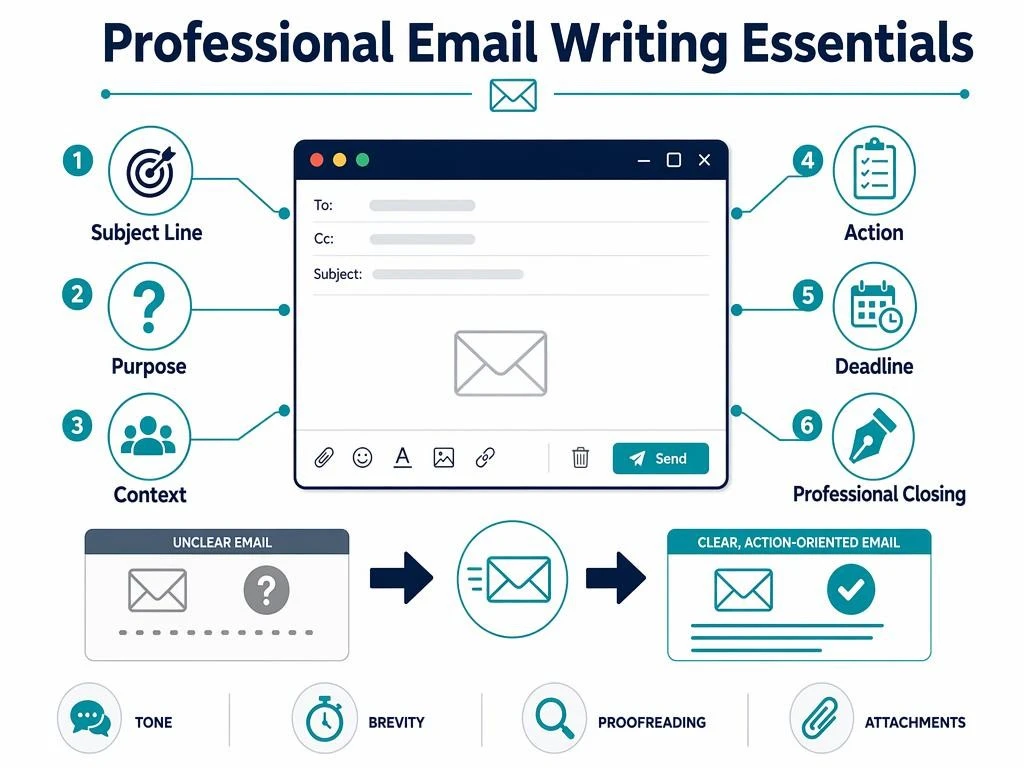
Most workplace emails should contain:
- A specific subject line.
- An appropriate greeting.
- A clear opening sentence.
- Essential context.
- A request, decision or update.
- A deadline where relevant.
- A professional closing.
- The sender’s name and contact details.
Not every message needs every element. A brief internal confirmation may be only a few sentences, while a complex client email may require more explanation.
The key is to make the message easy to understand.
Write Clear Email Subject Lines
Good email subject line examples communicate the topic and the action required.
Weak subject lines include:
- Hello
- Update
- Important
- Question
- Document
Stronger options include:
- Approval Required: Revised Marketing Budget
- Project Orion: Weekly Progress Update
- Meeting Request: Supplier Contract Review
- Action Required by Friday: Training Registration
- Client Proposal: Final Review
Specific subject lines support effective email communication because the recipient can prioritise the message and find it later.
State the Purpose Immediately
The opening sentence should explain why the email has been sent.
Useful examples include:
- “I am writing to request approval for the revised project budget.”
- “Please find below a summary of today’s meeting.”
- “I would like to confirm the delivery schedule.”
- “We have identified a delay that may affect the launch date.”
- “Could you please review the attached proposal?”
This approach improves clear email writing because the reader does not need to search for the main point.
Long social introductions may be appropriate in some cultures or relationships, but they should not hide the purpose.
Use a Logical Business Email Structure
A strong business email structure guides the reader from purpose to action.
A useful format is:
- Purpose
- Context
- Required action
- Deadline
- Next step
For example:
“We have completed the first draft of the campaign plan. The revised document is attached. Please review sections three and four and send your comments by 3 p.m. on Thursday. We will discuss the final version during Friday’s meeting.”
This email explains what has happened, what the recipient must do and when the action is required.
When several tasks are included, use numbered steps or bullet points. This improves readability and reduces the chance that an instruction will be missed.
Write Concise Business Emails
Concise business emails respect the reader’s time.
Compare these sentences:
“I just wanted to send you a quick email to let you know that we are currently in the process of reviewing the document that you recently sent.”
“We are reviewing your document and will respond by Wednesday.”
The second sentence is clearer and provides useful information.
Professionals can improve brevity by replacing wordy expressions:
- “At this point in time” becomes “now.”
- “In order to” becomes “to.”
- “Due to the fact that” becomes “because.”
- “With regard to” becomes “about.”
- “Please be advised that” becomes “Please note.”
Brevity does not mean removing essential context. It means including only what the reader needs.
Use an Appropriate Professional Email Tone
Professional email tone depends on the recipient, relationship and situation.
A message to a close colleague may be friendly and informal. A message to a new client, regulator or senior manager may require greater formality.
Compare:
“Send the document today.”
“Could you please send the revised document by 4 p.m. today?”
The second version is more polite and provides a precise deadline.
However, excessive politeness can make the request unclear. A professional email should be respectful without becoming vague.
Learning formal email writing includes understanding how to adjust tone while keeping the message natural.
Make the Action Obvious
Action-oriented email writing clearly identifies what the recipient needs to do.
A vague ending such as “Let me know what you think” may not produce a useful response.
A stronger version is:
“Please confirm by Wednesday whether you approve Option B.”
When several recipients are involved, name responsibilities directly:
- “Maria, please update the cost estimates.”
- “Daniel, please confirm the delivery date.”
- “The finance team should review the tax assumptions.”
Clear responsibilities are essential to productive workplace email communication.
Professional Email Openings and Closings
A suitable professional email opening may include:
- Dear Ms Patel,
- Hello Daniel,
- Good morning,
- Dear Recruitment Team,
The greeting should reflect the relationship and level of formality.
Professional closings include:
- Kind regards,
- Best regards,
- Many thanks,
- Sincerely,
- Thank you,
Overly casual endings may be inappropriate in formal contexts, while extremely formal closings may sound distant in routine internal communication.
Polite Email Requests
Effective polite email requests use respectful language while remaining specific.
Examples include:
- “Could you please send the revised figures by Friday?”
- “Would you be available for a short meeting on Tuesday?”
- “Please confirm whether the proposed date is suitable.”
- “I would appreciate your comments on the attached report.”
- “Could you clarify the payment terms in section four?”
These structures are useful for learners studying workplace english or a business english course.
Follow-Up Email Writing
Good follow-up email writing is important when a response has not been received.
A professional reminder should not sound accusatory.
For example:
“I am following up on the proposal sent last Monday. Could you please confirm whether you will be able to provide feedback by Friday?”
This message identifies the previous communication and makes a clear request.
If the issue is urgent, explain the reason:
“We need your approval by Thursday to maintain the current launch schedule.”
Providing context makes the reminder more persuasive.
Common Email Writing Mistakes
Common email writing mistakes include:
- vague subject lines;
- long introductions;
- missing deadlines;
- unclear requests;
- excessive use of “Reply All”;
- attaching the wrong document;
- using capital letters for emphasis;
- sending emotional messages;
- copying unnecessary recipients;
- failing to proofread.
Another mistake is choosing email when a conversation would be more effective. Complicated disputes or sensitive feedback may be better handled through a call or meeting.
Good email communication skills include knowing when not to send an email.
Review Grammar, Facts and Attachments
Before sending an email, check:
- recipient names;
- email addresses;
- dates;
- figures;
- deadlines;
- grammar;
- punctuation;
- attachments;
- links.
Errors in figures or attachments can be more damaging than a small grammar mistake.
Professionals developing written communication should ask:
“Could the recipient misunderstand any part of this email?”
If the answer is yes, revise it.
AI Email Writing
Ai email writing tools can help professionals:
- create an outline;
- improve tone;
- shorten a draft;
- correct grammar;
- generate subject lines.
These tools may be useful for professionals working in a second language.
However, AI-generated emails must be reviewed. The system may misunderstand the context, invent details or produce a generic tone.
Employees should also avoid entering confidential information into unapproved platforms.
AI should support Professional Email Writing, not replace professional judgement.
OET and PTE Writing Skills
Some language-test skills support workplace writing.
OET writing skills are particularly useful for healthcare professionals because candidates must produce accurate, reader-focused correspondence.
PTE writing practice develops grammar, coherence and concise written expression.
However, real workplace emails also require knowledge of relationships, organisational culture and urgency. Test practice should therefore be combined with practical business correspondence skills.
Corporate Email Etiquette
Corporate email etiquette includes several important habits:
- use “Reply All” only when necessary;
- protect confidential information;
- avoid forwarding messages without permission;
- do not use email for personal criticism;
- acknowledge important messages;
- use clear file names;
- maintain a professional tone.
A corporate communication training programme can help organisations establish consistent email standards.
This is particularly valuable when teams work across countries and time zones.
Improving Business Writing
Professionals can improve business writing by reviewing their real emails.
A useful practice process is:
- Identify the purpose.
- Remove unnecessary background.
- Move the request near the beginning.
- add a deadline.
- check the tone.
- proofread the final version.
An email writing course or business english course can provide structured practice and feedback.
Learners benefit most when they work on realistic messages connected to their jobs.
Practical Professional Email Example
Subject: Action Required: Contract Review by Thursday
Dear Priya,
Please review the attached supplier contract before Friday’s meeting.
The supplier has revised the payment terms and delivery schedule. Could you please check clauses four and seven and send your comments by 2 p.m. on Thursday?
Thank you for your help.
Kind regards,
This email has a clear subject, purpose, context, action and deadline.

Conclusion
Strong Professional Email Writing Skills help working adults communicate efficiently, reduce mistakes and maintain professional credibility.
An effective email includes a useful subject line, an early statement of purpose, a logical structure and a clear next action.
Whether professionals write independently or use ai email writing, every message should be reviewed for clarity, accuracy, tone and confidentiality.
By improving business email writing, corporate email etiquette and written communication, employees can become more reliable and effective workplace communicators.
Frequently Asked Questions
1. What should a professional email include?
It should normally include a clear subject line, greeting, purpose, relevant context, required action, deadline and professional closing.
2. How long should a professional email be?
It should be as short as possible while still including the information needed to understand and act on the message.
3. How can I make my emails sound more professional?
Use specific subject lines, clear requests, short paragraphs, polite language, accurate details and a suitable closing.
4. Is AI email writing safe to use?
It can be useful, but users should review the output and avoid entering confidential information into unapproved AI tools.
5. Should every workplace email use formal English?
No. The tone should match the audience and purpose. Internal messages may be friendly, while external or sensitive correspondence may require greater formality.




Leave a Reply