

Many students and young professionals believe that if they have studied English in school or college, they are ready to use English at work. In many cases, they are partly right. Classroom English gives a strong foundation. It helps with grammar, reading, writing, vocabulary and basic speaking. But once a person enters a workplace, they quickly realize something important: workplace English is different.
At work, English is not used only to answer questions or write essays. It is used to solve problems, make decisions, manage relationships, influence people, explain updates, handle pressure and represent an organization professionally. This is why Workplace Communication Skills matter so much for students, job seekers and working professionals.
The difference between Business English vs General English is not only about vocabulary. It is about purpose. General English helps people communicate in everyday situations. Business English helps people communicate in professional situations where time, clarity, tone and results matter.
This is where Business English Training becomes useful. It helps learners move from basic fluency to confident, practical and professional communication.
Read More: TOEIC, IELTS, TOEFL, or OET: Which Test Fits Your Career Goal?
Classroom English Builds the Base
Classroom English usually focuses on grammar, comprehension, essays, reading passages, vocabulary exercises, presentations and exam answers. These are important. Without this foundation, workplace communication becomes difficult.
In school or college, students learn how to write correctly, speak in complete sentences, understand texts and express opinions. They may practise debates, speeches, essays and group discussions. All of this supports language development.
However, classroom English often happens in a controlled environment. The teacher asks a question. The student answers. The topic is known. The goal is usually to get marks, show understanding or complete an assignment.
The workplace is less predictable. A manager may ask for a quick update. A client may raise an objection. A colleague may disagree. A meeting may suddenly require you to explain your idea. An email may need to sound polite but firm. A presentation may need to convince people, not just inform them.

That is why English Communication in the Workplace requires a different level of skill.
Business English vs General English
To understand the shift, it is useful to compare Business English vs General English.
General English helps you say:
“I want to talk about the project.”
Business English helps you say:
“I would like to discuss the project timeline, key responsibilities and next steps.”
General English helps you say:
“I cannot do this today.”
Business English helps you say:
“I may not be able to complete this by today. Could we review the deadline or prioritize the most urgent part?”
General English helps you say:
“Your idea is not good.”
Business English helps you say:
“I see the direction, but we may need to reconsider the cost and implementation challenges.”
The difference is not just language. It is maturity. Workplace English must be clear, respectful, purposeful and solution-oriented. It must help the conversation move forward.
This is why Professional English Communication Skills are essential for career growth.
Meetings: Speaking with Structure and Purpose
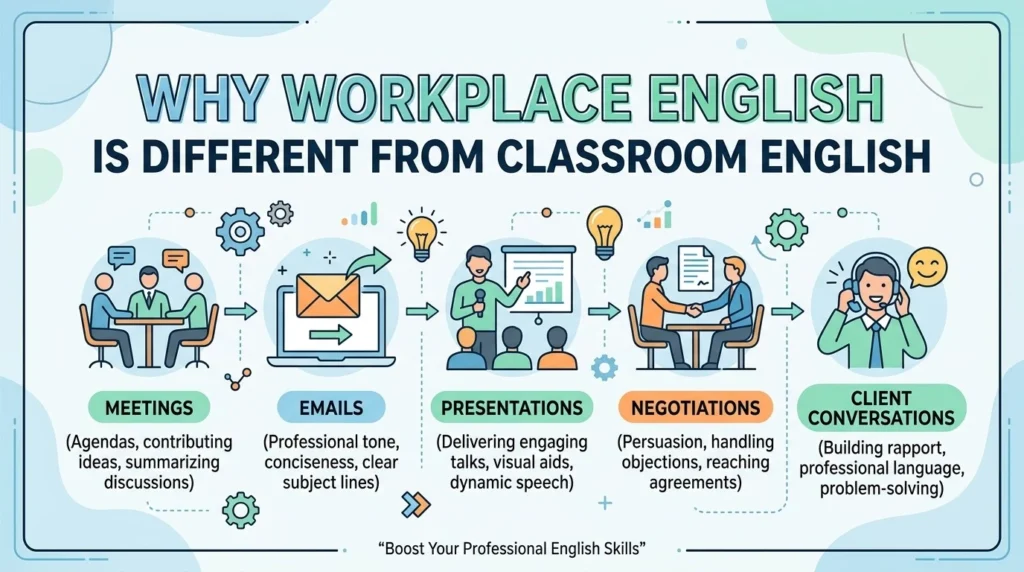
Meetings are one of the most common workplace situations where English is used. In a classroom, students may speak when asked. In meetings, professionals are expected to listen, contribute, clarify, question and sometimes challenge ideas.
Good meeting communication requires structure. Instead of speaking randomly, professionals need to make points clearly.
Useful workplace phrases include:
“Can I add a point here?”
“My understanding is that…”
“The key issue seems to be…”
“Could we clarify the next step?”
“I agree with the overall direction, but I have one concern.”
“To summarize, we have agreed on three actions.”
These phrases are part of practical English for Workplace Communication. They help professionals sound confident without being aggressive.
Meetings also require active listening. A good communicator does not only wait for their turn to speak. They listen carefully, connect ideas and respond to what others have said. This makes workplace communication more collaborative.
Emails: Clear, Polite and Action-Oriented
One major difference between classroom English and workplace English is email writing. In college, students may write essays or assignments. At work, they write emails every day.
Professional Email Writing Skills are important because emails create a written record. A confusing email can delay work. A rude email can damage relationships. A vague email can create misunderstanding.
A good workplace email should usually be clear, polite and action-oriented. It should answer three questions:
Why am I writing?
What information do I need to share?
What action is expected next?
For example, instead of writing:
“Please send the file soon.”
A more professional version would be:
“Could you please share the updated file by 4 p.m. today? We need to include it in the client presentation.”
This version gives a clear request, timeline and reason.
Professional emails often use phrases such as:
“Please find attached…”
“Could you please confirm…”
“I would appreciate your inputs on…”
“Following our discussion…”
“Kindly let me know if you need any clarification.”
“Looking forward to your response.”
These are simple but powerful parts of Corporate English Communication.
Presentations: From Information to Impact
In the classroom, presentations often test whether students understand a topic. In the workplace, presentations must do more. They may need to persuade, update, recommend, sell, explain or align people.
A classroom presentation may describe information. A workplace presentation must usually answer: “So what?”
For example, if you present sales data, it is not enough to say sales increased or decreased. You need to explain what it means, why it happened and what should be done next.
A good workplace presentation has:
A clear opening
A simple structure
Relevant data or examples
A point of view
A recommendation
A strong closing
This is where Professional English Communication Skills become visible. Professionals must speak with clarity, confidence and purpose. They must avoid reading every line from slides. They must connect with the audience and guide them through the message.
Strong presentation skills are especially important in English for International Business, where teams may include people from different countries and cultures. In such settings, simple and clear English is often more effective than complicated language.
Negotiations: Polite But Firm Communication
Negotiation is another area where workplace English differs from classroom English. Professionals may need to negotiate deadlines, budgets, salaries, responsibilities, client terms, vendor pricing or project expectations.
In negotiation, tone matters. Being too direct can sound rude. Being too soft can make you seem unsure. The goal is to be polite but firm.
Useful negotiation phrases include:
“We may need to revisit the timeline.”
“Would there be any flexibility on the pricing?”
“From our side, the main concern is…”
“Could we explore an alternative solution?”
“That may be difficult, but here is what we can offer.”
“Let us find a workable middle ground.”
These phrases help maintain respect while protecting one’s position. This is a key part of Workplace Communication Skills.
Negotiation is not about winning every argument. It is about reaching an outcome while keeping the professional relationship intact.
Client Conversations: Professionalism Under Pressure
Client conversations can be challenging because they often involve expectations, deadlines, feedback, complaints or decision-making. A professional may need to explain delays, present options, handle objections or respond to dissatisfaction.
In these moments, English must be calm and controlled.
For example, instead of saying:
“We cannot do that.”
A better workplace response would be:
“That may not be possible within the current timeline, but we can explore an alternative approach.”
Instead of saying:
“You misunderstood us.”
A more professional version would be:
“Let me clarify what we meant.”
Client communication requires patience, clarity and emotional control. It also requires the ability to simplify complex information. This is why English Communication in the Workplace is not just about language accuracy. It is about managing relationships.
Workplace English Is Often Shorter and Sharper
Students are often trained to write long answers in exams. At work, long communication is not always appreciated. Managers, clients and colleagues are busy. They value clarity and brevity.
In workplace English, a short, clear message is often better than a long, decorative one.
For example:
“Please review the attached proposal and share your feedback by Friday.”
This is better than:
“I am writing this email to request you to kindly go through the proposal document that has been attached herewith and let me know your valuable feedback at your earliest convenience.”
The second version may sound formal, but it is unnecessarily heavy. Professional English should be clear, modern and efficient.
This is a key principle of Business English Training: say what matters, in the right tone, without wasting the reader’s time.
Cross-Cultural Workplace English
In international workplaces, English is often used by people from many language backgrounds. This makes clarity even more important.
In English for International Business, professionals must avoid slang, unclear idioms and overly local expressions. They must speak in a way that global colleagues can understand.
For example, phrases such as “Let’s circle back,” “touch base,” or “move the needle” may be common in some offices, but they can confuse people who are not familiar with corporate idioms. Simple alternatives are often better:
“Let’s discuss this again later.”
“Let’s reconnect tomorrow.”
“Let’s focus on improving results.”
Good workplace English is inclusive. It helps everyone participate.
Why Business English Training Helps Professionals
Many people have good general English but still struggle at work. They may not know how to write a professional email, speak in meetings, present ideas or respond to clients.
Business English Training helps bridge this gap. It focuses on real professional situations, not just textbook exercises. It can help learners practise:
Emails
Meetings
Presentations
Client calls
Negotiations
Interviews
Reports
Professional vocabulary
Workplace tone
Cross-cultural communication
The goal is to build Professional English Communication Skills that help people perform better in real workplaces.
How Students Can Start Building Workplace English
Students do not need to wait until they get a job to build workplace English. They can begin early.
They can practise writing short professional emails. They can summarize articles in a business-like style. They can record one-minute project updates. They can practise introducing themselves professionally. They can join mock meetings or group discussions. They can learn workplace vocabulary such as deadline, update, feedback, deliverable, approval, agenda, minutes, stakeholder and follow-up.
They can also watch interviews, business presentations and workplace conversations to understand tone and structure.
The more students practise English for Workplace Communication, the smoother their transition from classroom to career will be.
Final Thought
Classroom English teaches the language. Workplace English teaches how to use the language with purpose. Both are important, but they serve different needs.
In the classroom, English helps students learn and pass exams. At work, English helps professionals build trust, solve problems, manage relationships, present ideas and grow in their careers.
Understanding Business English vs General English is the first step. The next step is practice. Meetings, emails, presentations, negotiations and client conversations all require a different kind of confidence.
For students, job seekers and working professionals, strong Workplace Communication Skills can become a major career advantage. Because in the professional world, good English is not just about speaking correctly. It is about communicating clearly, respectfully and effectively when it matters most.
FAQs
1. What is the difference between Business English and General English?
Business English vs General English is mainly about purpose. General English is used for everyday communication, while Business English is used in professional situations such as meetings, emails, presentations, negotiations and client conversations.
2. Why are Workplace Communication Skills important?
Workplace Communication Skills are important because they help professionals share ideas clearly, write better emails, participate in meetings, handle clients, negotiate effectively and work well with teams.
3. What does Business English Training include?
Business English Training usually includes professional email writing, meeting communication, presentation skills, workplace vocabulary, negotiation language, client communication and cross-cultural business communication.
4. How can students improve Professional English Communication Skills?
Students can improve Professional English Communication Skills by practising workplace emails, mock meetings, presentations, professional introductions, business vocabulary and real workplace scenarios before entering the job market.
5. Why is English important for international business?
English for International Business is important because global teams, clients and companies often use English as a common working language. Clear English helps avoid misunderstanding, build trust and support professional collaboration.




Leave a Reply