

For many nurses, doctors and allied healthcare professionals, a career abroad is not just a dream. It is a practical route to better clinical exposure, stronger income, improved quality of life and long-term professional growth. Across many countries, healthcare systems continue to need skilled professionals who can step into hospitals, clinics, care homes, community health settings and specialist medical roles.
But international healthcare careers do not depend only on qualifications and experience. To work safely in another country, healthcare professionals must also prove that they can communicate clearly in English. In a medical environment, language is not a soft skill. It is a patient safety skill.
This is where OET matters.
OET, or the Occupational English Test, is an English language test designed specifically for healthcare professionals. Unlike general English tests, OET uses healthcare scenarios, medical vocabulary and real clinical communication situations. For nurses, doctors, pharmacists, physiotherapists, radiographers and other allied health professionals, this makes the test highly relevant to their work abroad goals.
Read More: English Scores and Employability: What Recruiters and Institutions Look For?
Why English Communication Matters in Healthcare Jobs Abroad
When healthcare professionals move across borders, they enter a new system of care. They must speak with patients, understand doctors’ instructions, write clinical notes, explain treatment plans, reassure anxious families and coordinate with multidisciplinary teams.
A nurse may need to explain medication instructions to an elderly patient. A doctor may need to take a clear case history from someone in pain. A physiotherapist may need to guide a patient through rehabilitation exercises. A pharmacist may need to explain dosage, side effects and contraindications.
In all these situations, poor communication can create risk. This is why regulators and employers take English proficiency seriously. For healthcare jobs abroad, language ability is connected to safe practice, professional confidence and patient trust.
General tests such as IELTS, PTE and TOEFL can assess English ability well. However, OET for medical professionals has a stronger healthcare focus. It asks a practical question: can this professional communicate safely and effectively in a medical setting?

OET for Nurses: Why It Feels More Relevant
For many internationally trained nurses, OET feels more directly connected to real work than a general test. OET for nurses includes tasks based on nursing communication, patient care, discharge advice, case notes and workplace interactions.
In the speaking test, the nurse takes the professional role while the interlocutor plays a patient, relative or caregiver. This mirrors everyday nursing conversations. The nurse may need to explain a procedure, calm a worried patient, encourage lifestyle changes or clarify medication instructions.
This is one reason many candidates search for OET vs IELTS for nurses. IELTS is widely accepted and respected, but it is a general academic or general training test. A nurse preparing for IELTS may have to write about education, environment, technology or society. In OET, the same nurse prepares through healthcare communication.
That does not mean OET is automatically easy. The required standard is still high. But the context is familiar. For nurses, that familiarity can reduce anxiety and make preparation feel more meaningful.
OET for Doctors and Allied Healthcare Professionals
OET for doctors is equally relevant because medical communication is highly specific. Doctors must ask the right questions, explain diagnoses, discuss risks, obtain consent, and respond to patient concerns. The OET speaking test helps doctors practise this kind of structured, empathetic communication.
OET preparation for doctors should therefore focus not only on grammar and vocabulary, but also on consultation skills. Doctors need to practise opening a consultation, gathering information, explaining medical terms in simple language, checking understanding and closing the conversation professionally.
The same principle applies to dentists, pharmacists, physiotherapists and other allied healthcare workers. Each profession has different communication demands. OET recognizes this by offering profession-specific versions. That is why OET for medical professionals is not just an English exam; it is also a rehearsal for real workplace communication.
OET vs IELTS for Nurses: Which One Should You Choose?
The comparison between OET vs IELTS for nurses is one of the most common questions among healthcare candidates.
IELTS for healthcare professionals is still accepted by many regulators and institutions. It is a strong test of English ability and is recognized globally. However, IELTS is not healthcare-specific. Its writing and speaking tasks may involve general social, academic or workplace themes.
OET, on the other hand, is built around healthcare situations. The writing task usually requires a professional healthcare letter, such as a referral, discharge or transfer letter. The speaking task is based on professional role plays. Listening and reading also use healthcare-related content.
For nurses, OET may feel more natural because the topics match clinical reality. IELTS may be suitable for candidates who are comfortable with broader academic English and want a widely recognized general test. The right choice depends on the destination country, regulator requirements, personal strengths and timeline.
Before choosing, candidates should always check the latest rules of the nursing board, medical council or immigration authority they are applying to.
PTE vs OET and TOEFL vs OET
Candidates also compare PTE vs OET and TOEFL vs OET.
PTE is computer-based and uses automated scoring. It tests speaking, writing, reading and listening through integrated tasks. For some candidates, PTE feels attractive because of fast results and a digital format. However, it is not healthcare-specific. A nurse or doctor may still need to prepare for general academic English rather than clinical communication.
TOEFL is especially popular for academic admissions, particularly in the United States. It is strong for university contexts and tests academic reading, listening, speaking and writing. But when comparing TOEFL vs OET for healthcare migration, OET is usually more relevant to clinical practice because it tests healthcare communication.
The issue is not whether PTE, TOEFL or IELTS are good tests. They are established English tests. The issue is fit. For healthcare professionals whose goal is registration, migration or employment in a medical environment, OET often feels closer to the language they will actually use.
OET Accepted Countries and Global Mobility
One of the reasons OET matters is its recognition across many healthcare systems. OET is recognized by more than 400 organizations for purposes such as work, study, registration and visas, according to the official OET recognition information. Candidates should still verify the latest requirements directly with the relevant regulator, because accepted scores and policies can change. (oet.com)
Popular OET accepted countries commonly include the UK, Ireland, Australia, New Zealand, Singapore, the UAE, the United States and Canada, depending on the profession and regulatory body. For example, the UK Nursing and Midwifery Council accepts OET for nursing applicants and specifies required grades for different sub-tests. (Nursing & Midwifery Council)
For nurses, searches around OET accepted countries for nurses are especially important because each nursing board can have different score requirements, validity rules and application procedures. A country may accept OET, but the exact score required for registration may differ by profession.
OET for Healthcare Jobs in UAE
The UAE is an attractive destination for many healthcare professionals because of its hospitals, private healthcare growth and international workforce. Candidates often search for OET for healthcare jobs in UAE when planning careers in Dubai, Abu Dhabi or other Emirates.
The important point is that licensing rules can vary across authorities and roles. A healthcare professional may need to meet the requirements of bodies such as DHA, DOH or MOH, depending on where they plan to practise. OET may be accepted in certain healthcare pathways, but candidates should always confirm the latest English test requirement with the relevant licensing authority, employer or recruiter before booking the exam.
For nurses and doctors considering the UAE, OET preparation should focus on practical patient-facing communication: explaining procedures, giving discharge advice, understanding symptoms and documenting clinical information clearly.
OET Preparation for Nurses and Doctors
A strong plan for OET preparation for nurses or doctors should be practical and consistent. The exam has four sub-tests: Listening, Reading, Writing and Speaking. Each needs a slightly different preparation approach.
For Listening, candidates should practise following patient consultations, handovers, healthcare talks and professional discussions. The challenge is not only understanding English, but identifying important clinical information quickly.
For Reading, candidates should practise medical guidelines, research extracts, patient information leaflets and healthcare policies. They need to skim quickly, scan for specific details and understand professional meaning.
For Writing, candidates should practise selecting relevant information from case notes. Many candidates include too much information or miss the purpose of the letter. The key is to write clearly for the reader, whether the letter is for a doctor, nurse, specialist, community health worker or other professional.
For Speaking, candidates should practise role plays. They should learn to ask open questions, show empathy, explain in simple language, check understanding and close the conversation properly.
OET preparation for doctors should include consultation structure. OET preparation for nurses should include patient reassurance, care instructions, medication guidance and discharge communication.
The Role of OET Coaching in India
Many candidates look for OET coaching in India because they want structured guidance, feedback and practice. This can be useful, especially for candidates who have been away from formal English learning for many years or those who have attempted the test before without success.
Good coaching should not only give templates. It should help candidates understand assessment criteria, improve clinical communication, practise writing letters, handle role plays and take mock tests. For healthcare professionals with busy schedules, a structured preparation plan can save time and reduce repeated attempts.
However, coaching alone is not enough. Candidates must practise regularly. OET rewards clear, safe and professional communication. That comes from repeated exposure to real healthcare language.
Why OET Builds More Than Exam Readiness
The biggest advantage of OET is that preparation supports real career readiness. When a nurse practises explaining wound care to a patient, that skill is useful beyond the exam. When a doctor practises simplifying a diagnosis, that improves patient communication. When a physiotherapist practises giving exercise instructions, that helps future workplace performance.
In this sense, OET connects language learning with clinical purpose. It prepares candidates not only to pass an English test, but also to enter international healthcare careers with greater confidence.
For professionals aiming for healthcare jobs abroad, this matters. Employers and regulators want people who can work safely, communicate respectfully and adapt to new healthcare systems.

Final Thought
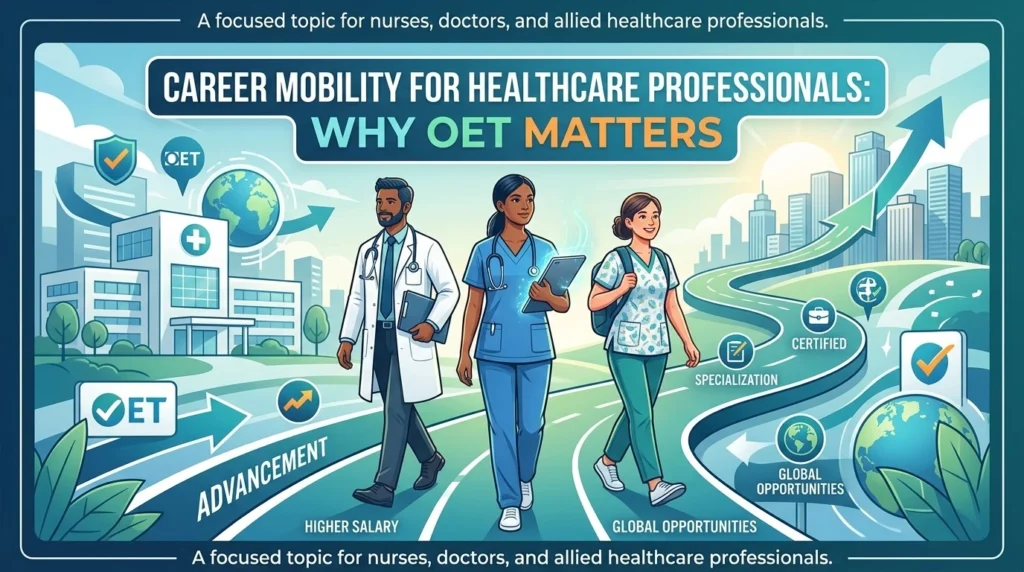
Career mobility for healthcare professionals is expanding, but global opportunity comes with responsibility. Nurses, doctors and allied healthcare workers need more than clinical knowledge. They need the communication ability to practise safely in another country.
OET matters because it understands the healthcare context. It speaks the language of hospitals, patients, case notes, referrals and consultations. For many candidates, it offers a more relevant pathway than general English tests.
Whether you are comparing OET vs IELTS for nurses, PTE vs OET, or TOEFL vs OET, the key question is simple: which test best supports your destination, profession and career goal?
For many healthcare professionals, the answer is OET—because it prepares them not only for migration, but for meaningful, confident and safe clinical practice abroad.
FAQs
1. Is OET better than IELTS for nurses?
OET vs IELTS for nurses depends on the destination country and regulator. IELTS for healthcare professionals is widely accepted, but OET for nurses is more healthcare-specific. Many nurses prefer OET because the speaking and writing tasks are based on real nursing situations.
2. What are the main OET accepted countries for nurses?
OET accepted countries for nurses commonly include the UK, Ireland, Australia, New Zealand, Singapore, the UAE, the USA and Canada, depending on the specific regulator. Candidates should always check the latest requirements with the relevant nursing board before applying.
3. How should doctors prepare for OET?
OET preparation for doctors should include medical listening practice, healthcare reading, referral or discharge letter writing, and speaking role plays. Doctors should especially practise consultation language, patient reassurance, explaining diagnoses and checking patient understanding.
4. What is the difference between PTE vs OET?
PTE vs OET is mainly a question of format and relevance. PTE is a computer-based general academic English test with automated scoring. OET is designed specifically for healthcare professionals and uses medical scenarios in writing, speaking, reading and listening.
5. Is TOEFL useful for healthcare professionals, or is OET better?
TOEFL is useful for academic admissions and is widely used by universities. However, when comparing TOEFL vs OET for healthcare jobs abroad, OET is usually more relevant because it tests communication in clinical and patient-care contexts.




Leave a Reply