
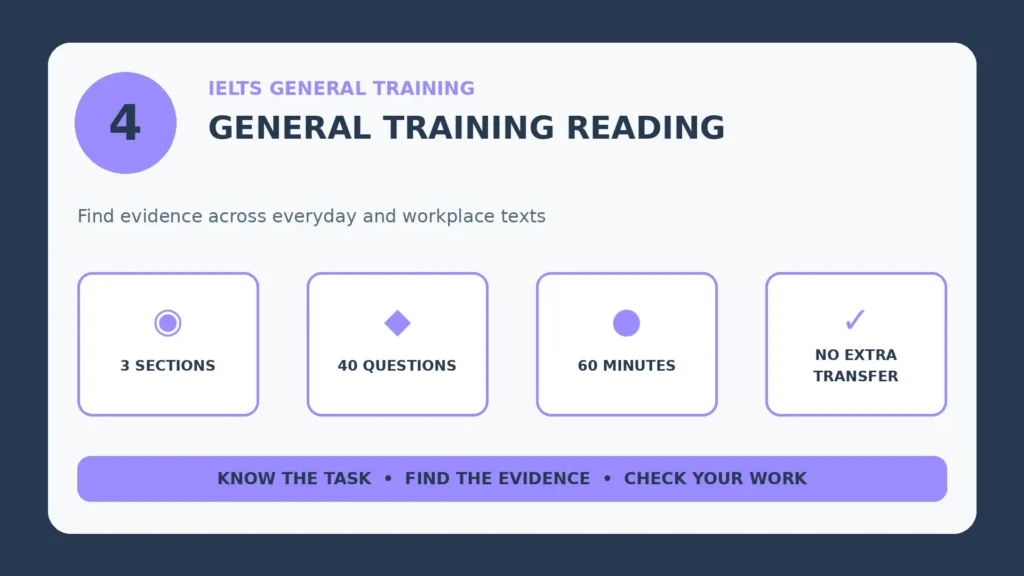
Find evidence across everyday and workplace texts
General Training Reading lasts 60 minutes and includes three sections, 40 questions and approximately 2,150–2,750 words in total. Transfer time is included, so paper-test candidates must place answers on the answer sheet within the hour. Every correct answer earns one raw mark before conversion to the nine-band scale.
Section 1 uses short everyday texts such as advertisements, notices and timetables. Section 2 focuses on workplace material, including policies, job descriptions, contracts or training information. Section 3 contains one longer, more complex general-interest text. The progression means candidates must move from locating practical facts to following extended arguments and detail.
Read More: Listening: Four Parts, One Recording
Do not read every text at the same speed. First identify the text type, purpose and structure. Scan for names, dates, prices or headings when a question requests a specific fact. Read closely around the evidence when meaning, inference or the writer’s view is tested. Efficient reading is controlled variation, not frantic skimming.
Treat True/False/Not Given carefully. True agrees with the text, False contradicts it, and Not Given means the text does not provide enough information. Personal knowledge is irrelevant. For matching headings, identify the main purpose of the whole paragraph rather than choosing a heading because it repeats one word.
Completion tasks demand exact attention to instructions. Check the permitted number of words, grammar of the gap, spelling and whether words must come from the passage. In multiple choice, prove the selected option with evidence and reject attractive alternatives that are only partly true or answer a different question.
Time should be planned but adjusted by evidence. Many candidates reserve more minutes for Section 3, yet an unusual early task can still consume too much. Practise checkpoints, move on from a stubborn question and return if time remains. Review slow correct answers: hesitation often reveals a skill that may fail under greater pressure.
A practical preparation method
Begin with an official-format diagnostic under time limits. Record the score, but also classify every weak answer: misunderstood instruction, vocabulary gap, lost place, inaccurate spelling, poor evidence, incomplete development or time pressure. For Writing and Speaking, save dated samples and assess them against the public band criteria. A precise error log is more useful than a vague promise to “practise more.”
Use five focused sessions each week. A balanced pattern is one Listening session, one Reading session, two productive-skill sessions and one mixed timed block. Keep vocabulary and grammar review short but frequent. Learn words in collocations and complete examples, then use them in a letter, essay or spoken answer. The purpose is flexible control, not displaying rare words.
Review correct answers that were slow or uncertain as well as wrong answers. In Listening and Reading, locate the evidence and explain why alternatives fail. In Writing, check task fulfilment first, then organisation, vocabulary and grammar. In Speaking, listen for relevance, development, fluency and intelligibility. Improve one recurring weakness, repeat a similar task, and confirm that the correction survives under time pressure.
Each week, complete one realistic simulation using the delivery mode you intend to book. Practise transferring or entering answers correctly, obey exact word limits in completion questions and leave time for checks. During the final week, revisit proven routines rather than collecting new tricks. Protect sleep, confirm identification and appointment details, and treat official IELTS guidance as the authority whenever advice conflicts.

Track progress with evidence rather than mood. Compare raw marks, completion rates, repeated error categories and dated productive samples. A difficult practice day can still be valuable when it exposes one correctable pattern and produces a clear action for the next session.
Quick FAQ
Do I need unusual vocabulary for a high band?
No. Accurate, appropriate and flexible language is more valuable than forced complexity.
Can one strong skill compensate for every weakness?
The overall band is averaged, but many organisations also impose minimum scores in individual skills. Check the exact requirement.
Should I memorise answers?
Memorised language may not address the prompt and can sound unnatural. Practise adaptable structures and genuine development instead.