
Predict, follow and record exact answers
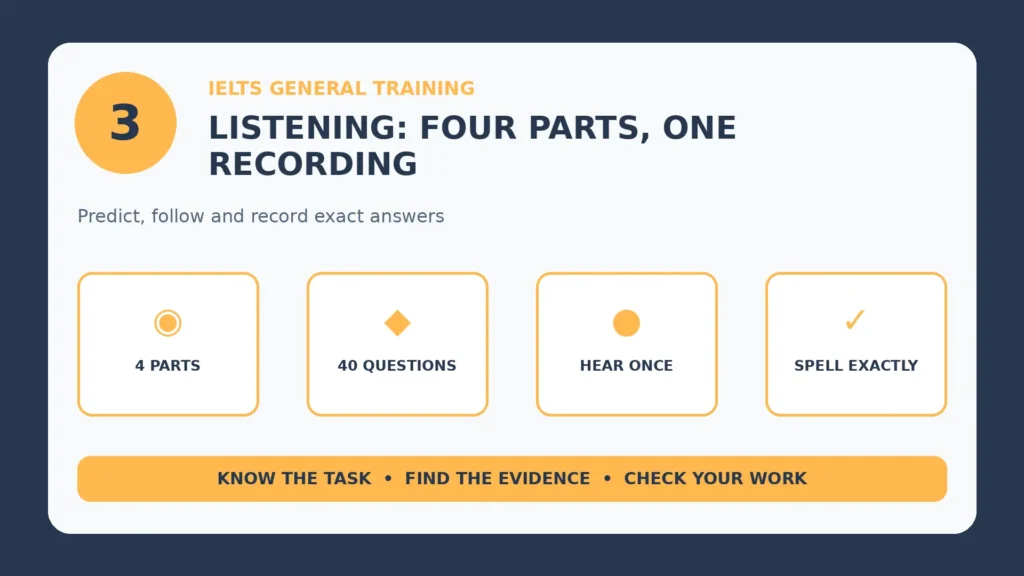
IELTS Listening contains four parts with ten questions each. Questions follow the order of information in the recording, an important advantage when maintaining your place. The contexts move from everyday social exchanges to educational or training situations, including conversations and monologues. Listening is the same for Academic and General Training candidates.
Use the preview time actively. Read the instruction, note the maximum number of words or numbers, underline key ideas and predict the grammatical form of the answer. A blank after an article may require a noun; a timetable may require a time; a map task requires location language. Prediction prepares attention but must remain flexible.
Read More: General Training Reading
Expect paraphrase rather than identical wording. The question may say “cost,” while the speaker says “fee”; the prompt may mention a postponement, while the recording says an event has been “put back.” Train by building pairs of equivalent expressions and noticing contrast signals, corrections and changes of mind.
If an answer is missed, move forward immediately. Questions remain in order, so chasing one lost answer can sacrifice several later marks. Mark the gap, reconnect using the next keyword and make a reasoned attempt when checking. Avoid allowing frustration to continue into the next part.
Accuracy includes spelling, plural endings and compliance with the word limit. An idea understood correctly can still lose the mark if the written form is wrong. Practise common names, numbers, dates and letter sequences, and copy answers carefully in the correct delivery mode.
For review, replay only after completing the task. Identify the exact moment of failure and classify it as sound recognition, vocabulary, distractor, lost attention, prediction error or answer-form error. Then use the transcript to study the phrase, close it and listen once more. Short, precise correction trains the ear more effectively than hours of passive background listening.
A practical preparation method
Begin with an official-format diagnostic under time limits. Record the score, but also classify every weak answer: misunderstood instruction, vocabulary gap, lost place, inaccurate spelling, poor evidence, incomplete development or time pressure. For Writing and Speaking, save dated samples and assess them against the public band criteria. A precise error log is more useful than a vague promise to “practise more.”
Use five focused sessions each week. A balanced pattern is one Listening session, one Reading session, two productive-skill sessions and one mixed timed block. Keep vocabulary and grammar review short but frequent. Learn words in collocations and complete examples, then use them in a letter, essay or spoken answer. The purpose is flexible control, not displaying rare words.
Review correct answers that were slow or uncertain as well as wrong answers. In Listening and Reading, locate the evidence and explain why alternatives fail. In Writing, check task fulfilment first, then organisation, vocabulary and grammar. In Speaking, listen for relevance, development, fluency and intelligibility. Improve one recurring weakness, repeat a similar task, and confirm that the correction survives under time pressure.
Each week, complete one realistic simulation using the delivery mode you intend to book. Practise transferring or entering answers correctly, obey exact word limits in completion questions and leave time for checks. During the final week, revisit proven routines rather than collecting new tricks. Protect sleep, confirm identification and appointment details, and treat official IELTS guidance as the authority whenever advice conflicts.

Track progress with evidence rather than mood. Compare raw marks, completion rates, repeated error categories and dated productive samples. A difficult practice day can still be valuable when it exposes one correctable pattern and produces a clear action for the next session.
Quick FAQ
Do I need unusual vocabulary for a high band?
No. Accurate, appropriate and flexible language is more valuable than forced complexity.
Can one strong skill compensate for every weakness?
The overall band is averaged, but many organisations also impose minimum scores in individual skills. Check the exact requirement.
Should I memorise answers?
Memorised language may not address the prompt and can sound unnatural. Practise adaptable structures and genuine development instead.