
The IELTS band score system can feel confusing at first, especially if you are preparing for the test for university admission, migration, professional registration, or work abroad. But once you understand how the scores are organised, the system becomes much easier to follow.
IELTS does not give a simple pass or fail result. Instead, it gives you a band score from 0 to 9. This score shows your level of English ability. You receive a separate score for each of the four skills: Listening, Reading, Writing, and Speaking. You also receive an Overall Band Score, which is calculated from those four results.
Read More: IELTS Academic vs IELTS General Training: Which Test Should You Take?
What Do IELTS Band Scores Mean?
Each IELTS band describes a different level of English ability.
| Band Score | Meaning | Simple Explanation |
| ———- | ———————- | ————————————————————————————— |
| Band 9 | Expert user | You use English very accurately and fluently. |
| Band 8 | Very good user | You handle complex English well, with only occasional mistakes. |
| Band 7 | Good user | You communicate effectively, though some errors may appear. |
| Band 6 | Competent user | You understand and use English in familiar situations, but errors are more noticeable. |
| Band 5 | Modest user | You can communicate in basic situations but may struggle with detail and accuracy. |
| Band 4 | Limited user | You understand simple English but have frequent problems with communication. |
| Band 3 | Extremely limited user | You can communicate only in very familiar situations. |
| Band 2 | Intermittent user | You have great difficulty understanding spoken and written English. |
| Band 1 | Non-user | You can use only a few isolated words. |
| Band 0 | Did not attempt | No assessable test performance was given. |
Most universities and employers ask for scores between **Band 6.0 and Band 7.5**, depending on the course, country, visa route, or profession. Some healthcare, law, teaching, and postgraduate programmes may require higher scores in specific sections, not just a high overall result.
Your Four IELTS Section Scores
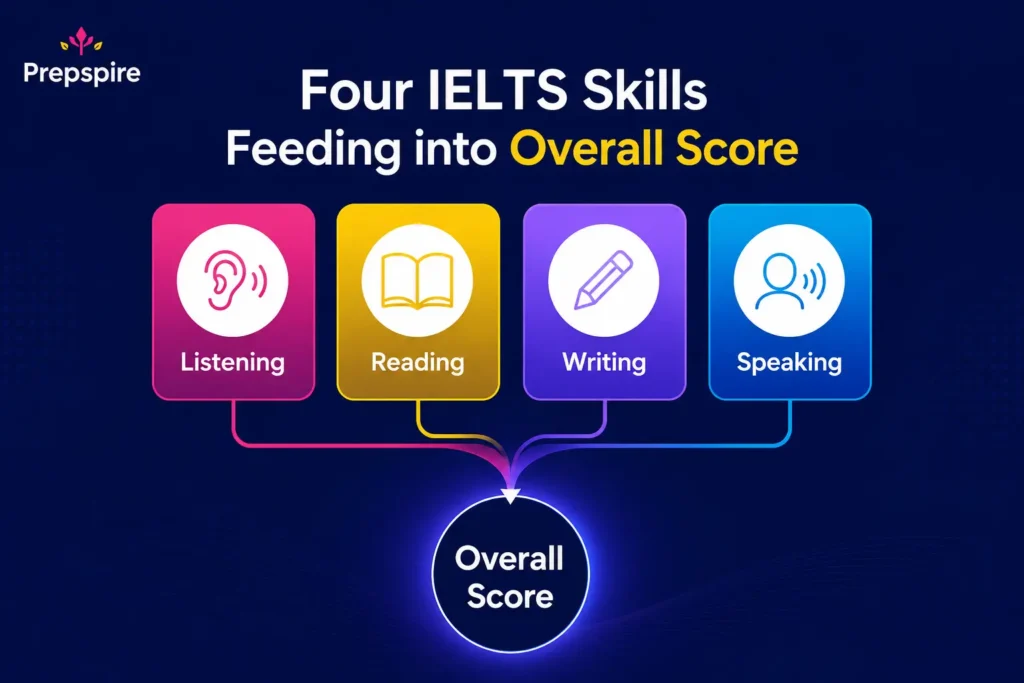
IELTS tests four language skills:
1. Listening
2. Reading
3. Writing
4. Speaking
Each skill receives its own band score. For example, a student might receive:
| Skill | Band Score |
| ——— | ———- |
| Listening | 7.0 |
| Reading | 6.5 |
| Writing | 6.0 |
| Speaking | 7.0 |
These individual scores are important because many institutions set minimum section requirements. For example, a university might ask for an overall score of 6.5, with no section below 6.0. This means a strong Speaking score cannot always compensate for a low Writing score.
How Listening and Reading Are Scored
The Listening and Reading tests each contain 40 questions. You get one mark for each correct answer. There is no penalty for a wrong answer, so you should always attempt every question.
Your raw score out of 40 is converted into an IELTS band score. The exact conversion can vary slightly between tests because some test versions may be a little harder or easier. However, the principle is simple: the more correct answers you get, the higher your band score.
How Writing and Speaking Are Scored
Writing and Speaking are assessed differently because they involve producing language.
In Writing, examiners look at things such as task response, organisation, vocabulary, grammar, and accuracy. In Task 1, you must answer the question clearly and describe the information accurately. In Task 2, you must present a clear argument with relevant ideas and examples.
In Speaking, examiners assess fluency, pronunciation, vocabulary, grammar, and how naturally you communicate. You do not need to sound like a native speaker, but you do need to speak clearly, extend your answers, and show control of English.
How the Overall IELTS Band Score Is Calculated
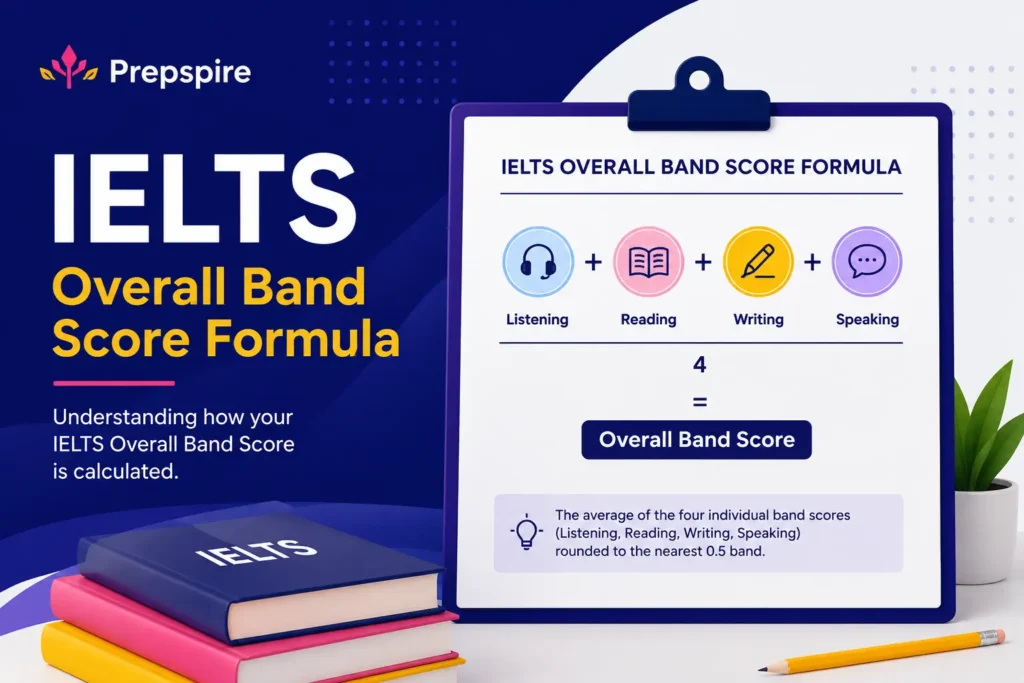
Your Overall Band Score is the average of your four skill scores:
Overall Score = Listening + Reading + Writing + Speaking ÷ 4
For example:
| Skill | Score |
| ——— | —– |
| Listening | 7.0 |
| Reading | 6.5 |
| Writing | 6.0 |
| Speaking | 7.0 |
Calculation:
7.0 + 6.5 + 6.0 + 7.0 = 26.5
26.5 ÷ 4 = 6.625
This score is then rounded to the nearest whole or half band. So, 6.625 becomes 6.5.
Here is another example:
| Skill | Score |
| ——— | —– |
| Listening | 6.5 |
| Reading | 6.5 |
| Writing | 5.0 |
| Speaking | 7.0 |
Calculation:
6.5 + 6.5 + 5.0 + 7.0 = 25.0
25.0 ÷ 4 = 6.25
Because .25 is rounded up, the overall band score becomes 6.5.
Why Half Bands Matter
IELTS scores can be given as whole bands, such as 6.0 or 7.0, and half bands, such as 6.5 or 7.5. A half band can make a big difference. For example, many universities accept **6.5 overall**, but not **6.0 overall**. Some visa or professional bodies may also require exact minimum scores in each section.
That is why IELTS preparation should not focus only on “passing”. It should focus on reaching the exact band score required for your goal.

Final Advice for Test Takers
Before preparing for IELTS, check the score requirement for your university, employer, visa route, or professional body. Look carefully at both the overall score and the minimum score for each skill.
A balanced score is usually safer than one very high score and one weak score. For example, Listening 8.0 and Speaking 8.0 are impressive, but if Writing is 5.5 and your course requires 6.5 in Writing, you may still not meet the requirement.
The IELTS band score system is not just a number. It is a map of your English ability. Once you understand how it works, you can prepare more strategically, focus on your weakest skills, and move closer to the score you need.