
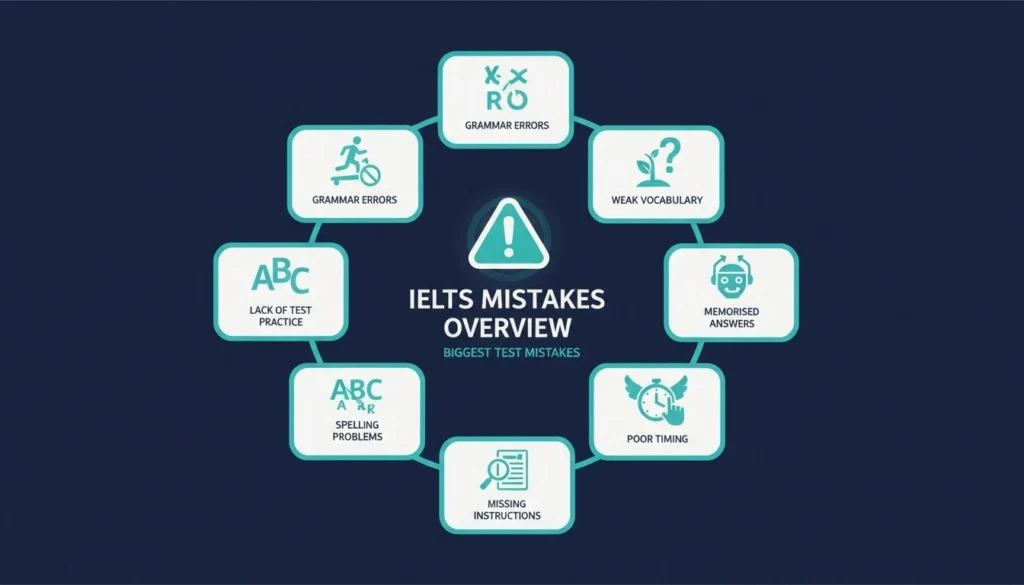
Many IELTS test takers work hard but still lose marks because of avoidable mistakes. IELTS is not only a test of English knowledge. It is also a test of accuracy, timing, strategy, and awareness of instructions. A student may understand English quite well but still receive a lower band score if they write too little, miss a word limit, repeat memorised answers, or run out of time.
The good news is that most IELTS mistakes can be fixed with focused practice. This article explains the most common IELTS errors and how to avoid them.
Read More: IELTS Academic vs IELTS General Training: Which Test Should You Take?
1. Grammar Errors That Reduce Clarity
Grammar mistakes are common in Writing and Speaking. Some small mistakes are normal, but repeated errors can make your meaning unclear and lower your score.
Common grammar problems include:
– Incorrect verb tenses
– Missing articles such as a, an, and the
– Subject–verb agreement errors
– Incorrect plural forms
– Sentence fragments
– Overly long sentences with poor punctuation
For example:
Incorrect: Many student wants study abroad.
Correct: Many students want to study abroad.
Incorrect: Technology is improve our life.
Correct: Technology is improving our lives.
To improve, do not only study grammar rules. Practise using grammar in real IELTS-style sentences. After writing an essay, check one grammar area at a time. First check verbs, then articles, then plurals. This is more effective than trying to find every mistake at once.
2. Weak or Repetitive Vocabulary
Some candidates repeat the same basic words again and again. For example, in an essay about education, they may use students, school, good, and important too often.
A stronger vocabulary range helps you express ideas more precisely. However, this does not mean using difficult words just to impress the examiner. If a word is unnatural or used incorrectly, it can reduce your score.
Weak sentence:
Education is very important for students because it helps students get good jobs.
Improved sentence:
Education plays an important role in helping young people develop skills and access better career opportunities.
Build vocabulary by topic. Useful IELTS themes include education, technology, health, environment, work, transport, culture, and society. Learn word families as well. For example: **develop, development, developed, developing.
3. Memorised Answers
Memorising full answers is one of the biggest IELTS traps. Many students memorise essays, speaking responses, or “high-band” phrases from the internet. The problem is that memorised answers often do not fit the exact question.
In Speaking, memorised answers can sound unnatural. The examiner may notice that the answer does not directly respond to the question. In Writing, memorised paragraphs can make the essay feel mechanical and irrelevant.
Instead of memorising full answers, learn flexible structures. For example, in Speaking, use:
Answer + Reason + Example + Extra detail
In Writing Task 2, use:
Point + Explanation + Example + Link
These structures help you create fresh answers for different questions.
4. Poor Time Management
IELTS is a timed test, and poor timing can seriously affect your score.
In Reading, many candidates spend too long on one difficult question and then rush the final passage. In Writing, some spend 30 minutes on Task 1 and leave too little time for Task 2. In Listening, some candidates keep thinking about a missed answer and then miss the next one.
A simple Writing time plan is:
| Writing Section | Suggested Time |
| ————— | ————– |
| Task 1 | 20 minutes |
| Task 2 | 40 minutes |
For Reading, practise completing three passages in 60 minutes. Do not pause the timer during practice. Your brain needs to become comfortable working under test conditions.
5. Missing or Misreading Instructions
Many IELTS marks are lost because students do not follow instructions carefully.
In Listening and Reading, instructions may say:
NO MORE THAN ONE WORD
NO MORE THAN TWO WORDS AND/OR A NUMBER
Choose TWO letters
Write TRUE, FALSE, or NOT GIVEN
If the answer is longer than the word limit, it is wrong, even if the information is correct.
For example, if the instruction says NO MORE THAN ONE WORD and the correct idea is **public transport**, you cannot write both words. You must check whether the answer should be transport or another single word from the passage or recording.
Always read instructions before answering. Underline the word limit and question type.
6. Spelling Problems
Spelling is especially important in Listening and Reading because answers must be written accurately. A misspelled answer may be marked wrong.
Common spelling problem areas include:
– Double letters: accommodation, successful, necessary
– Similar sounds: fifteen / fifty
– Names and places
– Plurals: book / books
– British and American spelling variations
– Hyphenated words
Create a personal spelling list from your mistakes. Review it every day for five minutes. This is simple but very powerful.
7. Not Enough Real Test Practice
Some students study vocabulary and grammar for months but do not practise full IELTS tests. This creates a problem because the real exam requires stamina, speed, and strategy.
You should practise each skill separately, but you also need full timed practice. This helps you understand your real level and identify weak areas.
A useful weekly plan could include:
| Day | Practice Focus |
| ——— | ————————– |
| Monday | Listening section practice |
| Tuesday | Reading passage practice |
| Wednesday | Writing Task 1 |
| Thursday | Writing Task 2 |
| Friday | Speaking practice |
| Weekend | Full timed test and review |
Practice is only useful if you review your mistakes. Do not simply check your score and move on. Ask: Why was this answer wrong? Was it grammar, vocabulary, timing, spelling, or misunderstanding?

Final Advice
IELTS success comes from avoiding repeated mistakes. Improve your grammar, build topic vocabulary, avoid memorised answers, manage your time, follow instructions, check spelling, and practise under real test conditions.
Small improvements can make a big difference. A student who fixes spelling errors, manages time better, and writes clearer paragraphs may improve faster than someone who only learns difficult vocabulary. IELTS rewards clear communication, accurate language, and smart test strategy.