The IELTS Reading test is not only a test of English vocabulary. It is also a test of strategy, speed, focus, and accuracy. Many test takers understand the passage but still lose marks because they read too slowly, miss keywords, misunderstand paraphrases, or spend too much time on one difficult question.
Whether you are taking IELTS Academic or IELTS General Training, the Reading test lasts 60 minutes and contains 40 questions. You do not get extra time, so you must write your answers within the hour. To improve your score, you need to use the right reading method for each question type.
Read More: IELTS Academic vs IELTS General Training: Which Test Should You Take?
1. Skimming: Understand the Main Idea Quickly
Skimming means reading quickly to understand the general meaning of a text. You are not trying to understand every word. You are looking for the topic, structure, and main ideas.
When you skim an IELTS passage, look at:
– The title
– The first paragraph
– The first sentence of each paragraph
– Repeated words or themes
– The final paragraph
Skimming is useful before answering detailed questions because it gives you a mental map of the passage. For example, you may notice that Paragraph A introduces the topic, Paragraph B explains a problem, Paragraph C gives research evidence, and Paragraph D discusses solutions.
This helps you know where to return when answering questions.
2. Scanning: Find Specific Information Fast
Scanning means searching for a specific word, number, name, date, place, or idea. You do not read the whole paragraph carefully at first. Instead, your eyes move quickly across the text to locate the information you need.
Scanning is especially useful for questions involving:
– Dates
– Names of people
– Places
– Numbers or percentages
– Scientific terms
– Capital letters
– Specific nouns
For example, if a question asks about “Professor Helen Carter,” scan the passage for “Helen Carter,” “Carter,” or “Professor.” Once you find the correct area, then read the surrounding sentence carefully.
3. Keyword Matching: Connect the Question to the Passage
Many IELTS Reading questions contain keywords that help you find the answer. A keyword may be a name, concept, object, action, or phrase.
For example, in the question:
What caused the decline in bee populations?
The keywords are caused, decline, and **bee populations**.
However, IELTS often does not repeat the exact same words in the passage. The passage may say:
**The number of bees fell sharply because of pesticide use.
Here, “decline” matches “fell sharply,” and “caused” matches “because of.” This is why keyword matching must be combined with paraphrasing.
4. Paraphrasing: The Skill Behind High Scores
Paraphrasing means expressing the same idea using different words. IELTS Reading tests this skill again and again. Many wrong answers happen because students search only for exact words from the question.
Here are common paraphrase patterns:
| Question Word | Passage Paraphrase |
| ————- | ———————————- |
| increase | rise, grow, expand |
| decrease | fall, decline, reduce |
| problem | issue, difficulty, challenge |
| many | numerous, a large number of |
| important | significant, essential, key |
| caused by | due to, because of, as a result of |
To improve, practise building synonym lists while reading. Also remember that paraphrasing can involve grammar changes, not just vocabulary changes. For example, “the government introduced new laws” may become “new laws were introduced by the government.”
5. Time Management: Do Not Let One Question Ruin the Test
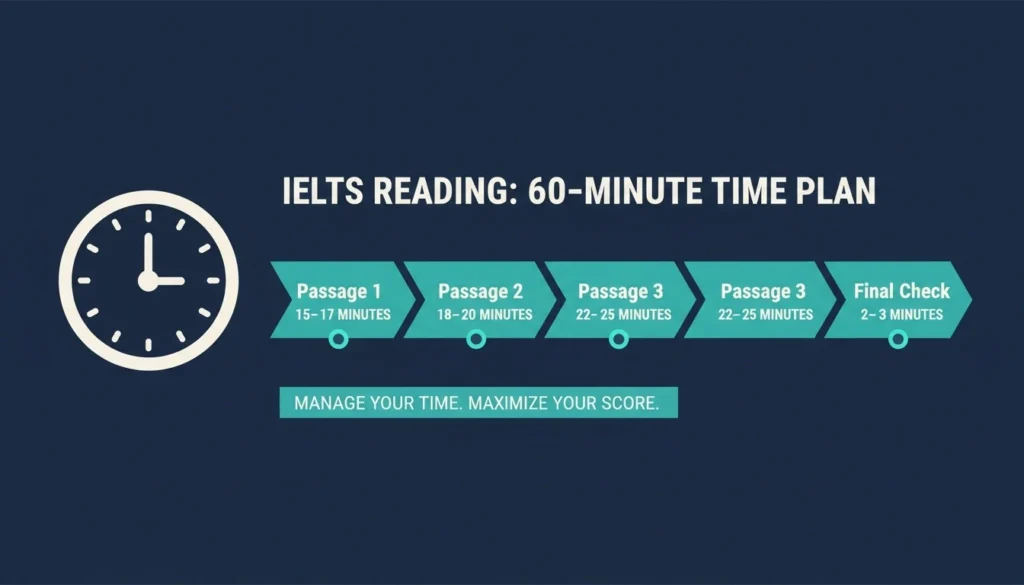
Time pressure is one of the biggest challenges in IELTS Reading. You have 60 minutes for three passages and 40 questions. Many students spend too long on Passage 1 and then rush through Passage 3.
A practical time plan is:
| Section | Suggested Time |
| ———– | ————– |
| Passage 1 | 15–17 minutes |
| Passage 2 | 18–20 minutes |
| Passage 3 | 22–25 minutes |
| Final check | 2–3 minutes |
Passage 3 is usually the most difficult, so it needs more time. If you cannot find an answer after about one minute, make a sensible guess, mark it, and move on. You can return later if time remains.
Always answer every question. There is no penalty for wrong answers, so a guess is better than a blank space.
6. True, False, Not Given: How to Handle the Trickiest Questions
True/False/Not Given questions are difficult because they test exact meaning, not general understanding.
Use this simple rule:
| Answer | Meaning |
| ——— | ———————————————— |
| True | The statement agrees with the passage. |
| False | The statement contradicts the passage. |
| Not Given | The passage does not provide enough information. |
The biggest mistake is choosing False when the answer is actually Not Given.
For example:
Passage: The museum opened in 1985 and attracts thousands of visitors each year.
Statement: The museum is the most popular tourist attraction in the city.
The answer is Not Given. The passage says many people visit it, but it does not say it is the most popular attraction.
For True/False/Not Given questions, read the statement carefully and check every detail. Be careful with words such as:
– always
– never
– only
– most
– all
– some
– mainly
– before
– after
Small words can completely change the meaning.

Final Advice
IELTS Reading success comes from using the right strategy at the right time. Skim first to understand the structure. Scan to find specific details. Match keywords, but expect paraphrasing. Manage your time carefully and do not panic when a question is difficult.
Most importantly, practise under timed conditions. Reading slowly with a dictionary may improve vocabulary, but IELTS requires speed and accuracy. The more you practise with real test-style passages, the better you will become at finding answers quickly and confidently.