
For students and working professionals planning global careers, English is no longer just a subject or an exam requirement. It has become a career signal. Whether you are applying for a university programme, a healthcare role, a corporate job, a legal position, or an international internship, your ability to communicate in English can strongly influence how others judge your readiness.
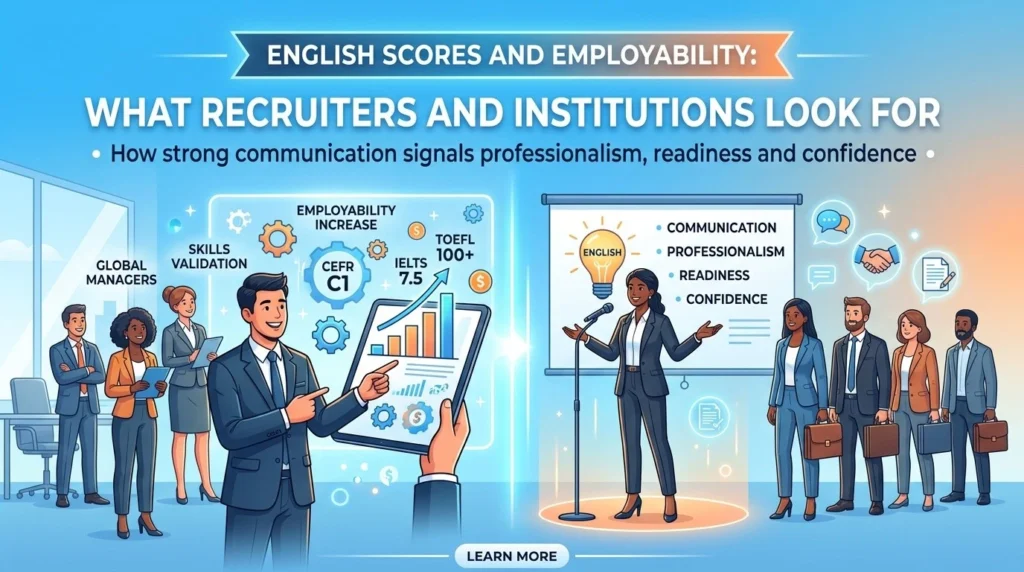
This is why English communication skills for employability matter so much. Recruiters and institutions are not only checking whether you know English. They are trying to understand whether you can participate in meetings, write professional emails, handle interviews, collaborate with teams, speak to clients, understand instructions, and represent yourself with confidence.
English test scores from exams such as IELTS, TOEFL, PTE, CAE, OET, TOEIC, TOLES can support this evaluation. A score does not tell the full story of a candidate, but it gives employers, universities, immigration bodies, and professional regulators a measurable indication of language proficiency.
Read More: Why Workplace English Is Different from Classroom English
In a global job market, strong communication is not a luxury. It is part of professional readiness.
Why English Skills Affect Employability
Employability is not only about technical knowledge. A candidate may be excellent in engineering, healthcare, business, law, finance, design, or technology, but if they cannot communicate clearly, their professional impact becomes limited.
This is where communication skills and employability are closely connected. Employers look for people who can understand tasks, ask questions, share updates, write reports, explain problems, and work with others. In many industries, especially international ones, English becomes the common language of collaboration.

For example, a software developer may need to explain technical issues to a client. A nurse may need to reassure a patient. A business analyst may need to present findings to senior managers. A lawyer may need to draft clear documents. A customer service executive may need to handle conversations with people from different countries.
In each case, English proficiency supports performance. That is why English proficiency for jobs is now a practical career requirement, not just an academic advantage.
What Recruiters Really Look For
Many candidates assume recruiters only look at qualifications and experience. Those are important, but communication is often evaluated from the first interaction.
Recruiters notice how you write your CV, how clearly you answer interview questions, how professionally you respond to emails, and how confidently you explain your experience. They also notice whether you listen carefully, answer directly, and adapt your tone to the situation.
This is the practical side of how recruiters evaluate English skills. They may not always say, “We are testing your English.” But they are observing it throughout the selection process.
They may ask themselves:
Can this candidate speak clearly with clients?
Can they write professional emails?
Can they understand instructions without repeated clarification?
Can they participate in team discussions?
Can they handle pressure in interviews or meetings?
Can they represent the organization professionally?
This is why recruiters and English proficiency are linked. Strong English does not replace skill, but it helps skill become visible.
The Role of English Test Scores for Employment
In some jobs, English ability is judged through interviews and written tasks. In others, formal English test scores for employment are required or preferred.
For international roles, migration pathways, healthcare registration, academic admissions, and corporate training programmes, test scores provide a standardized benchmark. They help institutions compare applicants from different countries and education systems.
A strong IELTS, TOEFL, PTE, CAE, OET, TOEIC, or TOLES score can show that the candidate has invested in preparation and can meet a recognized language standard. This can be especially useful when applying across borders, where recruiters may not know the quality of every local school, college, or workplace.
However, candidates should remember that a score is not enough by itself. Employers also look for practical communication. A high score should be supported by real confidence in speaking, writing, listening, and workplace interaction.
IELTS Score for Job Opportunities
IELTS is widely used for study, migration, professional registration, and employment-related pathways. An IELTS score for job opportunities can be useful when applying to countries or organizations that require proof of English ability.
For many candidates, IELTS demonstrates academic and general English competence. The speaking test shows whether you can respond naturally. The writing test shows whether you can organize ideas. Listening and reading show whether you can understand information accurately.
For job seekers, IELTS can be particularly useful when applying for roles in countries such as the UK, Canada, Australia, New Zealand, and other English-speaking or internationally connected markets. But the required score depends on the employer, regulator, visa category, or institution.
A strong IELTS score can support your profile, but the real career benefit comes when the score reflects actual communication confidence.
TOEFL Score for Career Growth
TOEFL is strongly associated with academic pathways, especially in university admissions. However, a TOEFL score for career growth can also be valuable for professionals planning postgraduate study, research careers, academic work, or international roles.
TOEFL tests academic English in integrated ways. Candidates may need to read, listen, speak, and write based on connected information. This is useful because many professional environments also require integrated communication. You may read a report, listen to a meeting, summarize findings, and present your recommendation.
For candidates aiming at global education followed by international employment, TOEFL can support both admission and long-term professional growth.
PTE Score for Employment
PTE is popular among candidates who prefer a computer-based test and faster result cycles. A PTE score for employment can be useful in migration, study abroad, and professional pathways where PTE is accepted.
PTE assesses speaking, writing, reading, and listening through several integrated tasks. Because it is computer-scored, candidates must be comfortable with timing, microphone use, fluency, pronunciation, and task format.
For working professionals, PTE can be attractive because it is structured, digital, and often convenient to schedule. But as with all tests, candidates should check whether their target employer, regulator, or institution accepts PTE before choosing it.
TOEIC for Workplace Communication
TOEIC is specifically designed to assess English in workplace contexts. This makes TOEIC for workplace communication particularly relevant for corporate jobs, business roles, multinational companies, hospitality, customer service, aviation, and international trade.
Unlike academic tests, TOEIC focuses more on practical workplace situations. Candidates may encounter business conversations, office announcements, emails, meetings, travel-related communication, and customer interactions.
For employers, TOEIC can help assess whether a candidate is ready to function in an international workplace. For candidates, it can be a useful way to demonstrate business communication ability.
OET for Healthcare Employability
OET is designed for healthcare professionals. Doctors, nurses, pharmacists, physiotherapists, dentists and allied healthcare workers often choose OET because it tests English in medical contexts.
For healthcare roles abroad, communication is directly linked to patient safety. A healthcare professional must explain symptoms, understand concerns, write referral letters, communicate with colleagues, and respond empathetically to patients.
This is why OET can be valuable for healthcare employability. It does not test English through unrelated topics. It tests whether healthcare professionals can use English in the kinds of situations they will face at work.
CAE and Advanced Professional English
CAE, or Cambridge English: Advanced, demonstrates a high level of English ability. For candidates applying to academic programmes, professional roles, or international organizations, CAE can signal strong language maturity.
CAE is useful for showing advanced reading, writing, listening, speaking, and use of English. It can support candidates who want to prove that they can handle complex communication in academic and professional environments.
For recruiters, a strong CAE result may suggest that the candidate can manage advanced communication demands with confidence.
TOLES for Legal Careers
TOLES, or the Test of Legal English Skills, is designed for legal professionals and law students. Legal communication requires precision, clarity, and careful wording. A small language error in legal writing can change meaning.
For candidates pursuing legal careers, TOLES can support employability by demonstrating familiarity with legal English, contract language, legal drafting, and professional legal communication.
This makes TOLES especially relevant for law graduates, legal assistants, paralegals, corporate legal teams, and professionals working with international legal documents.
English Proficiency and Career Success
There is a strong connection between English proficiency and career success, especially in global or multinational environments. Strong English does not guarantee success by itself, but it often opens doors.
It improves interview performance. It strengthens workplace confidence. It helps professionals build networks. It supports presentations, client communication, documentation, and leadership development.
Most importantly, strong English helps professionals express their true capability. Many candidates have good ideas but struggle to communicate them. As a result, they appear less confident or less prepared than they actually are.
This is why English language skills for professional growth should be treated as a career investment.
What Institutions Look For
Academic institutions also evaluate communication carefully. Universities want students who can understand lectures, participate in seminars, write assignments, conduct research, and collaborate with peers.
A student with strong English is more likely to adjust faster to international education. They can ask questions, seek help, join discussions, and complete academic tasks with confidence.
Institutions may look at overall scores, but they also pay attention to section scores. A strong reading score with a weak speaking score may suggest that a student can understand written material but may struggle in classroom discussions. A weak writing score may raise concerns about essays, reports, or dissertations.
This is why test preparation should focus on balanced skill development, not only the overall score.
How Candidates Can Build Employability Through English
Candidates should begin by identifying the test most relevant to their goal. IELTS, TOEFL, PTE, CAE, OET, TOEIC, and TOLES serve different needs. The right test depends on whether the candidate is applying for study, migration, healthcare registration, corporate employment, or legal work.
Next, candidates should take a mock test to understand their current level. This helps identify whether they need more work on speaking, writing, listening, reading, vocabulary, pronunciation, or professional communication.
They should also practise real workplace English: emails, interviews, presentations, meetings, phone calls, client conversations, case notes, reports, and professional introductions.
Finally, candidates should remember that employability is built through both scores and behaviour. A good score gets attention. Good communication sustains confidence after selection.
Final Thought
English scores matter because they help recruiters and institutions assess readiness. But the deeper value lies in what those scores represent: clarity, professionalism, confidence and the ability to work or study in a global environment.
Whether you choose IELTS, TOEFL, PTE, CAE, OET, TOEIC or TOLES, your goal should not be only to pass an exam. Your goal should be to build English communication skills for employability.
Because in the real world, strong communication does more than improve your application. It helps you perform, connect, lead and grow.
FAQs
1. Why are English communication skills important for employability?
English communication skills for employability are important because they help candidates perform in interviews, write professional emails, collaborate with teams, communicate with clients, and work confidently in global or multicultural environments.
2. Do recruiters really check English proficiency?
Yes. Recruiters and English proficiency are closely connected, especially for international roles. Recruiters evaluate English through CVs, emails, interviews, written tasks, presentations and sometimes formal test scores.
3. Which test is best for job opportunities: IELTS, TOEFL, PTE, CAE, OET, TOEIC or TOLES?
The best test depends on your goal. IELTS, TOEFL and PTE are commonly used for study and migration. OET is best suited for healthcare professionals. TOEIC focuses on workplace communication. TOLES is useful for legal careers. CAE shows advanced English ability.
4. How does a TOEIC score support workplace communication?
TOEIC for workplace communication is useful because it tests English in business and office contexts. It can help employers assess whether a candidate can handle meetings, emails, announcements, travel communication and workplace conversations.
5. Can English test scores improve career growth?
Yes. English test scores for employment can support applications, migration, professional registration and career mobility. However, real career growth also requires practical English proficiency, confidence, professional behaviour and continuous communication practice.




Leave a Reply