
In today’s fast-paced world, finding time to learn a new language can feel almost impossible. Between work, family responsibilities, and personal commitments, many Adult Learners struggle to fit traditional language classes into their schedules. Yet, the demand for strong English communication skills continues to grow across industries and professions. This is where an english fluency course built around immersion offers a smarter and faster path to success.
Unlike conventional classroom learning that often focuses heavily on grammar rules and memorization, immersive language learning places learners in real-world communication situations. Instead of simply studying English, learners actively use it in conversations, listening exercises, role-playing, and practical scenarios. This approach significantly reduces learning time while improving long-term retention, confidence, and practical communication skills.
Read More: How English Immersion Builds Fluency, Confidence, and Natural Expression
What Is Language Immersion Learning?
Language immersion learning is a teaching method where learners are surrounded by English throughout the learning experience. Rather than translating everything into their native language, students think, listen, speak, and interact directly in English.
An english immersion course typically includes:
- Live conversations with instructors
- Interactive speaking activities
- Real-life scenarios
- Listening to authentic English content
- Immediate feedback and corrections
- Daily speaking practice
The goal is simple: make English a natural part of everyday thinking rather than just another subject to study.
Why Immersion Helps Adult Learners Learn English Faster
Busy adults don’t have years to spend mastering a language. They need practical results in the shortest possible time. This is why immersion works so well.
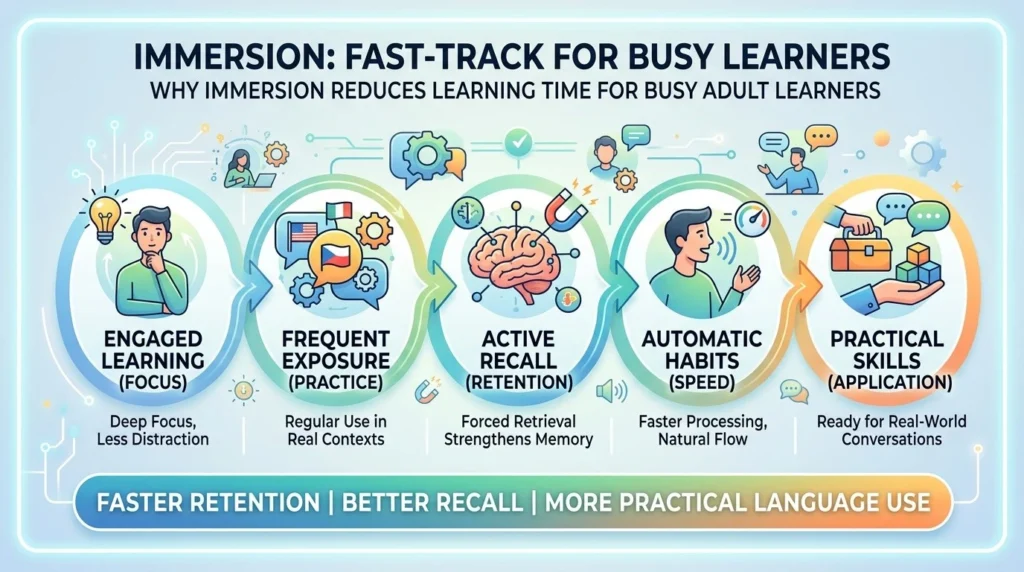
1. Faster Memory Retention
Traditional learning often relies on memorizing vocabulary lists and grammar rules. Unfortunately, much of that information is forgotten within days if it isn’t used.
Immersive language learning changes this completely.
When learners actively use new words during conversations, meetings, presentations, or discussions, the brain forms stronger memory connections. Instead of memorizing isolated vocabulary, learners remember words through experiences and context.
This makes it much easier to learn english faster while retaining information for the long term.
2. Better Recall During Real Conversations
Many learners understand English while reading but struggle when speaking.
This happens because passive learning doesn’t train the brain for instant recall.
An english fluency course that emphasizes immersion repeatedly exposes learners to real conversations. Over time, vocabulary and sentence structures become automatic rather than something learners have to translate mentally.
The result is:
- Faster responses
- Improved fluency
- Less hesitation
- Greater speaking confidence
3. Practical English Instead of Textbook English
Real-life conversations rarely sound like textbook dialogues.
Immersion introduces learners to authentic English used in:
- Business meetings
- Interviews
- Client discussions
- Workplace collaboration
- Social conversations
- Professional networking
This practical exposure helps learners develop advanced english communication skills that employers actually value.
Instead of memorizing perfect grammar rules, learners develop the confidence to communicate naturally and effectively.
4. Accelerated Language Learning Through Daily Practice
Consistency matters more than long study sessions.
One of the biggest advantages of accelerated language learning is frequent exposure.
Even 20–30 minutes of speaking every day is often more effective than studying grammar for several hours once a week.
Immersion creates daily opportunities to:
- Listen actively
- Respond quickly
- Build vocabulary naturally
- Improve pronunciation
- Strengthen comprehension
These repeated experiences help learners progress much faster.
5. Reduced Fear of Making Mistakes
Adults often hesitate to speak because they’re afraid of making errors.
Ironically, this fear slows progress.
An immersive learning environment encourages learners to communicate despite imperfections.
Mistakes become learning opportunities rather than failures.
As confidence grows, learners speak more often, leading to faster improvement.
This increased confidence is one of the biggest reasons an english speaking course online that uses immersive techniques delivers better outcomes than traditional self-study.
Immersion Supports Professional English Goals
Many professionals require specialized English for career advancement.
An immersive english fluency course can be customized for industry-specific communication needs.
English for Legal Professionals
Lawyers frequently communicate with international clients, courts, and legal teams.
Courses focusing on english for lawyers help improve:
- Legal vocabulary
- Client consultations
- Contract discussions
- Negotiation skills
- Courtroom communication
Professionals can also benefit from legal english training and structured preparation through a TOLES Preparation Course, ensuring they develop both legal terminology and practical communication abilities.
Immersion Improves Exam Performance
Many international English exams assess communication skills rather than memorized grammar.
Immersion prepares learners for real speaking situations found in popular English proficiency tests.
These include:
- IELTS Speaking Practice
- IELTS Communication Skills
- IELTS Speaking Confidence
- PTE Speaking Practice
- TOEFL Speaking Practice
- CAE Speaking Practice
- OET Speaking Preparation
Because learners regularly participate in discussions, role-plays, and interactive speaking exercises, they become more comfortable answering spontaneous questions under exam conditions.
Instead of memorizing model answers, they learn to communicate naturally.
Why Busy Adults Prefer Intensive English Learning
Time is one of the biggest challenges for working professionals.
An intensive english learning approach focuses only on the skills learners need most.
Rather than spending months reviewing topics they already know, learners practice:
- Speaking
- Listening
- Vocabulary in context
- Pronunciation
- Workplace communication
- Presentation skills
This targeted approach maximizes every study session.
Immersion Creates Long-Term Fluency
Many learners experience a common problem.
They complete a course, score well on tests, but forget most of what they learned within months.
Immersion reduces this problem because English becomes part of daily thinking.
Learners repeatedly apply their knowledge in meaningful situations.
The more frequently English is used, the stronger those language pathways become.
Instead of temporary memorization, learners develop lasting fluency.
Choosing the Right English Fluency Course
Not every language course follows immersive teaching methods.
When selecting an english fluency course, look for programs that include:
- Live speaking sessions
- Real-world conversations
- Personalized feedback
- Interactive group discussions
- Practical vocabulary
- Listening practice
- Industry-specific communication training
- Flexible online schedules
An english immersion course should encourage learners to actively communicate rather than simply complete grammar exercises.

Final Thoughts
For busy Adult Learners, time is valuable. Every study session should produce measurable progress. Traditional learning methods often focus on memorization, leaving learners unable to communicate confidently in real situations.
Immersion offers a faster and more practical alternative. Through immersive language learning, learners build stronger memory, improve recall, develop confidence, and use English naturally in everyday conversations. Whether your goal is career advancement, international education, professional certification, or exam success, an immersive english fluency course helps you achieve meaningful results in less time.
From improving advanced english communication skills to preparing for exams like IELTS Speaking Practice, TOEFL Speaking Practice, PTE Speaking Practice, CAE Speaking Practice, and OET Speaking Preparation, immersion provides the consistent practice needed to communicate fluently and confidently.
Rather than simply studying English, start living it—and you’ll discover that fluency comes faster than you ever imagined.
Frequently Asked Questions (FAQs)
1. Why is immersion more effective than traditional English learning?
Immersion encourages learners to actively use English in real-life situations instead of memorizing grammar rules. This improves retention, recall, confidence, and practical communication skills much faster.
2. Is an english fluency course suitable for busy working professionals?
Yes. Many modern english fluency course programs are designed with flexible online schedules, allowing busy professionals to practice speaking daily without disrupting work or personal commitments.
3. Can immersive language learning help improve speaking test scores?
Absolutely. Regular speaking practice builds confidence and fluency, making learners better prepared for IELTS Speaking Practice, PTE Speaking Practice, TOEFL Speaking Practice, CAE Speaking Practice, and OET Speaking Preparation.
4. How does immersion support professional communication?
Immersive learning focuses on practical conversations used in workplaces, helping learners develop advanced english communication skills. Specialized programs also support english for lawyers, legal english training, and TOLES Preparation Course requirements.
5. How long does it take to learn English through immersion?
The timeline varies based on consistency and current proficiency. However, learners who engage in immersive daily practice often experience faster progress than those relying solely on traditional classroom methods, making it one of the most effective ways to learn english faster.




Leave a Reply