
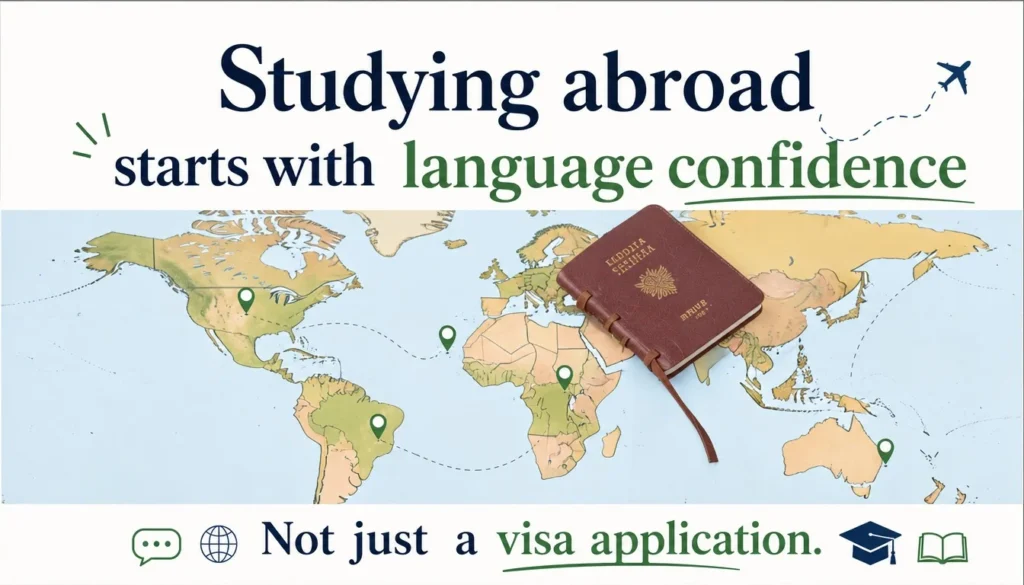
For many students, the journey of studying abroad begins with forms, documents, deadlines, bank statements, offer letters, and the visa application. These steps are important, of course. Without the right paperwork, you cannot move forward.
But studying abroad is not only a paperwork journey.
It is also a communication journey.
Whether you plan to study abroad in UK, study abroad in USA, Canada, Australia, Europe, or any other destination, your ability to communicate in English can shape your entire experience. It affects how you perform in class, how you answer interview questions, how you make friends, how you ask for help, and how confident you feel in daily life.
That is why good study abroad preparation should not stop at visa documents. It should also include language confidence, classroom readiness, and real-world communication skills.
In simple words, studying abroad starts with your voice.
Read More: Country-wise English Test Requirements: USA, UK, Canada, Australia, and Europe
Why Language Confidence Matters
Many students prepare for IELTS or TOEFL because universities require a score. They join IELTS preparation classes, follow TOEFL preparation plans, and practise reading, writing, listening, and speaking for the test.
That is a good start.
But a test score is not the same as full communication confidence. You may get the required score and still feel nervous speaking in class. You may understand grammar but struggle to ask questions in a seminar. You may write essays well but feel uncomfortable speaking to a professor after class.

This is why English communication skills matter beyond the exam.
When you enter a new academic and cultural environment, English becomes part of almost everything you do. You use it to understand lectures, join group discussions, introduce yourself, attend interviews, email teachers, explain problems, find accommodation, open a bank account, and communicate with people from different countries.
Language confidence helps you feel less lost.
Study Abroad Guidance Should Include Communication Readiness
Good study abroad guidance should not only tell students how to apply for universities or visas. It should also prepare them for the reality of international student life.
Many students ask, “How do I get admission?” or “How do I pass the visa interview?” These are important questions. But students should also ask:
Will I be comfortable speaking in class?
Can I explain my ideas clearly?
Can I understand different accents?
Can I ask for help when I need it?
Can I communicate respectfully across cultures?
These questions are just as important as document checklists.
When students think about how to prepare for studying abroad, they should include language practice, confidence-building, interview preparation, and cultural awareness in their plan.
Academic English Skills for the Classroom
One of the biggest adjustments for international students is academic communication.
University classrooms abroad may feel different from what students are used to. Professors may expect students to ask questions, join discussions, challenge ideas politely, work in groups, and present their opinions.
This requires strong academic English skills.
Academic English is not only about difficult vocabulary. It is about understanding lectures, taking notes, reading research articles, writing assignments, giving presentations, and explaining your ideas in a structured way.
For example, in a business class, you may need to analyse a case study and defend your opinion. In a science course, you may need to explain results from a lab report. In a humanities class, you may need to discuss different viewpoints. In a postgraduate seminar, you may need to speak confidently in front of classmates.
A student with strong academic English feels more prepared. A student without it may understand the subject but struggle to express knowledge clearly.
Speaking in Class: A Common Challenge
Many international students are afraid of speaking in class. They worry about making mistakes, having an accent, using the wrong word, or being judged by classmates.
This fear is very normal.
But the truth is that university is a learning environment. You are not expected to speak perfect English all the time. What matters more is your willingness to communicate, ask questions, and participate.
This is where conversational English practice can help. The more you practise speaking before you travel, the easier it becomes to speak after you arrive.
Try practising simple classroom phrases such as:
“I have a question about this point.”
“Could you explain that again?”
“In my opinion…”
“I agree with that, but I also think…”
“Can I add something?”
These small phrases can make a big difference. They give you a starting point when you feel nervous.
IELTS and TOEFL Are Only the Beginning
IELTS preparation and TOEFL preparation are valuable because they build important language skills. They teach you how to listen carefully, read quickly, write clearly, and speak under pressure.
However, students should not treat IELTS or TOEFL as the final goal.
The real goal is communication readiness.
For example, IELTS Speaking may prepare you to answer questions about familiar topics, describe experiences, and express opinions. Good IELTS speaking tips can help you improve fluency, pronunciation, and confidence. But after the test, you still need to continue speaking practice for real-life situations.
Similarly, TOEFL may prepare you for academic lectures and integrated speaking tasks. But once you are abroad, you will face spontaneous conversations, group projects, presentations, interviews, and social situations.
Your test score gets you closer to admission. Your communication skills help you survive and succeed after admission.
Visa Interview Preparation Is Also Communication Preparation
For many students, the visa interview is one of the most stressful parts of the process. They worry about what questions will be asked and whether their answers will sound convincing.
Good visa interview preparation is not about memorising perfect answers. It is about understanding your own story and explaining it clearly.
You should be able to answer questions like:
Why did you choose this course?
Why did you choose this country?
Why this university?
How will you fund your studies?
What are your future plans?
Will you return after your studies if required by your visa conditions?
These answers should sound natural, honest, and confident. If you memorise long paragraphs, your answers may feel robotic. If you practise real communication, you will sound more believable.
This is why interview communication tips are important. Speak clearly. Keep answers focused. Do not rush. Give direct responses. Support your answers with facts. Stay calm if you do not understand a question and politely ask for clarification.
Daily Life Abroad Needs Practical English
Studying abroad is not only about classrooms. It is also about everyday life.
You may need to speak to landlords, shopkeepers, bank staff, doctors, university advisors, transport officers, classmates, flatmates, and part-time job employers.
Daily life requires practical English.
You may need to explain that your heating is not working. You may need to ask about bus routes. You may need to call a clinic. You may need to discuss rent. You may need to understand safety instructions. You may need to introduce yourself at a student society event.
These situations are not always covered in academic test preparation.
That is why students should also practise everyday spoken English. Spoken English classes, conversation clubs, speaking partners, or an English fluency course can help students become more comfortable with real communication.
The goal is not to remove your accent or sound like someone else. The goal is to be clear, confident, and understood.
Cross-Cultural Communication Matters
When you study abroad, you do not only meet people from one country. You may meet classmates from many cultures, languages, and backgrounds.
This makes cross-cultural communication very important.
Sometimes communication problems happen not because of grammar, but because of cultural differences. A joke may not be understood. A direct answer may sound rude in one culture but normal in another. A student may be shy about speaking up because their previous education system encouraged silence and respect for authority.
In international classrooms, you need to learn how to listen actively, disagree politely, ask questions respectfully, and understand different viewpoints.
This is a major part of global education. You are not only learning a subject. You are learning how to work with people from around the world.
Soft Skills for Students
Language confidence is closely connected to soft skills for students.
Soft skills include communication, teamwork, confidence, time management, problem-solving, adaptability, leadership, and emotional intelligence.
These skills matter in university and later in employment. A student who can explain ideas clearly, work in a group, and present confidently often has an advantage.
For example, group projects are common in many universities. You may need to divide tasks, share opinions, solve disagreements, and present together. If your English is weak or your confidence is low, group work can become stressful.
But if you practise communication early, you will feel more prepared.
Public Speaking for Students
Many courses require presentations. For some students, this is exciting. For others, it is terrifying.
Public speaking for students is a skill that improves with practice. You do not become confident by waiting until you feel ready. You become confident by speaking regularly, making mistakes, and improving slowly.
Start small. Record a two-minute talk on your phone. Explain why you chose your course. Summarise an article. Practise introducing yourself. Then move to longer presentations.
Focus on structure. Say what you are going to discuss, explain your main points, give examples, and finish clearly.
Good public speaking does not mean perfect English. It means clear communication.
Study Abroad in UK: Communication Expectations
If you plan to study abroad in UK, be prepared for seminar discussions, independent study, essay writing, and polite academic debate. UK universities often expect students to read before class and come ready to discuss ideas.
You may hear different accents, not only British accents but also international accents from classmates and staff. This is why listening practice is important.
Students going to the UK should practise academic phrases, seminar participation, email writing, and presentation skills. IELTS preparation can help, but real communication practice is equally useful.
Study Abroad in USA: Participation and Confidence
If you plan to study abroad in USA, classroom participation may be very important. Many American universities encourage students to ask questions, join discussions, attend office hours, and speak openly.
This does not mean you must be loud or overly confident. But you should be ready to express your thoughts.
Students going to the USA should practise discussion skills, classroom interaction, interview answers, and professional communication. TOEFL preparation can help with academic listening and speaking, but daily conversation practice is also important.
How to Build Language Confidence Before You Go
The best time to build language confidence is before you travel.
Start by speaking English every day, even for a few minutes. Record yourself. Listen to your pronunciation. Practise common university situations. Join spoken English classes if you need structure. Take an English fluency course if you need guided improvement.
Watch university lectures online. Listen to podcasts. Read articles related to your subject. Practise explaining your opinions. Prepare for interviews. Practise introducing yourself naturally.
Also, do not wait until your English is perfect. Confidence grows through use. The more you communicate, the easier it becomes.
Final Thoughts
Studying abroad is not just about getting a visa. It is about becoming ready for a new academic, social, and cultural life.
Your visa allows you to enter a country. Your language confidence helps you belong there.
Good study abroad preparation should include documents, university applications, finances, and visa planning. But it should also include English communication skills, academic English, interview practice, speaking confidence, and cross-cultural awareness.
Whether your dream is to study abroad in UK, study abroad in USA, or join any form of global education, remember this: your journey does not begin at the airport. It begins when you start preparing to communicate with confidence.
Because once you arrive, your English will not only be tested in exams.
It will be used in real life.
FAQs
1. Why is language confidence important for studying abroad?
Language confidence helps students participate in classes, ask questions, attend interviews, make friends, handle daily life, and communicate with people from different cultures. It is important for both academic success and personal comfort abroad.
2. Is IELTS or TOEFL preparation enough for studying abroad?
IELTS and TOEFL preparation are important, but they are only the beginning. Students also need conversational English practice, academic English skills, interview communication, and confidence for real-life situations.
3. How can I improve my English communication skills before studying abroad?
You can improve by speaking English daily, joining spoken English classes, taking an English fluency course, recording yourself, practising interviews, watching lectures, reading academic articles, and joining conversation groups.
4. How should I prepare for a visa interview?
For visa interview preparation, understand your course, university, funding, study plans, and future goals. Practise answering clearly and honestly. Avoid memorising long answers. Focus on sounding natural, calm, and confident.
5. What communication skills are useful for international student life?
Useful skills include classroom speaking, academic writing, listening to different accents, public speaking, group discussion, polite disagreement, email writing, interview communication, and cross-cultural communication.




Leave a Reply