
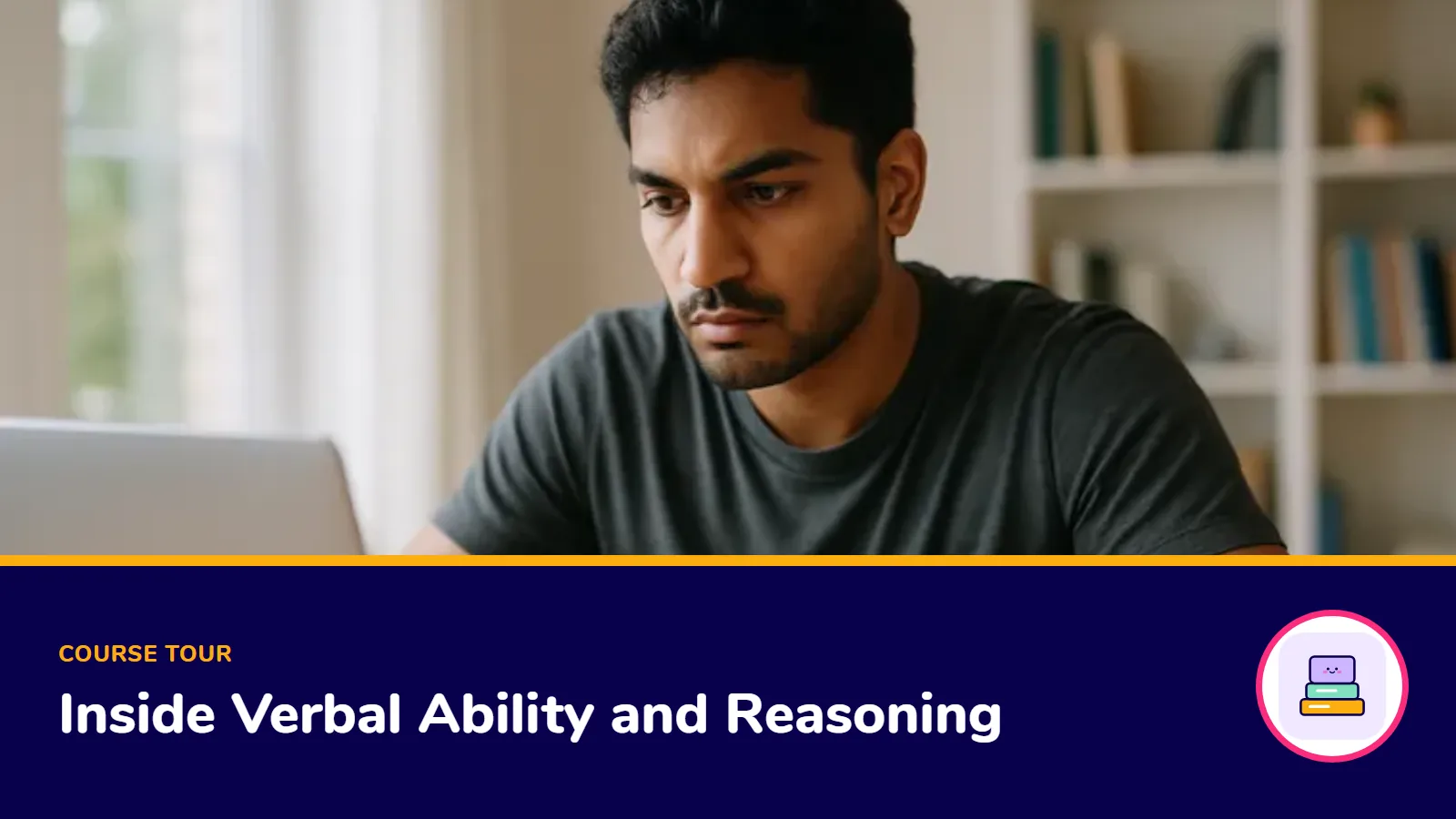
The hard part of a verbal section is rarely rare words. It is knowing what the question wants and testing each option against it.
What the course is
Verbal Ability and Reasoning is a skills course for the verbal sections of aptitude, entrance and employment tests. You name the question, predict the answer, test every option and watch the clock. Every option is explained, and every wrong answer is labelled with its trap: too extreme, reversed, half true or out of scope. Examples of use include GMAT, GRE, CAT, bank exams, and campus and employer tests.

The ten units
- The verbal sections: formats, timing and traps
- Words in context: synonyms, antonyms, idioms and words with more than one meaning
- Sentence and text completion: one, two and three blanks, chosen by logic, not by sound
- Grammar the exams test: error spotting, sentence improvement and the ten rules that carry most items
- Cloze and fill in the blanks: connectors, prepositions, articles and tense inside a passage
- Reading comprehension I: main idea, detail and tone
- Reading comprehension II: inference, purpose and long, abstract passages
- Para jumbles and ordering: openers, links, odd sentence out, para completion and summary
- Critical reasoning: assumption, strengthen, weaken, inference, flaw and boldface roles
- Verbal reasoning and the mocks: analogies, odd one out, and timed section mocks
The units run by question type, about one a week.
How it teaches
Each unit opens with the idea in plain words, a strategy card and a worked example that highlights the words that decide the answer. You then meet guided sets, where every option is explained, and a timed set at about a minute a question with no feedback until the end. A review without the clock follows, so you see which families cost you time and marks.
You begin with a diagnostic of 31 short questions across every family. Nothing is revealed until the end, and it is a starting map, not a verdict. Then you open your Type Map, which covers all 32 question types in eight families, with stars to earn: Reading, Arguments, Completion, Grammar, Cloze, Jumbles, Vocabulary and Reasoning.
A mistake log keeps each wrong answer with its trap name. After a set you can replay only your mistakes, and a later set can offer them again. Ten minutes of vocabulary a day, played as a word game, sits beside the units. In all, there are more than 100 interactive practice activities.
Two guides to try first
If you want to see the method before you apply, two articles show it. Name the question first in reading tests covers Units 6 and 7. Critical reasoning without formal logic covers Unit 9.
Who it suits
- Graduates, final-year students and professionals who read English well and want to improve at verbal sections.
- People who lose marks to traps rather than to unknown words.
- Anyone who wants a method they can reuse on a paper they have not seen.
Who it does not suit
- You are still building basic English. This course does not teach it. English Refresher is the place to start, and you can read about it on the Prepspire site.
- You want past-paper questions. Every question here is original, and nothing in the course predicts what you would score in any test.
- You want a long vocabulary list to memorise. The course teaches a method and plays vocabulary as a short daily game.
Applying
Enrolment is reviewed by our team and opened by hand. You apply on the course page. For the numbers and logic sides of the same tests, see Inside Quantitative Aptitude and Inside Logical and Non-verbal Reasoning.
Keep going: the Verbal Ability course, free taster courses and free sample tests.




Leave a Reply