
Get the right response the first time
A professional email succeeds when the reader understands what you want, why, and by when, in the first few seconds. Clear structure and the right tone matter more than impressive vocabulary.
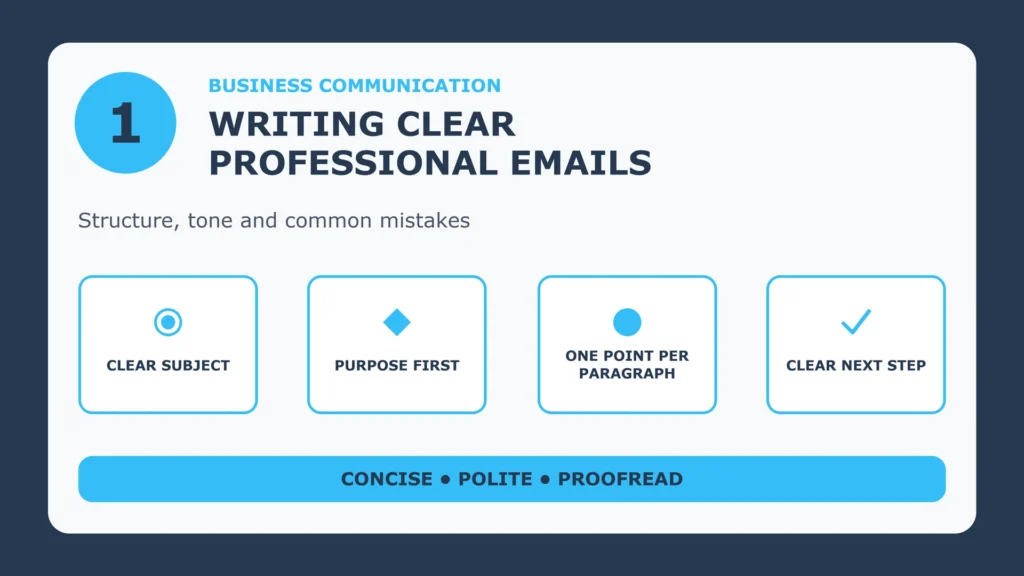
A reliable structure
- Subject line: specific and short. Invoice 2291: payment date is better than Question.
- Greeting: suited to the reader. Dear Ms Rahman, for a first formal contact; Hi Sam, for a colleague you know.
- Purpose first: state why you are writing in the opening sentence.
- Details: one short paragraph per point, in a logical order.
- Action and deadline: say exactly what you need and when.
- Closing: Kind regards, or Best regards, followed by your name and role.
Getting the tone right
| Situation | More formal | More neutral |
|---|---|---|
| Opening | I am writing to enquire about… | I’m writing about… |
| Requesting | Would it be possible to…? | Could you…? |
| Apologising | Please accept my apologies for… | Sorry for… |
| Following up | I would be grateful for an update on… | Just checking in on… |
Match the reader and the relationship. When in doubt with a new contact, start slightly more formal and follow their lead.
Useful phrases
- Giving information: Please find attached…, I’d like to let you know that…
- Asking for action: Could you please confirm by Friday?
- Softening a request: If possible, could we…?
- Clarifying: To make sure I’ve understood correctly, …
- Closing politely: Please let me know if you have any questions.
Common mistakes
- Burying the request in the last paragraph.
- Very long paragraphs that mix several topics.
- Unclear pronouns: “it” or “this” with no clear reference.
- Too direct in tone: Send me the report can sound abrupt; Could you send me the report? is safer.
- Missing attachments mentioned in the text.
- No proofreading: names, dates and figures matter most.
A quick checklist before you send
- Is the purpose clear in the first two lines?
- Does every paragraph have one point?
- Is the action and deadline explicit?
- Is the tone right for this reader?
- Are names, numbers, dates and attachments correct?
Practise
- Rewrite one of your recent emails using the structure above.
- Write the same request twice: once formally to a new client, once neutrally to a colleague.
- Keep a personal phrase bank of expressions you see in good emails.