

Professionals often assume that becoming fluent in everyday English will automatically prepare them for international workplaces. Although strong General English provides an essential foundation, it does not cover every situation encountered in modern offices, interviews, meetings, negotiations, or client conversations.
The difference between Business English and General English lies mainly in purpose. General English helps people communicate in everyday life, while Business English focuses on completing professional tasks accurately, confidently and appropriately.
Understanding this distinction can help working adults select the right professional English course, build stronger workplace language skills, and avoid spending time on vocabulary or exercises that do not support their career objectives.
Read More: How Fluency and Clarity Build Workplace Confidence
What Is General English?
A common question among adult learners is: what is general English?
General English is the language used in ordinary social and practical situations. A typical general English course may include topics such as:
- family and relationships;
- travel and transport;
- food and shopping;
- health and lifestyle;
- hobbies and entertainment;
- news and current affairs;
- everyday social conversations.
Students develop grammar, pronunciation, listening, reading, writing and conversational fluency. The aim is to help them communicate effectively across a wide variety of familiar situations.
For example, a learner may practise ordering food in a restaurant, describing a holiday, asking for directions or discussing weekend plans. These activities build a broad language foundation and improve overall english speaking confidence.
General English is important because professionals cannot use specialised workplace language effectively without understanding basic sentence structures and everyday vocabulary. However, general fluency does not always prepare someone for the demands of office communication in English.
A person may be able to socialise comfortably but still struggle to write a formal proposal, challenge an idea diplomatically or provide a concise project update.
What Is Business English?
Another frequently asked question is: what is business english?
Business English is the specialised language and communication style used in workplaces. It includes the vocabulary, tone, structure and communication strategies needed to achieve professional outcomes.
A practical business English course may cover:
- meetings and project updates;
- presentations and public speaking;
- business email writing;
- negotiations and conflict resolution;
- networking;
- job interviews;
- customer service;
- report writing;
- telephone and video communication;
- communication with international teams.
Business English is not limited to memorising corporate terminology. Effective training develops broader business communication skills, including clarity, active listening, persuasion, diplomacy and audience awareness.
For example, instead of simply teaching the word “deadline,” a course may show professionals how to negotiate one:
“Would it be possible to extend the deadline until Friday so that we can complete the quality checks?”
This is why English for corporate communication is practical and outcome-focused.
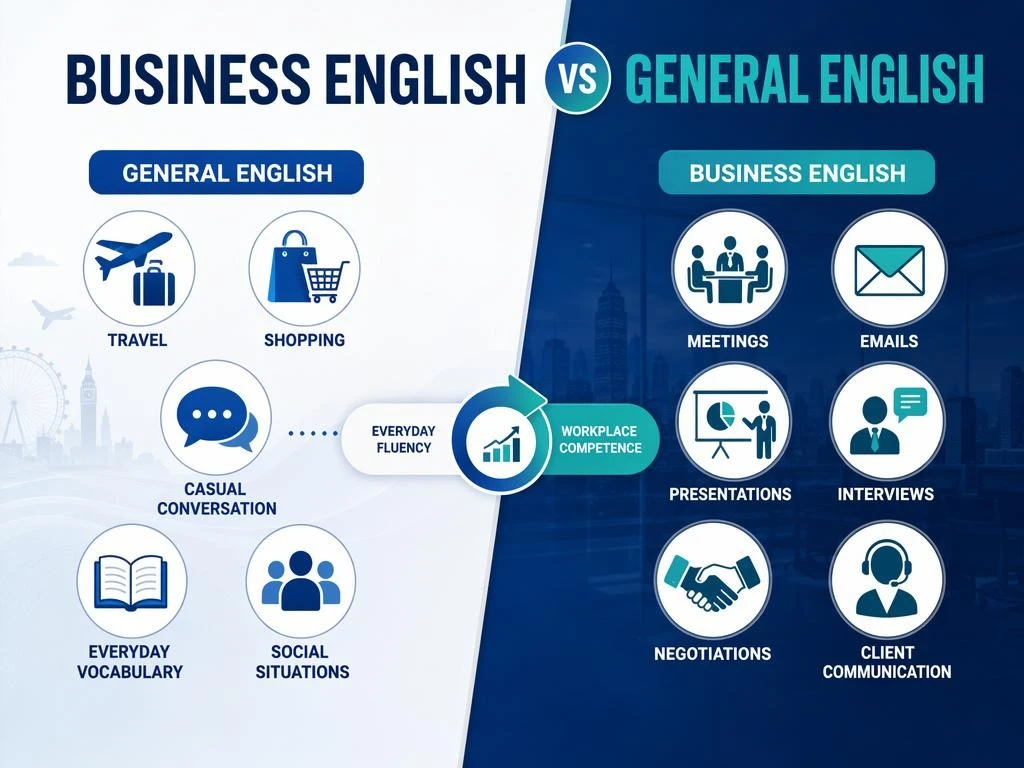
The Main Difference Between Business English and General English
The clearest difference is the situation in which the language is used.
General English helps a learner participate in ordinary conversations. Business English helps a professional perform effectively at work.
General English might involve discussing a favourite film. Business English might involve presenting quarterly results to senior management.
General English might teach how to make a polite request in a shop. Business English develops polite email requests, negotiation language and professional telephone skills.
Both areas require grammar and vocabulary, but professional contexts demand additional judgement. Employees need to know:
- how direct or formal to be;
- how much detail to provide;
- how to organise information;
- how to communicate disagreement;
- how to make recommendations;
- how to protect professional relationships.
These abilities form the basis of strong professional communication skills.
Professional English Vocabulary
A key feature of Business English is professional English vocabulary.
Workplaces regularly use words connected to:
- budgets;
- targets;
- performance;
- recruitment;
- contracts;
- sales;
- operations;
- logistics;
- compliance;
- customer relationships;
- project management.
Learners also need functional expressions, not just individual words.
Examples of useful business meeting phrases include:
- “Could you clarify that point?”
- “Let us return to the main issue.”
- “I would like to propose an alternative.”
- “Can we agree on the next steps?”
- “Who will be responsible for this action?”
This type of business conversation skill allows employees to participate instead of merely understanding what others say.
A good business English speaking practice programme should repeatedly expose learners to these expressions until they become natural.
Formal and Informal English at Work
Professionals must understand the difference between formal and informal English.
Not every workplace message needs to sound highly formal. Communication with a close colleague may be relaxed, while an email to a new client may require a more professional tone.
Compare these messages:
“Can you send me the figures?”
“Could you please send the revised figures by 2 p.m. today?”
The second example is clearer and more suitable for many professional situations. It provides a deadline and uses polite language.
However, excessively formal English can also sound distant or unnatural. Phrases such as “Please be advised that” may be unnecessary when “Please note” communicates the same meaning more clearly.
Learning formal english means choosing language that is appropriate for the audience, relationship and purpose.
English for Business Meetings
English for business meetings is one of the most important areas for international professionals.
Good meeting communication involves more than speaking fluently. Employees need to:
- introduce agenda items;
- provide concise updates;
- interrupt politely;
- agree and disagree professionally;
- request clarification;
- summarise decisions;
- assign actions.
An employee may understand the discussion but avoid contributing because they do not know how to enter the conversation.
Useful phrases such as “May I add something here?” or “I see your point, but I have one concern” make participation easier.
Regular practice improves workplace speaking skills and helps employees contribute with greater confidence.
Professional Email and Workplace Writing Skills
Business English also develops workplace writing skills.
Professional emails must usually be:
- clear;
- concise;
- accurate;
- logically structured;
- action-oriented.
Strong email writing skills include choosing a useful subject line, explaining the purpose early and stating what action is required.
A vague email might say:
“Please look at the attached document and let me know.”
A clearer version is:
“Please review sections two and three of the attached proposal and send your comments by Thursday afternoon.”
This is an example of effective professional writing because the recipient knows exactly what to do.
Professionals also need to write updates, reports, proposals, meeting summaries and customer responses. These tasks require a different style from casual messaging.
English for Job Interviews
English for job interviews requires structured and persuasive communication.
Candidates must explain:
- their experience;
- their achievements;
- the challenges they have handled;
- their professional strengths;
- their suitability for the role.
Strong interview communication goes beyond answering basic questions. Candidates need to provide evidence.
Instead of saying, “I am a good team member,” a candidate should describe a situation in which teamwork produced a measurable result.
A practical English for career development programme may teach candidates to organise answers using Situation, Task, Action and Result.
This makes responses easier to follow and strengthens professional credibility.
English for Customer Service
English for customer service requires patience, empathy and solution-focused language.
Customer service employees often communicate with people who are frustrated or confused. A direct statement such as “You completed the form incorrectly” may sound accusatory.
A better response is:
“It appears that one section still needs to be completed. I can guide you through it.”
This demonstrates how professional communication skills involve emotional intelligence as well as language accuracy.
Employees in customer-facing roles must also learn how to apologise, explain delays, manage expectations and offer alternatives.
Cross-Cultural Communication
Modern workplaces increasingly depend on cross cultural communication.
International colleagues may have different expectations regarding:
- directness;
- hierarchy;
- disagreement;
- decision-making;
- silence;
- punctuality;
- feedback.
A communication style considered efficient in one culture may sound rude in another.
Professionals working in multinational companies should avoid obscure idioms, local humour and culturally specific references when clarity is important.
Strong English for international business includes checking understanding without embarrassing the listener:
“Let me confirm that we have agreed to deliver the first draft on Monday.”
This approach reduces misunderstandings and protects working relationships.
Public Speaking and English Presentation Language
Presentations require specialised English presentation language.
Speakers need phrases that guide the audience:
- “Today, I will focus on three areas.”
- “Let us begin with the current situation.”
- “This chart illustrates…”
- “The most important finding is…”
- “Based on these results, we recommend…”
These expressions improve organisation and support public speaking confidence.
Professionals also need to explain visual information, emphasise key points and answer questions. A technically knowledgeable employee may still struggle if the presentation lacks structure.
A focused English presentation language course can help professionals turn complex information into clear messages.
Negotiations and Business English
English negotiation skills are another major difference between professional and everyday English.
Negotiation requires careful language. Participants must express priorities without damaging relationships.
Useful phrases include:
- “We may be able to accept that if…”
- “Our main concern is…”
- “Could we explore another option?”
- “That proposal would be difficult for us because…”
- “Would you consider a longer delivery period?”
Such language allows professionals to remain flexible while protecting their interests.
Is Business English Certification Valuable?
A business english certification may demonstrate commitment to professional development. It can support applications for jobs that involve international communication.
However, certification should be supported by practical ability. Employers are likely to judge whether a candidate can:
- answer interview questions;
- write a clear email;
- explain an idea;
- communicate with clients;
- participate in meetings.
The best programmes combine assessment with realistic practice. A professional English certification is most valuable when it reflects genuine workplace competence.
Choosing the Right English Training
A general English course may be suitable for learners who still need to improve basic grammar, everyday vocabulary and conversational fluency.
A Business English course is more appropriate for professionals who need to:
- attend international meetings;
- write workplace emails;
- prepare for interviews;
- communicate with clients;
- give presentations;
- lead teams.
Some learners benefit from combining both. General English strengthens overall flexibility, while English training for employees develops targeted professional skills.

Conclusion
General English and Business English are connected, but they serve different purposes.
General English helps people communicate in everyday situations. Business English develops the language, judgement and workplace communication skills required to achieve professional outcomes.
Professionals need more than grammar. They need workplace English training, cultural awareness, effective meeting language, strong email writing skills, presentation structure and confident client communication.
For working adults seeking international roles, management responsibilities or improved employability, targeted Business English can transform general fluency into practical professional competence.
Frequently Asked Questions
1. What is the difference between Business English and General English?
General English develops everyday communication skills, while Business English focuses on workplace tasks such as meetings, emails, presentations, negotiations and interviews.
2. Do I need General English before studying Business English?
A foundation in General English is helpful, but learners can begin studying workplace phrases and vocabulary while continuing to improve general grammar and fluency.
3. Is Business English only for managers?
No. Business English is useful for employees, job applicants, freelancers, customer-service professionals, entrepreneurs and anyone working with international colleagues or clients.
4. What should a good Business English course include?
It should include realistic meetings, professional emails, interview practice, presentations, workplace vocabulary, cross-cultural communication and personalised feedback.
5. Does Business English certification help with employment?
It can strengthen a CV, but employers will also expect candidates to demonstrate practical communication ability during interviews and workplace tasks.




Leave a Reply