
Learning English as an adult often feels like balancing two full-time jobs. Between work, family responsibilities, and personal commitments, finding enough time to study can be challenging. Traditional classroom methods and memorizing endless vocabulary lists may not fit into a busy schedule. This is why Adult Learning Immersion has become one of the most effective and practical approaches for improving English skills naturally.
Unlike passive studying, immersion allows learners to absorb English through meaningful exposure. One of the most powerful methods is combining listening and reading in English at the same time. When learners hear spoken English while following the written text, they strengthen vocabulary retention, pronunciation, grammar recognition, and overall understanding without feeling overwhelmed.
For modern Adult Learning, this dual-input approach creates a faster and more enjoyable path toward confidence. Whether your goal is career advancement, international travel, academic success, or exam preparation, combining listening and reading can dramatically improve your progress.
Read More: How English Immersion Builds Fluency, Confidence, and Natural Expression
Why Adult Learners Benefit from Immersion
Children often acquire languages through constant exposure, but adults usually rely on structured lessons. While grammar instruction certainly has value, adults can make remarkable progress by increasing their exposure to authentic English every day.
Adult Learning Immersion focuses on surrounding yourself with understandable English rather than simply memorizing rules. The brain gradually recognizes patterns, sentence structures, common expressions, and pronunciation naturally.
Busy professionals especially benefit because immersion can fit into daily routines. You can practice while commuting, exercising, cooking, or taking a walk. Instead of creating extra study time, English becomes part of your everyday life.
This natural exposure also reduces learning fatigue. Instead of feeling like you’re studying for an exam, you’re enjoying stories, podcasts, articles, or educational content while improving your language skills.
How Listening and Reading Together Strengthen English Skills
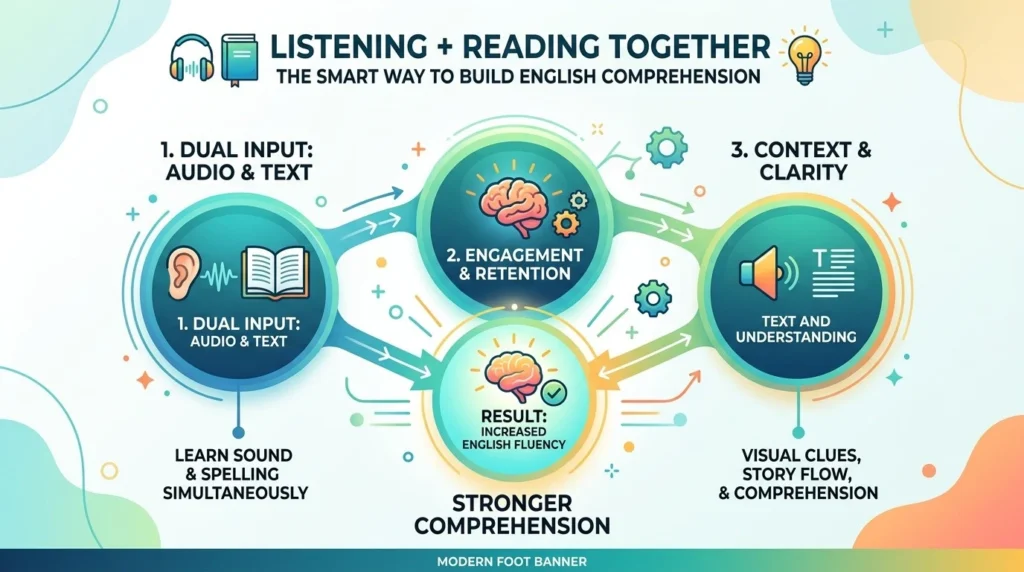
Listening and reading activate different parts of the brain. When both are used together, comprehension becomes significantly stronger.
Imagine reading a news article while simultaneously listening to its audio version. Your eyes recognize spelling, sentence structure, and punctuation, while your ears process pronunciation, rhythm, stress, and natural intonation.
This combined english input method allows learners to connect written and spoken English more efficiently.
Over time, learners notice several improvements:
- Better vocabulary retention
- Improved pronunciation
- Faster reading speed
- Greater understanding of grammar in context
- Increased confidence during conversations
Instead of translating every sentence into your native language, your brain begins to understand English directly. This is exactly how english language acquisition becomes more natural.
The Science Behind Multiple Language Inputs
Language experts often recommend receiving information through multiple channels. Reading alone improves vocabulary, while listening alone develops pronunciation and comprehension.
However, combining both creates stronger neural connections.
When learners practice reading and listening comprehension together, they reinforce the same information twice. This repeated exposure helps the brain recognize patterns much faster.
For example, if you hear the phrase “I’m looking forward to hearing from you” while seeing it written simultaneously, you’re more likely to remember both its meaning and natural pronunciation.
This method is especially valuable because English pronunciation does not always match spelling. Listening while reading helps eliminate confusion.
Practical English Learning Techniques for Busy Adults
One of the biggest misconceptions is that language improvement requires several hours of daily study. In reality, consistency matters more than duration.
Here are several effective english learning techniques that fit into a busy schedule:
Listen While Reading
Choose an audiobook, graded reader, or transcript with matching audio. Follow the text as the narrator speaks.
This is one of the best forms of listening and reading practice because it builds vocabulary, pronunciation, and comprehension simultaneously.
Read Before Listening
Read a short article first, then listen to the audio afterward.
You’ll already understand the topic, allowing you to focus on pronunciation and natural speech instead of decoding every word.
Listen First
Sometimes reversing the order is equally effective.
Listen without subtitles first, then read the transcript to confirm your understanding.
This strengthens English listening practice while improving confidence with authentic speech.
Repeat Short Sections
Replay difficult paragraphs several times.
Each repetition strengthens pronunciation awareness and improves long-term memory.
Building Strong English Comprehension Skills
Many learners know hundreds of English words but still struggle to understand conversations.
The problem usually isn’t vocabulary—it’s processing speed.
Improving english comprehension skills requires regular exposure to complete sentences in realistic situations.
Listening and reading together help learners understand:
- Context
- Word relationships
- Idioms
- Natural sentence patterns
- Everyday expressions
Instead of learning isolated vocabulary, learners absorb language as it is actually used.
This contextual understanding leads to stronger communication abilities.
How Immersion Improves English Fluency Development
Fluency isn’t about speaking quickly.
True fluency means understanding English naturally and responding confidently without translating every sentence mentally.
Consistent immersion supports long-term english fluency development by exposing learners to authentic language repeatedly.
As vocabulary becomes familiar, learners spend less mental energy recalling words and more energy communicating ideas.
This process also supports effective english fluency training, especially when learners regularly repeat phrases aloud after listening.
Shadowing—a technique where learners imitate native speakers immediately after hearing them—is especially useful when combined with reading.
Supporting Exam Success Through Listening and Reading
Immersion doesn’t only improve conversational English. It also supports standardized English exams.
IELTS Listening Improvement
Many learners preparing for IELTS struggle with different accents, connected speech, and fast conversations.
Daily listening while reading transcripts improves IELTS Listening Improvement by increasing familiarity with spoken English.
This method also supports broader IELTS preparation, helping learners recognize keywords, paraphrasing, and context more efficiently.
TOEFL Listening Practice
Academic English often includes lectures, discussions, and complex vocabulary.
Regular TOEFL Listening Practice with matching transcripts allows learners to follow academic content more confidently.
Developing stronger TOEFL Listening Skills also improves note-taking and comprehension during lectures.
TOEIC Listening and Reading
Professionals preparing for workplace English exams can greatly benefit from combined input.
Regular TOEIC Listening and Reading exercises expose learners to business vocabulary, workplace conversations, emails, reports, and announcements.
Because the TOEIC exam measures both reading and listening, practicing both together closely reflects the actual testing experience.
Learn English Naturally Through Context
One of the greatest advantages of immersion is that learners begin to learn English naturally.
Instead of asking, “What grammar rule applies here?” learners simply recognize what sounds correct through repeated exposure.
Context teaches meaning more effectively than memorization.
For example, seeing and hearing the word “appointment” repeatedly in conversations about doctors, meetings, and interviews helps learners understand its usage without lengthy explanations.
This contextual learning makes vocabulary easier to remember and easier to use correctly.
Creating a Daily Immersion Routine
Consistency always beats intensity.
Even 20 to 30 minutes of daily immersion can produce noticeable improvements over several months.
A practical routine might look like this:
- Read and listen to a short article for 10 minutes.
- Replay difficult sections while following the text.
- Repeat useful phrases aloud.
- Listen again later without reading.
- Review new vocabulary in context instead of isolated lists.
This balanced approach combines english reading practice, listening, vocabulary building, and pronunciation into one efficient session.
For busy adults, this routine is sustainable and realistic.

Final Thoughts
Learning English doesn’t have to involve endless grammar drills or overwhelming study schedules. For today’s busy learners, Adult Learning Immersion offers a smarter and more engaging path to success.
By combining listening and reading in English, learners strengthen comprehension, vocabulary, pronunciation, and confidence simultaneously. This powerful english input method accelerates english language acquisition, making it easier to understand English in real-life situations rather than simply memorizing rules.
Whether you’re working toward better communication at work, preparing for international exams like IELTS, TOEFL, or TOEIC Listening and Reading, or simply hoping to become more fluent, daily immersion can transform your progress.
The key is consistency. Small, enjoyable learning sessions repeated every day often produce greater long-term results than occasional intensive study. Start today, stay consistent, and you’ll discover that learning English naturally is not only possible—it can also be enjoyable.
Frequently Asked Questions (FAQs)
1. What is Adult Learning Immersion in English?
Adult Learning Immersion is an approach where learners surround themselves with English through activities like listening, reading, watching videos, and real-life communication. It helps adults absorb the language naturally through continuous exposure rather than relying only on grammar lessons.
2. Why is listening and reading together more effective than studying separately?
Combining listening and reading strengthens vocabulary, pronunciation, grammar recognition, and comprehension simultaneously. This dual-input approach helps the brain connect spoken and written English more efficiently, leading to faster progress.
3. How much daily listening and reading practice is enough?
Even 20–30 minutes of consistent daily listening and reading practice can produce noticeable improvements over time. Regular exposure is more effective than studying for several hours only once or twice a week.
4. Can this method help with IELTS, TOEFL, and TOEIC preparation?
Yes. Listening while reading transcripts improves comprehension, vocabulary, and familiarity with natural speech, making it highly beneficial for IELTS preparation, TOEFL Listening Practice, TOEFL Listening Skills, and TOEIC Listening and Reading exams.
5. Is immersion suitable for beginners?
Absolutely. Beginners can start with graded readers, slow-paced audio, children’s books, or beginner-friendly podcasts. As comprehension improves, they can gradually move to more advanced materials while continuing to build confidence naturally.




Leave a Reply