
When students prepare to study abroad, they often focus on getting the required English test score. They practise IELTS, TOEFL, PTE, or another exam, hoping to prove that their English is strong enough for university admission.
That score matters. It helps universities understand whether you can study in an English-speaking environment.
But after admission, students quickly discover something important: university English is not the same as Everyday English.
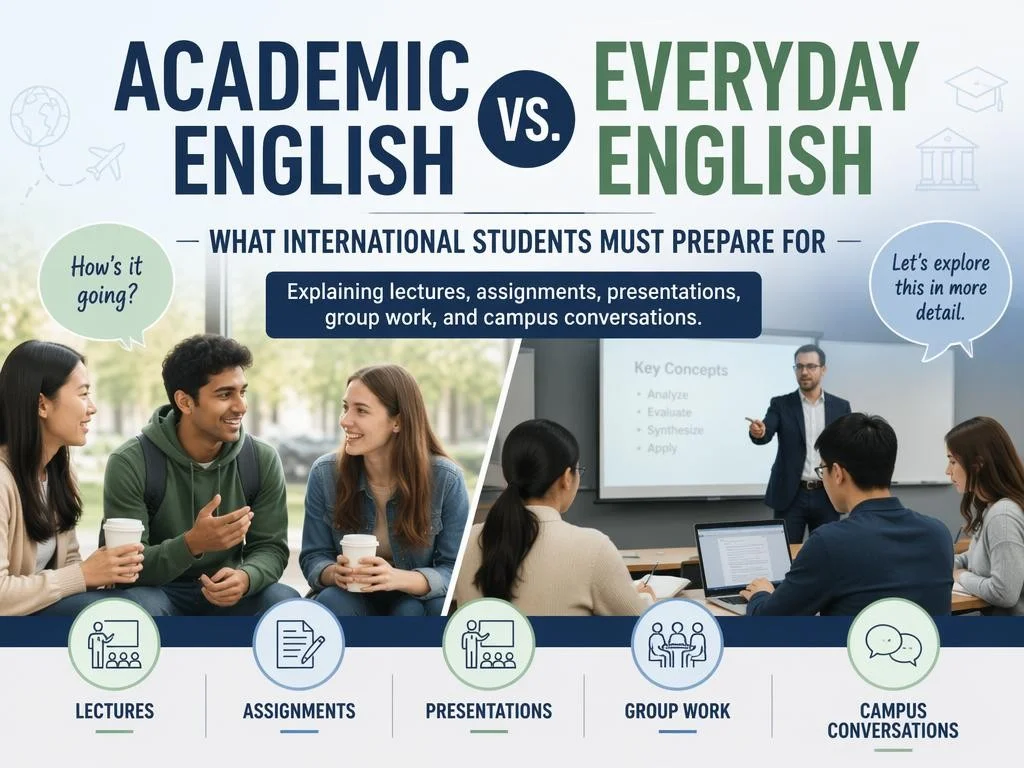
You may be able to order food, chat with friends, watch English videos, or introduce yourself confidently. But university life brings a different kind of language challenge. You need to understand lectures, write assignments, join discussions, give presentations, work in groups, email professors, and explain your ideas clearly.
This is why understanding Academic English vs. Everyday English is so important for international students. Everyday English helps you live abroad. Academic English helps you study, perform, and succeed there.
For students planning their study abroad preparation, both types of English matter.
Read More: Studying Abroad Starts with Language Confidence, Not Just a Visa Application
What Is Everyday English?
Before understanding academic English, it helps to ask: what is Everyday English?
Everyday English is the language people use in normal daily situations. It is the English you use when you buy groceries, talk to flatmates, ask for directions, meet new friends, book an appointment, or join a casual conversation.

For example, Everyday English includes phrases like:
“How’s it going?”
“Can I get a coffee, please?”
“Where is the nearest bus stop?”
“Do you want to meet later?”
“Sorry, I didn’t catch that.”
This type of English is usually more relaxed, direct, and conversational. Sentences may be shorter. People may use slang, idioms, humour, informal expressions, and incomplete sentences.
Everyday English is very important for international student life. It helps you feel comfortable outside the classroom. It helps you make friends, manage daily tasks, and settle into a new country.
But it is not enough on its own.
What Is Academic English?
Now let us answer the next question: what is academic English?
Academic English is the formal, structured language used in universities and higher education. It is the English of lectures, textbooks, research papers, essays, presentations, seminars, academic discussions, and written assignments.
It is usually more organised and precise than Everyday English. It often uses subject-specific vocabulary, logical arguments, evidence, references, definitions, analysis, and a formal tone.
For example, instead of saying, “This idea is good,” academic English may say:
“This approach is significant because it provides a more reliable explanation of the results.”
Instead of saying, “Lots of people moved to cities,” academic writing may say:
“Urban migration increased significantly during this period due to economic and social changes.”
Academic English does not mean using difficult words just to sound intelligent. It means communicating ideas clearly, accurately, and logically.
For students entering English for higher education, academic English is essential.
Academic English vs. Everyday English: The Real Difference
The difference between Academic English vs. Everyday English is not only about vocabulary. It is about purpose.
Everyday English helps you communicate in normal life. Academic English helps you study and think in a university setting.
Everyday English may be casual and personal. Academic English is usually more formal and evidence-based.
In Everyday English, you might say, “I think social media is bad for students.”
In Academic English, you may need to say, “Although social media can support communication and access to information, excessive use may negatively affect students’ concentration, sleep patterns, and Academic performance.”
The Academic version is more balanced, more developed, and more specific.
This is where many international students struggle. They may have good conversational fluency but find it difficult to write essays, understand lectures, or speak in seminars.
That does not mean their English is bad. It simply means they need to build Academic communication skills.
Why Academic English Matters for International Students
Strong Academic English for international students is important because university study is language-heavy.
Even if you are studying engineering, business, medicine, computing, or design, you still need English to explain your knowledge. You may understand the subject in your mind, but if you cannot express it clearly, your performance may suffer.
Academic English helps you:
understand lectures,
read textbooks and research articles,
write essays and reports,
take useful notes,
ask questions in seminars,
give presentations,
join group projects,
email professors professionally,
explain ideas with evidence.
This is why English for studying abroad should include more than test preparation. IELTS or TOEFL can help you build a foundation, but university success requires deeper Academic communication.
Preparing for University Lectures
One of the first challenges international students face is understanding lectures.
Lectures can be fast. Professors may use Academic vocabulary, subject-specific terms, humour, examples, and different accents. They may not repeat every point slowly. They may also assume that students have done the reading before class.
This is why students should learn how to prepare for university lectures before arriving on campus.
A good habit is to read about the topic before the lecture. Even ten or fifteen minutes of preparation can help. If you already know the key terms, you will understand the lecture more easily.
During the lecture, do not try to write every word. Focus on main ideas, definitions, examples, arguments, dates, names, and conclusions. After the lecture, review your notes and fill in gaps while the topic is still fresh.
Listening to online university lectures before studying abroad can also help. It trains your ear for Academic rhythm and classroom language.
Academic Writing Skills
For many students, writing is the hardest part of Academic English.
Academic writing skills are different from everyday writing. You cannot write university assignments like casual messages or social media posts. You need structure, clarity, evidence, and formal expression.
A good Academic paragraph usually has a clear main idea, explanation, evidence or example, and a link back to the question. Essays and reports need introductions, organised body sections, and conclusions.
Students also need to learn how to avoid plagiarism. In many universities, using someone else’s words or ideas without proper reference is a serious issue. Academic writing requires students to summarise, paraphrase, quote carefully, and cite sources correctly.
This can feel difficult at first, especially if your previous education system did not focus much on referencing or independent research.
The good news is that Academic writing improves with practice. Start with short paragraphs. Learn how to make clear arguments. Read sample essays. Ask for feedback. Use university writing support services if they are available.
Presentations and Public Speaking
Many international students feel nervous when they hear the word “presentation.”
This is normal. Speaking in front of classmates can be stressful, especially in a second language.
But presentation skills for students are an important part of university life. You may need to present research, explain a group project, defend an idea, or summarise a case study.
A strong presentation is not about perfect English. It is about clear structure and confident delivery.
Start by organising your presentation into simple parts: introduction, main points, examples, and conclusion. Use slides to support your message, not to carry the whole speech. Practise aloud several times. Record yourself if possible.
Useful Academic presentation phrases include:
“Today, I will be discussing…”
“The main point I want to make is…”
“This example shows that…”
“To conclude…”
These phrases help you sound organised and confident.
University Group Projects
Another major area where students need communication confidence is university group projects.
Group work can be challenging because students must discuss ideas, divide tasks, manage deadlines, solve disagreements, and present together. This requires both English ability and teamwork.
You may need to say things like:
“Which section would you like to work on?”
“I think we should divide the research first.”
“Can we agree on a deadline?”
“I see your point, but maybe we could also consider…”
These are not very difficult sentences, but they require confidence and timing.
Good student communication skills help you contribute without sounding too silent or too aggressive. In international classrooms, it is important to share your ideas politely, listen to others, and ask for clarification when needed.
Campus Conversations and Daily Life
While Academic English is important, Everyday English still matters a lot.
Campus life includes casual conversations before class, messages from classmates, society events, part-time work, accommodation issues, and conversations with university staff.
You may need to explain that you are confused about an assignment, ask where a classroom is, discuss rent with a flatmate, or speak to someone at the student support office.
Everyday English helps you feel included.
Many students underestimate this part. They prepare for essays and exams but feel lonely because they are afraid to start conversations. Simple daily communication can make your study abroad experience much more comfortable.
Try practising small talk before you travel. Learn how to introduce yourself, ask follow-up questions, accept invitations, and politely say no.
Building Academic Communication Skills Before You Travel
Good study abroad preparation should include both Academic and everyday communication.
To build Academic communication skills, start reading articles related to your subject. Watch lectures. Practise taking notes. Write short summaries. Learn common Academic phrases. Practise explaining your opinion with reasons and examples.
To build Everyday English, speak regularly. Join conversation groups. Practise with friends. Watch natural conversations. Learn common phrases for daily situations.
Also, practise switching between formal and informal English. The way you write to a professor is different from the way you message a classmate. The way you speak in a presentation is different from the way you chat in a café.
This flexibility is one of the most useful skills for international students.
Common Mistakes Students Make
One common mistake is thinking that a good English test score means full university readiness. A score is important, but it does not automatically prepare you for every Academic and social situation.
Another mistake is focusing only on grammar. Grammar matters, but communication also needs clarity, confidence, structure, listening, and cultural awareness.
Some students also avoid speaking because they are afraid of mistakes. This slows down improvement. Mistakes are part of learning.
Another mistake is using overly complicated words in Academic writing. Clear and accurate language is better than confusing language.
Finally, many students do not ask for help. Universities often have writing centres, language support, Academic skills workshops, and tutors. Using these services is not a weakness. It is a smart way to improve.
Final Thoughts
The difference between Academic English vs. Everyday English is one of the most important things international students should understand before studying abroad.
Everyday English helps you manage life. Academic English helps you succeed at university.
You need Everyday English to make friends, ask for help, and settle into a new country. You need Academic English to understand lectures, write assignments, give presentations, and join group discussions.
For international students, the goal is not perfect English. The goal is useful, confident, and flexible English.
So, as you prepare for university, do not only prepare for an English test. Prepare for real communication.
Because once you arrive on campus, English will not only be something you study.
It will be something you live through every day.
FAQs
1. What is Academic English?
Academic English is the formal and structured English used in universities. It includes the language of lectures, essays, research papers, presentations, seminars, textbooks, and Academic discussions.
2. What is Everyday English?
Everyday English is the informal language used in daily life. It includes conversations with friends, shopping, asking for directions, making appointments, chatting with classmates, and handling normal social situations.
3. Why is Academic English important for international students?
Academic English is important because students need it to understand lectures, read Academic texts, write assignments, give presentations, join discussions, and succeed in higher education.
4. How can I prepare for university lectures?
You can prepare by reading about the topic before class, learning key vocabulary, practising note-taking, listening to online lectures, and reviewing your notes after each session.
5. Is Everyday English still important if I already know Academic English?
Yes. Everyday English is very important for campus life, friendships, accommodation, part-time work, and daily communication. International students need both Academic English and Everyday English to feel confident abroad.




Leave a Reply