
The language behind every TOEFL iBT section
ETS does not publish a word list for the TOEFL iBT. But the current tasks make vocabulary and grammar visible in almost every section: you complete missing words in Reading, build sentences in Writing, repeat sentences exactly in Speaking, and choose natural replies in Listening. Strong, usable language pays off everywhere.
Where vocabulary and grammar count
| Task | What it demands |
|---|---|
| Complete the Words (Reading) | Vocabulary, word forms and spelling in context |
| Read an Academic Passage (Reading) | Understanding important academic vocabulary |
| Listen and Choose a Response (Listening) | Common spoken patterns and intent |
| Listen to an Academic Talk (Listening) | Sometimes uncommon or idiomatic vocabulary |
| Build a Sentence (Writing) | Word order in sentences and questions |
| Write an Email / Academic Discussion (Writing) | Accurate grammar and suitable tone |
| Listen and Repeat / Take an Interview (Speaking) | Accurate, clearly intelligible speech; appropriate vocabulary and grammar |
Vocabulary: build depth, not just lists
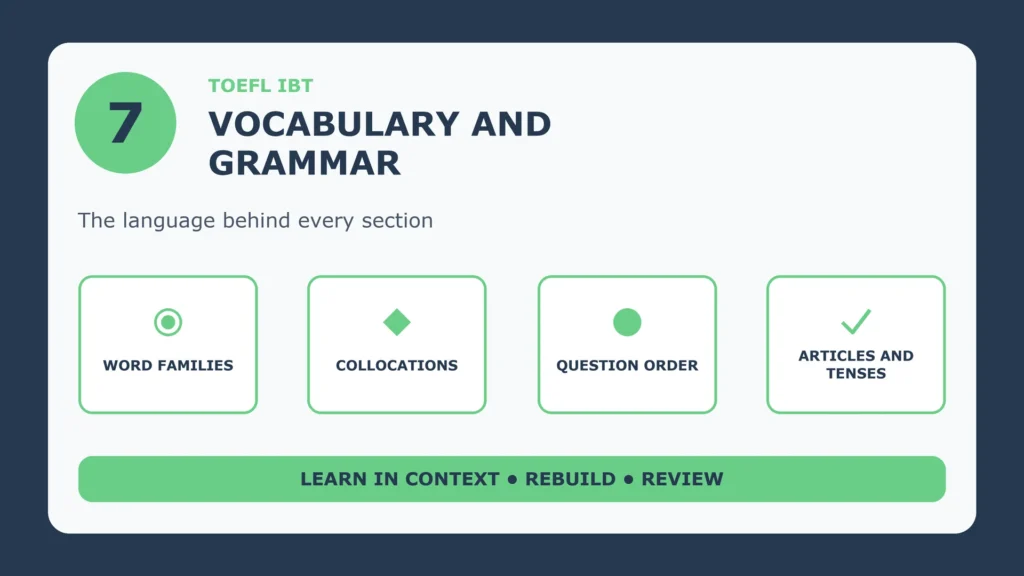
- Word families: economy, economic, economical, economist. Complete the Words tests forms, not just meanings.
- Collocations: conduct research, draw a conclusion, raise a question.
- Academic and campus language: prerequisite, deadline, extension, seminar, enrol.
- Spoken patterns and idioms: I’m not sure that works, it’s up to you, on second thought.
Method: keep a notebook by topic. For each new word, write its forms, two collocations and one sentence of your own, then review it on a spaced schedule.
Grammar: what to prioritise
- Question formation: Could you tell me where the lab is? (not where is the lab).
- Verb tenses and agreement, especially in emails and discussion posts.
- Articles and countable/uncountable nouns: a piece of advice, research (uncountable).
- Relative clauses: the course that I mentioned.
- Word order with adverbs: I have always wanted to…
Practice that transfers to the test
- Sentence rebuilding: scramble sentences from your reading and rebuild them.
- Partial-word gaps: blank out word endings in a paragraph and complete them later.
- Shadowing: repeat short recorded sentences exactly, which trains grammar and pronunciation together.
- Short writing with correction: write a five-sentence email, then check it against your grammar priorities.
Common mistakes
- Knowing a word’s meaning but not its other forms.
- Direct-question word order inside indirect questions.
- Dropping articles and plural endings when speaking or writing quickly.

Quick FAQ
Should I memorise long word lists? Lists help less than learning words in context with their forms and collocations.
Is British or American spelling required? Be consistent. Focus on accurate spelling of the form you choose.
Official ETS sources
Accuracy note (15 September 2026): this article reflects the TOEFL iBT format introduced in January 2026.