
Know every section before test day
IELTS Academic tests Listening, Reading, Writing and Speaking in 2 hours and 45 minutes. The format is the same wherever you take it. Listening and Speaking are identical to IELTS General Training; Reading and Writing are different, with academic texts and tasks. Knowing exactly what each section asks for is the quickest way to stop losing marks to surprises.
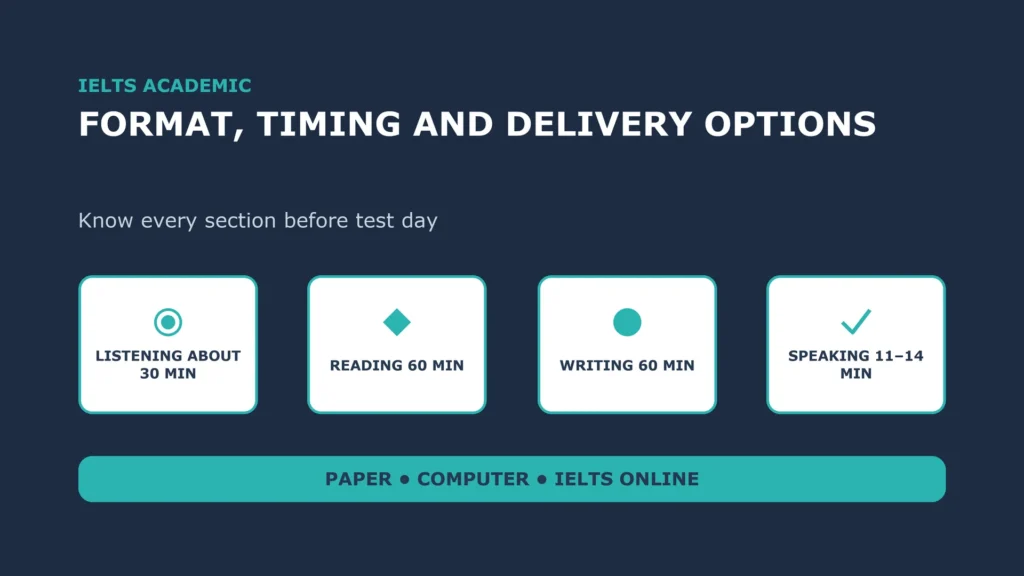
The four sections at a glance
| Section | Time | What you do |
|---|---|---|
| Listening | About 30 minutes | Four parts, 40 questions, each recording heard once |
| Reading | 60 minutes | Three sections, 40 questions, 2,150–2,750 words in total |
| Writing | 60 minutes | Task 1 (at least 150 words) and Task 2 (at least 250 words) |
| Speaking | 11–14 minutes | A three-part interview with an examiner, recorded |
Listening
Parts 1 and 2 are set in everyday social situations: a conversation between two speakers, then one main speaker. Parts 3 and 4 move to educational and training contexts. You hear each recording once only, so preview the questions and keep your place as the audio moves on.
Question types include multiple choice, matching, plan, map or diagram labelling, form, note, table or flow-chart completion, sentence completion and short answers. Completion questions have word limits such as “NO MORE THAN TWO WORDS AND/OR A NUMBER”. Each correct answer earns one mark, and your total converts to a band score.
Reading
The three texts come from books, journals, magazines, newspapers and online sources, written for a non-specialist audience at undergraduate or postgraduate level. There are eleven question types, including True/False/Not Given, Yes/No/Not Given, matching headings, matching features, sentence completion, summary completion and diagram labelling. The 60 minutes include any time you need to record your answers, so do not plan extra time at the end.
Writing
Task 1 asks you to describe visual information, such as a graph, table, chart or diagram, in your own words. Spend no more than 20 minutes on it.
Task 2 asks you to respond to a point of view, argument or problem. Spend no more than 40 minutes on it. Task 2 counts twice as much as Task 1, so protect its time.
Both tasks are marked on Task achievement or Task response, Coherence and cohesion, Lexical resource, and Grammatical range and accuracy. Write in full sentences and connected paragraphs: answers written as notes or bullet points, off-topic answers and plagiarised writing are penalised.
Speaking
- Part 1 (4–5 minutes): introduction and questions about familiar topics.
- Part 2 (3–4 minutes): you get a task card and one minute to prepare, then speak for up to two minutes.
- Part 3 (4–5 minutes): a longer discussion of more abstract ideas linked to Part 2.
The examiner assesses Fluency and coherence, Lexical resource, Grammatical range and accuracy, and Pronunciation.
Paper, computer or online?
IELTS on paper is taken at a test centre. Results are available up to 13 days after the test.
IELTS on computer is also taken at a test centre, with the same content, timing and scoring. Speaking is still a face-to-face interview with an examiner. Results usually arrive within 1–5 days, and IELTS reports that most are issued within two days. In selected countries you can choose to take Writing on paper. Only candidates who took the full test on computer can later book One Skill Retake.
IELTS Online lets you take IELTS Academic at home or in a suitable private location, with Speaking by video call. It is available for IELTS Academic only, and results arrive 6–8 days after the test. You need a laptop or desktop computer with one screen, a webcam, a microphone and speakers, in a quiet, private, well-lit room. IELTS Online is not accepted for immigration or professional registration, and each organisation decides whether it accepts it.
How to choose your mode
- Check acceptance first. The organisation you apply to decides which delivery modes it accepts.
- Think about your deadline. Computer and online results arrive faster than paper results.
- Match your strengths. If you type quickly and accurately, computer delivery may help in Writing. If you think better on paper, choose paper, or Writing on paper where it is offered.
- Practise in the mode you book. Reading on screen, typing answers and handwriting all feel different under time pressure.

Quick FAQ
Is the computer test easier or harder? Neither. The content, timing and scoring are the same; only the way you enter answers changes.
Do I speak to a computer? No. At a test centre, Speaking is a face-to-face interview with an examiner. In IELTS Online it is a video call with an examiner.
Can I use IELTS Online for a visa? No. IELTS Online is not accepted for immigration purposes.
Official IELTS sources
- IELTS Academic test format
- IELTS Academic Listening format
- IELTS Academic Reading format
- IELTS Academic Writing format
- IELTS Academic Speaking format
- Ways to take IELTS
- IELTS Online
Accuracy note (14 September 2026): delivery options, availability and results timings vary by country and can change. Check ielts.org and your test centre before booking.