
English for migration, work and practical life
IELTS General Training assesses English used in practical, social, workplace and training contexts. IELTS recommends it for people planning migration to an English-speaking country or study and training below degree level. It is not automatically the correct choice for every university, profession or visa. The receiving organisation or government route decides which test type and score are acceptable.
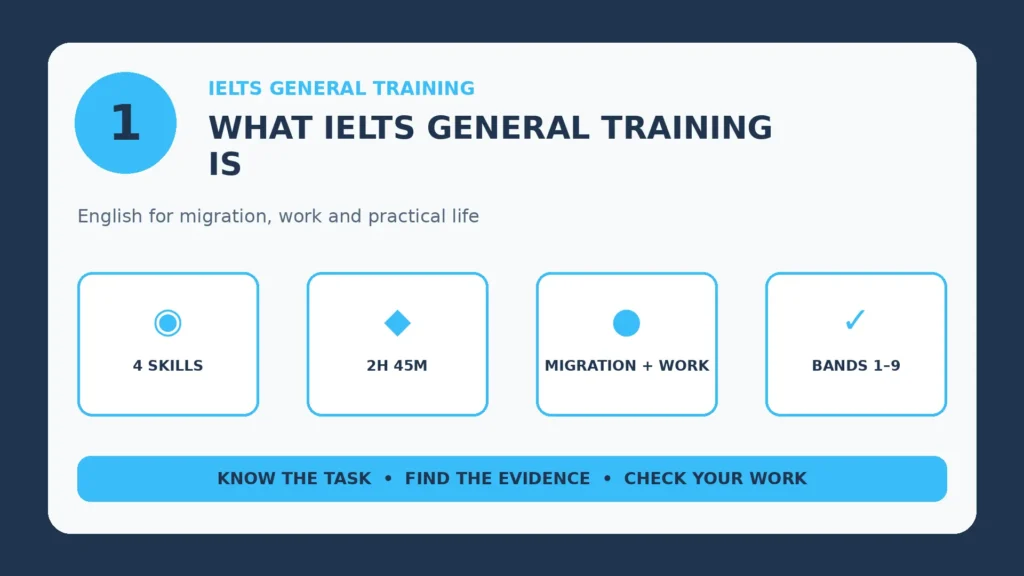
The test covers Listening, Reading, Writing and Speaking. Listening and Speaking are the same in IELTS Academic and General Training, while Reading and Writing differ. General Training Reading uses materials such as notices, advertisements, workplace documents and a longer general-interest text. General Training Writing Task 1 is a letter responding to a situation; Task 2 is an essay.
Read More: Format, Timing and Band Scores
The scheduled testing time is approximately 2 hours 45 minutes: Listening takes about 30 minutes, Reading 60 minutes, Writing 60 minutes and Speaking 11–14 minutes. On paper, Listening normally includes transfer time; delivery details should be confirmed for the booked mode. Speaking may be scheduled separately according to local arrangements.
Results use the IELTS nine-band scale. Candidates receive a score for each skill and an overall band calculated from the four skill scores, rounded according to IELTS rules. Listening and Reading are marked from 40 questions and converted to bands. Writing and Speaking are assessed using published criteria.
General Training suits candidates whose official route specifically requests or accepts it and whose real-world goals align with its content. A candidate applying for postgraduate study may need Academic instead. UK immigration applicants may need an approved IELTS for UKVI version or, for certain routes, a Life Skills test. Never choose solely because someone says General Training is “easier.”
Before booking, make a verification sheet listing the country or organisation, programme or visa category, required test name, overall band, minimum section bands, validity window and deadline. Link every claim to an official source. This small step prevents the expensive mistake of preparing for the wrong assessment.
A practical preparation method
Begin with an official-format diagnostic under time limits. Record the score, but also classify every weak answer: misunderstood instruction, vocabulary gap, lost place, inaccurate spelling, poor evidence, incomplete development or time pressure. For Writing and Speaking, save dated samples and assess them against the public band criteria. A precise error log is more useful than a vague promise to “practise more.”
Use five focused sessions each week. A balanced pattern is one Listening session, one Reading session, two productive-skill sessions and one mixed timed block. Keep vocabulary and grammar review short but frequent. Learn words in collocations and complete examples, then use them in a letter, essay or spoken answer. The purpose is flexible control, not displaying rare words.
Review correct answers that were slow or uncertain as well as wrong answers. In Listening and Reading, locate the evidence and explain why alternatives fail. In Writing, check task fulfilment first, then organisation, vocabulary and grammar. In Speaking, listen for relevance, development, fluency and intelligibility. Improve one recurring weakness, repeat a similar task, and confirm that the correction survives under time pressure.
Each week, complete one realistic simulation using the delivery mode you intend to book. Practise transferring or entering answers correctly, obey exact word limits in completion questions and leave time for checks. During the final week, revisit proven routines rather than collecting new tricks. Protect sleep, confirm identification and appointment details, and treat official IELTS guidance as the authority whenever advice conflicts.

Track progress with evidence rather than mood. Compare raw marks, completion rates, repeated error categories and dated productive samples. A difficult practice day can still be valuable when it exposes one correctable pattern and produces a clear action for the next session.
Quick FAQ
Do I need unusual vocabulary for a high band?
No. Accurate, appropriate and flexible language is more valuable than forced complexity.
Can one strong skill compensate for every weakness?
The overall band is averaged, but many organisations also impose minimum scores in individual skills. Check the exact requirement.
Should I memorise answers?
Memorised language may not address the prompt and can sound unnatural. Practise adaptable structures and genuine development instead.