
Many TOEIC candidates understand more English than their final score suggests.
The problem is often not knowledge. It is performance under examination conditions.
The Listening and Reading test contains 200 questions. Listening takes approximately 45 minutes and Reading 75 minutes, meaning candidates must maintain concentration and make decisions continuously.
Effective time management should therefore be practised long before test day.
Read More: TOEIC Vocabulary and Grammar: What You Really Need to Learn
Understand where time is flexible
Listening and Reading behave differently.
During Listening, the audio determines the pace. If you miss something, the recording continues.
During Reading, you control the 75 minutes yourself.
This means your strategies must differ.
For Listening, practise rapid recovery.
For Reading, practise active time allocation.
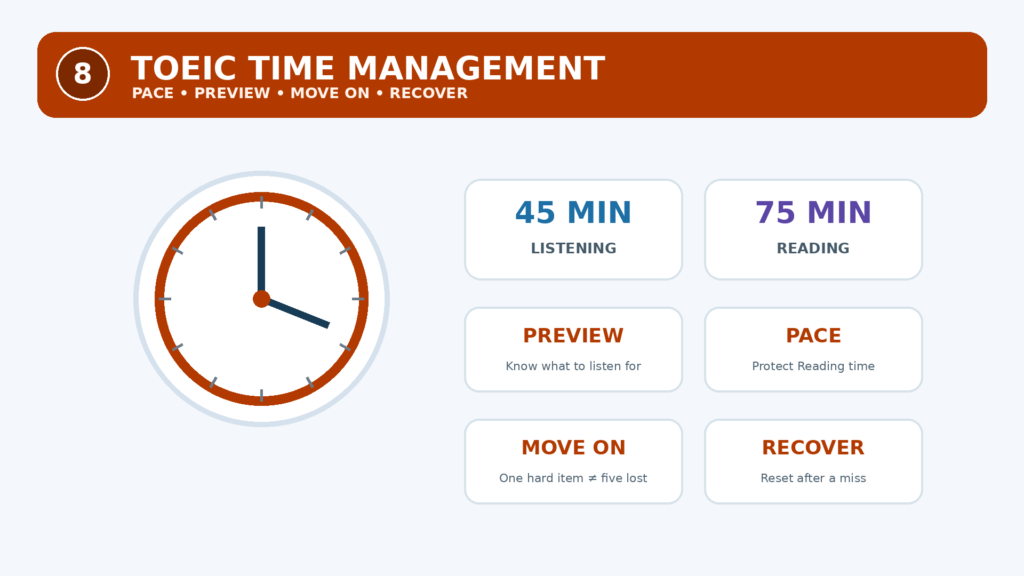
Never sacrifice several questions for one
A common Reading mistake is spending two or three minutes struggling with one difficult vocabulary item.
Even if you eventually answer it correctly, the cost may be several unanswered questions later.
Ask yourself:
“Am I likely to solve this with another ten seconds?”
If not, choose the most plausible option and continue.
Timed examinations reward decision-making, not perfectionism.
Build automatic responses
Some Reading questions should gradually become quick.
If you see:
“The reports must be _____ by Friday.”
and the options contain different grammatical forms of “submit”, recognising that **must be submitted** is required should eventually become almost automatic.
This saves valuable time for complex comprehension passages.
Vocabulary, grammar and question-format familiarity therefore contribute directly to time management.
Look ahead during Listening
During longer Listening sections, use every available moment strategically.
If you can preview questions before a conversation or talk begins, identify what you need to listen for.
Perhaps the questions concern the speakers’ location, a problem and what will happen next.
You now have three listening targets.
This is more efficient than trying to memorise every sentence.

Do not mentally replay mistakes
Suppose you miss a Listening question.
Your brain may begin thinking:
“What did he say? Was it Tuesday? Why didn’t I understand that?”
Meanwhile, the next recording has started.
One mistake has now become three.
Make your best decision and mentally reset.
Successful TOEIC candidates are good at recovering quickly.
Simulate the real test
Untimed question practice is useful while learning a skill, but eventually you must reproduce exam pressure.
Complete full-length sections with:
– no dictionary;
– no telephone;
– no pausing recordings;
– realistic timing;
– minimal interruptions.
Then analyse your performance.
Did accuracy decline near the end?
Did you run out of Reading time?
Did your concentration fall during longer talks?
These observations should shape your training.
Prepare the practical details
Test-day rules can vary by location and administration, so always check the relevant instructions.
Confirm your required identification, test location, reporting time, travel arrangements and any local centre procedures before test day.
Do not discover these details on the morning of the examination.
The day before, prioritise readiness rather than desperate last-minute learning. Sleep is more valuable than midnight cramming.
During the examination use a simple principle:
Easy questions efficiently. Difficult questions decisively.
Do not rush questions you know how to answer. Equally, do not become trapped by questions you do not know.
TOEIC endurance is a genuine skill. Gradually increase practice duration so sustained concentration becomes familiar.
Good time management is not a trick learned the night before. It is the product of repeated timed practice until appropriate pacing becomes automatic.