

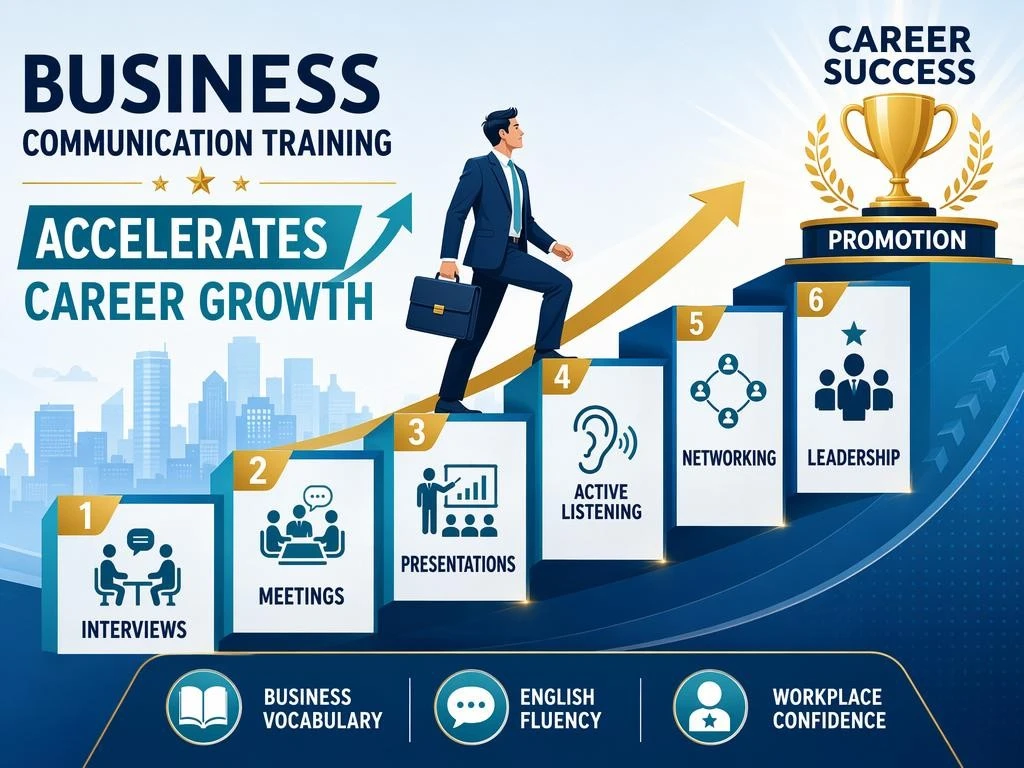
Career progress depends on more than qualifications and technical expertise. Professionals must also explain ideas, build relationships, handle interviews, participate in meetings and communicate decisions.
Focused Business Communication Training can accelerate these abilities by targeting the situations that directly influence workplace readiness, employability and leadership potential.
Instead of spending months on unrelated vocabulary, professionals can practise interviews, presentations, meetings, emails, networking and workplace conversations.
This career-focused approach can support Career Growth in less time because it transforms language knowledge into visible professional performance.
Read More: Accent Training and Pronunciation: Why Clear Speech Matters in Global Business
Why Business Communication Influences Career Growth
Employers do not evaluate knowledge in isolation. They also consider whether a person can communicate that knowledge effectively.
Strong business communication skills help professionals:
- contribute to meetings;
- explain recommendations;
- negotiate priorities;
- give useful updates;
- handle clients;
- manage difficult conversations;
- build professional relationships.
An employee may have excellent technical ability but receive limited recognition if their ideas are unclear or rarely expressed.
Communication makes expertise visible. This visibility supports career success and can lead to promotion, leadership responsibilities and better opportunities.
Why Structured Training Saves Time
Unstructured language study may improve general knowledge, but it does not always address urgent career needs.
Structured business communication training begins with specific goals.
A learner may need to:
- prepare for an interview in three weeks;
- lead a monthly meeting;
- communicate with international clients;
- present a proposal;
- move into management;
- improve workplace emails.
A practical business english course selects the vocabulary and communication tasks connected to these goals.
This approach supports faster career progression because the learner practises high-value skills first.
Communication Training for Professionals
Effective communication training for professionals should be practical.
It may include:
- role plays;
- recorded presentations;
- mock interviews;
- email rewriting;
- meeting simulations;
- negotiation exercises;
- personalised feedback.
Communication is a performance skill. Watching lectures or memorising definitions is not enough.
Professionals need repeated opportunities to speak, write, make decisions and adjust their communication based on feedback.
Interview Communication Training
Interviews are one of the clearest examples of how communication affects opportunity.
Strong job interview communication training helps candidates:
- understand questions;
- organise answers;
- describe achievements;
- explain career decisions;
- demonstrate leadership;
- ask thoughtful questions.
A weak answer might say:
“I am good at solving problems.”
A stronger answer is:
“In my previous role, customer complaints increased after a software update. I created a troubleshooting guide and trained the support team. Complaints fell by 30% within two months.”
This response provides evidence and supports interview success.
Focused training can improve interview performance relatively quickly because candidates often need a limited set of structured examples.
Business Vocabulary and Workplace Readiness
Professionals need vocabulary connected to their responsibilities.
A useful business vocabulary may include terms related to:
- budgets;
- deadlines;
- targets;
- performance;
- recruitment;
- sales;
- operations;
- contracts;
- customer service;
- strategy.
Words should be learned in context.
For example, instead of memorising “forecast,” learners can practise:
- “revise the forecast”;
- “the annual forecast”;
- “forecast slower growth”;
- “compare actual results with the forecast.”
Contextual learning supports practical workplace readiness skills.
Specialist professionals may also need legal business english to understand contracts, compliance, regulations and formal correspondence.
English Fluency and Career Visibility
Limited english fluency may cause professionals to remain silent in meetings or avoid client conversations.
A career-focused programme develops reusable structures for:
- giving updates;
- describing problems;
- explaining causes;
- making recommendations;
- requesting clarification;
- agreeing and disagreeing.
IELTS speaking fluency practice may help learners develop longer, organised responses. PTE speaking practice can improve speed and clarity under time pressure.
However, exam exercises should be combined with realistic workplace tasks.
A professional needs to practise the language used in their actual role.
Meeting Communication
Strong meeting communication is highly visible.
Professionals need phrases such as:
- “Could we return to the main objective?”
- “I would like to add one point.”
- “What impact would this have on the budget?”
- “Let me summarise what we have agreed.”
- “Who will be responsible for the next step?”
These structures reduce hesitation and help meetings produce decisions.
Professionals also need to disagree constructively:
“I understand the reasoning, but I am concerned about the implementation timeline.”
This communicates respect while introducing a valid concern.
Regular workplace communication course practice can make these phrases feel natural.
Active Listening
Active listening is a central part of business communication.
It involves:
- giving full attention;
- identifying the main message;
- asking relevant questions;
- paraphrasing key points;
- noticing uncertainty;
- confirming actions.
A manager might say:
“So, your main concern is that the deadline does not allow enough time for testing. Is that correct?”
This response shows understanding and reduces conflict.
Active listeners often build stronger professional relationships because colleagues feel heard and respected.
Verbal Communication and Leadership
Verbal communication becomes more important as professionals move into management.
Leaders must:
- set expectations;
- explain decisions;
- give feedback;
- motivate employees;
- address conflict;
- communicate change.
A vague message such as “Your performance needs to improve” may create anxiety without providing direction.
A clearer message is:
“The last three reports contained missing figures. Please use the revised checklist and send the next report for review before submission.”
This version identifies the problem and provides an action.
Strong communication skills for managers make leadership more consistent and fair.
Corporate Communication
Corporate communication includes messages shared with employees, customers, partners, investors and the public.
A corporate communication training programme may establish standards for:
- internal updates;
- client correspondence;
- presentations;
- crisis communication;
- remote meetings;
- customer complaints;
- cross-cultural interaction.
Clear corporate messages protect trust and reduce organisational risk.
Employees should learn to consider:
- the audience;
- the purpose;
- the level of detail;
- the likely response;
- confidentiality.
This is especially important in international companies.
Workplace Communication Skills and Promotion
Promotion decisions often involve communication-related questions:
- Can this person manage stakeholders?
- Can they represent the team?
- Can they explain complex information?
- Can they handle disagreement?
- Can they lead meetings?
- Can they communicate with senior management?
Strong workplace communication skills provide evidence that an employee is ready for greater responsibility.
Professionals seeking promotion should also learn to communicate achievements clearly.
Instead of saying:
“I managed the reporting system.”
They might say:
“I redesigned the reporting process, reducing preparation time by 20%.”
This demonstrates impact.
Presentation Training
Workplace presentation training helps professionals organise information and influence decision-makers.
A strong presentation should include:
- a clear objective;
- a small number of main points;
- supporting evidence;
- a recommendation;
- a concise conclusion.
Useful signposting language includes:
- “Today, I will focus on three areas.”
- “The main challenge is…”
- “This data indicates…”
- “Our recommendation is…”
- “The next step should be…”
Presentation practice improves both language and leadership presence.
Professional Networking
Professional networking can create access to jobs, partnerships, mentors and knowledge.
Networking requires more than collecting contact details. Professionals need to introduce themselves clearly and maintain relationships.
A useful professional introduction may explain:
- the person’s role;
- their area of expertise;
- the problems they solve;
- the reason for attending the event.
Follow-up communication is equally important.
A brief message such as “It was a pleasure discussing digital training with you yesterday. I would be interested in continuing our conversation” can strengthen the connection.
Developing professional networking skills supports long-term Career Growth.
English for Leadership Roles
English for leadership roles involves more than advanced grammar.
Leaders need to:
- communicate expectations;
- inspire confidence;
- explain difficult decisions;
- manage conflict;
- provide feedback;
- represent the organisation.
A specialised corporate English programme may combine language, leadership and cultural awareness.
This allows professionals to prepare for managerial responsibilities rather than waiting until they are promoted.
Professional Development Through Deliberate Practice
Communication should form part of a wider professional development plan.
A learner may focus on one skill each month:
- Month 1: interview answers;
- Month 2: meeting participation;
- Month 3: presentations;
- Month 4: email writing;
- Month 5: negotiation;
- Month 6: leadership conversations.
This creates measurable progress.
Professional skills training should be challenging enough to produce improvement but relevant enough to maintain motivation.
Choosing a Business Communication Course
A useful business communication course online or in person should include:
- a needs assessment;
- realistic scenarios;
- role-specific vocabulary;
- speaking and writing;
- personalised feedback;
- measurable goals;
- progress reviews.
A programme should not rely only on lectures or vocabulary lists.
Professionals should look for business communication coaching that allows them to practise situations they actually encounter.
How Quickly Can Results Appear?
No responsible programme can promise complete fluency in a few days. However, targeted improvements may appear within weeks.
Learners may quickly become better at:
- structuring interview answers;
- opening meetings;
- giving short updates;
- writing clearer emails;
- asking professional questions;
- introducing themselves at networking events.
The speed of progress depends on practice frequency, feedback and the learner’s starting point.
Targeted training improves efficiency because it directs effort towards communication tasks with immediate career value.

Conclusion
Business Communication Training can accelerate professional progress by focusing on the situations that influence recruitment, workplace performance and promotion.
It strengthens business communication skills, active listening, interview performance, meeting participation, networking and verbal communication.
Training cannot replace technical expertise, but it helps professionals demonstrate that expertise clearly.
When employees communicate with confidence, clarity and purpose, they are better prepared to pursue opportunities, accept leadership responsibilities and achieve lasting career success.
Frequently Asked Questions
1. How does business communication training support Career Growth?
It improves performance in interviews, meetings, presentations, networking and leadership conversations, all of which influence professional opportunities.
2. Is a business English course useful for fluent English speakers?
Yes. Fluent speakers may still need help with professional tone, concise writing, negotiation, presentations or leadership communication.
3. Can communication training improve interview success quickly?
Focused practice can produce noticeable improvement within weeks, especially when candidates receive personalised feedback.
4. What should corporate communication training include?
It should include realistic scenarios, speaking and writing practice, workplace vocabulary, audience awareness, feedback and measurable goals.
5. Is communication more important than technical ability?
Both are essential. Technical knowledge creates value, while communication allows professionals to explain, apply and demonstrate that value.




Leave a Reply