
Build accurate legal vocabulary and grammar
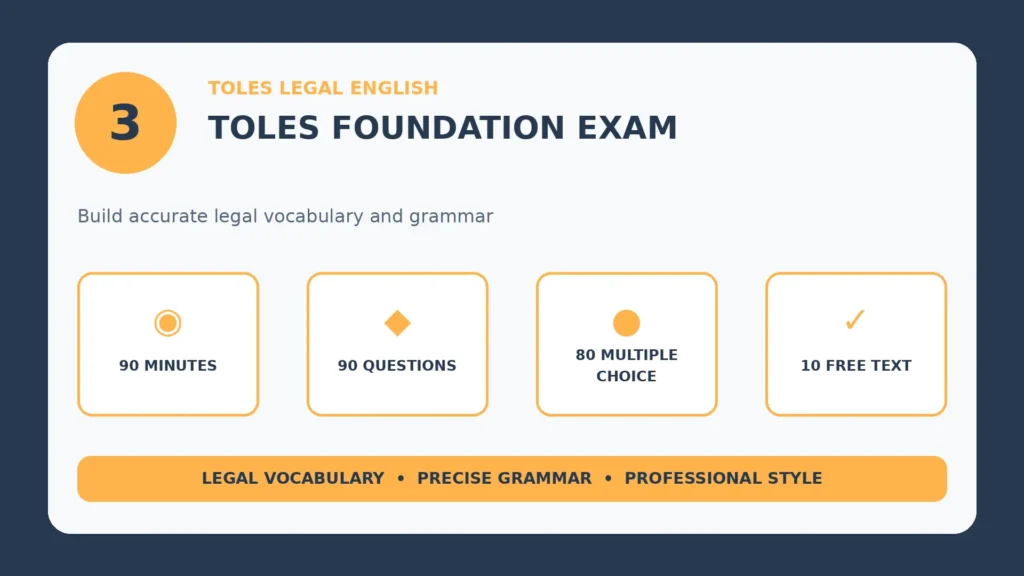
The TOLES Foundation exam is the first certification level. It is a secure, proctored online test lasting 90 minutes. The current format contains ten sections and 90 questions: 80 multiple-choice and ten free-text items typed by the candidate. It tests legal-English reading and writing skills.
Foundation is designed for candidates who have recently begun commercial legal English. TOLES recommends at least elementary or lower-intermediate general English, approximately A2+. The level is not simplistic: it expects precision with vocabulary and grammar that ordinary English courses rarely teach.
Read More: TOLES Foundation Exam
The syllabus covers real court cases, bank accounts and loans, common-law contracts, oral and written agreements, sole traders, partnerships and LLPs, limited companies, insolvency, litigation, landlord and tenant, tort, negligence, nuisance, employment, intellectual property, alternative dispute resolution and the operation of common law.
Preparation should start with high-frequency contrasts: claimant and defendant, borrow and lend, breach and terminate, damages and damage, employer and employee, assignor and assignee. Learn verb–noun and adjective–noun combinations, prepositions and word families. A legal term known only through translation may still be unusable in a sentence.
Grammar work should include tense, passive voice, modal obligation, conditionals, relative clauses, articles, prepositions and agreement. Study grammar inside legal examples. “The agreement was terminated” expresses a different focus from “the supplier terminated the agreement,” and a misplaced modal can change the degree of obligation.
The ten free-text questions require active recall and exact typing. Practise producing terms without options, checking spelling and grammatical form. In multiple-choice work, resist selecting a familiar-looking word before reading the complete sentence.
A strong Foundation result indicates readiness to progress toward Higher, but the certificate also documents useful core legal English in its own right. Use the band description to identify whether vocabulary breadth, grammatical accuracy or document familiarity needs further work.
A practical preparation method
Begin with the free official example for the intended level. Work under time, then classify every error: unfamiliar legal term, collocation, grammar, document structure, common-law concept, misleading option, typing or time management. Record uncertain correct answers too. A percentage alone cannot show which language behaviour should change.
Use five focused sessions each week. Rotate vocabulary, grammar, legal reading, contract language and timed question practice. Keep an active notebook with the term, plain-English meaning, common collocations, contrast with a near-synonym and one authentic sentence. Learn language as lawyers use it in clauses, correspondence and commercial situations—not as disconnected word lists.
Review requires evidence. For multiple-choice questions, explain why the selected option fits the grammar, meaning and professional context and why each distractor fails. For free-text items, check spelling, form, precision and whether the expression is the standard legal collocation. Rewrite difficult sentences in clearer modern legal English without changing legal effect.
Complete a realistic online simulation regularly. Reproduce the intended 90- or 120-minute limit, secure-browser behaviour, typing and proctoring conditions. Use no unauthorised references. Afterwards, separate language problems from interface and concentration problems, correct one pattern, and repeat a related set under time.
Track evidence rather than mood: percentage, accuracy by topic, time per section, repeated grammar errors and vocabulary successfully recalled in context. In the final week, revisit proven material, complete technical checks, confirm identification and appointment details and protect sleep. Official TOLES guidance overrides unofficial shortcuts.

Keep professional usefulness at the centre of study. Ask whether each new expression helps you interpret a clause, explain a legal relationship, draft more clearly or avoid ambiguity. This makes exam preparation valuable beyond the certificate itself.
Quick FAQ
Is TOLES a law-degree examination?
No. It tests specialised legal English, particularly the language used in international commercial legal work.
Does a TOLES certificate expire?
TOLES states that its certificates are valid for life.
Is there a pass mark?
TOLES does not describe the exams as pass/fail. Candidates receive a percentage and a performance band indicating their legal-English level at that exam tier.