
Reasoning with numbers, not heavy calculation
Quantitative Reasoning has 21 Problem Solving questions in 45 minutes. Each has five answer choices, and there is no calculator. The content is arithmetic and algebra at roughly school level; geometry is not on GMAC’s content list.
The difficulty comes from the reasoning, not the maths. Questions are often word problems that hide a simple idea under business or everyday detail, and the answer choices are built to catch common slips.
Typical areas include number properties (divisibility, factors, odd and even, positive and negative), fractions, decimals and percents, ratios and rates, work and mixture problems, equations and inequalities, functions, counting and probability, and basic statistics such as averages and spread.
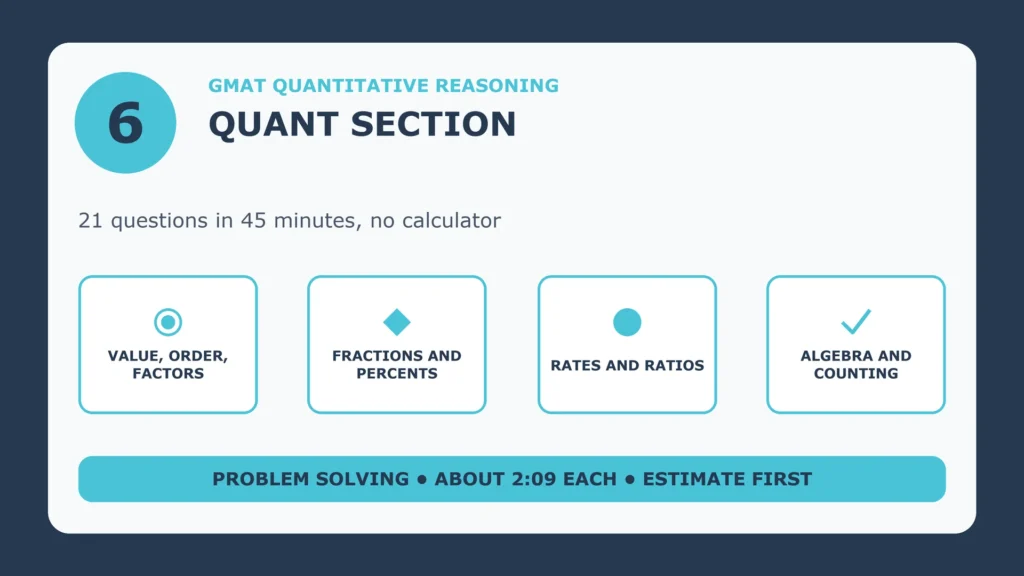
At about 2 minutes 9 seconds per question, there is no time for long calculation. Strong test-takers estimate, test answer choices, pick convenient numbers and notice when a question can be solved by logic alone.
Read More: GMAT Data Sufficiency: How the Answer Choices Work
A preparation method that works
First rebuild the basics without a timer: mental arithmetic, percent change, fraction work, and the rules for exponents and inequalities. Speed comes from fluency in these steps.
Then practise by topic, and for each question you miss, write down the rule or idea you needed. Name the rule: “the number of factors comes from the prime factorisation” is more useful than a page of working.
Finally, do mixed timed sets of 21 questions. Mixed sets train the hardest skill on test day: recognising quickly which idea a question needs.

Keep an error log by topic and by mistake type: misread question, arithmetic slip, wrong method or time pressure. The pattern tells you what to practise next.
Quick FAQ
Is there a calculator in Quant?
No. A calculator is available only in Data Insights.
Is Data Sufficiency in the Quant section?
No. In the Focus Edition, Data Sufficiency is part of Data Insights. Quant is Problem Solving only.
How hard is the maths?
The content is mostly school-level arithmetic and algebra. The challenge is reasoning quickly and avoiding traps.
Official GMAT sources
Ready for structured practice? See the GMAT course.