
Decide what is enough, not what is true
A Data Sufficiency question gives a question and two statements. Your job is to decide whether the statements give enough information to answer the question. You rarely need to work out the answer itself.
The five answer choices are always the same. (A) Statement 1 alone is sufficient, but statement 2 alone is not. (B) Statement 2 alone is sufficient, but statement 1 alone is not. (C) Both statements together are sufficient, but neither alone is. (D) Each statement alone is sufficient. (E) The statements together are not sufficient.
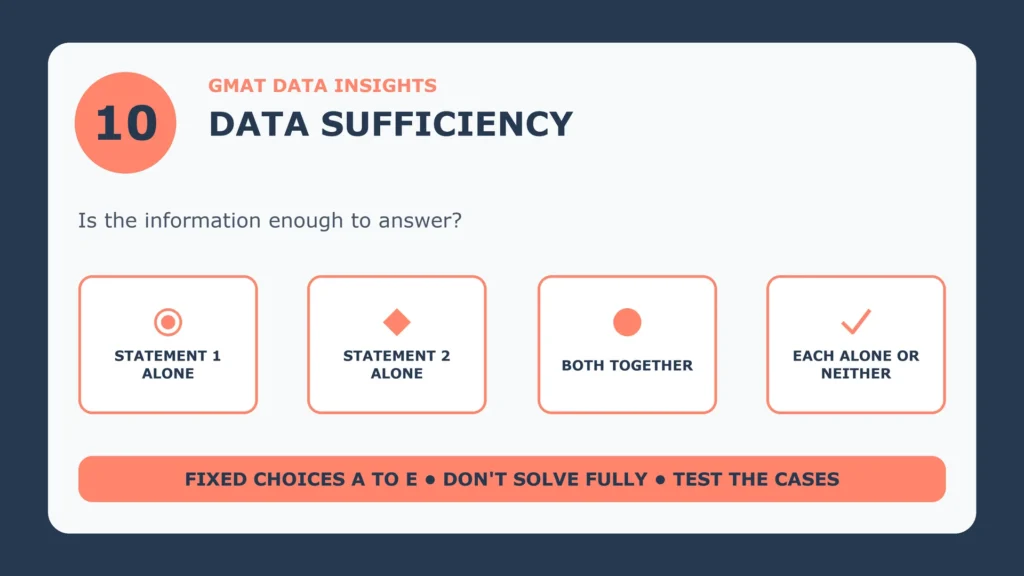
For a value question, “sufficient” means the information leads to exactly one value. For a yes/no question, it means the answer is always yes or always no; a definite “no” is sufficient too.
Read More: GMAT Data Insights: The Five Question Types
A step-by-step method
First, rephrase the question: what exactly would you need to know? Then judge statement 1 on its own, then statement 2 on its own, forgetting statement 1 completely. Only if neither works alone, combine them.
Test cases when a statement involves variables. Try numbers that fit the statement, including negatives, zero and fractions where they are allowed. If two allowed cases give different answers, the statement is not sufficient.
Watch for the common traps: carrying information from statement 1 into your judgement of statement 2, assuming numbers are integers or positive when the question does not say so, and choosing C when one statement was already enough.

Practise Data Sufficiency in its own short sets until the A-to-E logic is automatic, then mix it into full Data Insights sets so you can switch between question types under time.
Quick FAQ
Do I have to calculate the answer?
Usually not. You only need to know whether a single answer can be determined.
Is a definite “no” sufficient?
Yes. For a yes/no question, information that always gives “no” is sufficient.
Do the answer choices ever change?
No. The five choices are the same on every Data Sufficiency question.
Official GMAT sources
Ready for structured practice? See the GMAT course.
Read next: GMAT Data Insights: Tables, Graphs and Two-Part Analysis.