

Preparing to study abroad is exciting, but it can also feel like standing in front of a long checklist. University applications, visa documents, finances, accommodation, recommendation letters, SOPs, and deadlines all compete for attention. In the middle of this, one important task often becomes stressful: English proficiency preparation.
For many students, an English test is not just another exam. It is a gateway. Your TOEFL, IELTS, PTE, Duolingo English Test, or another language proficiency score can influence your eligibility, admission timeline, scholarship chances, and confidence before you enter an international classroom.

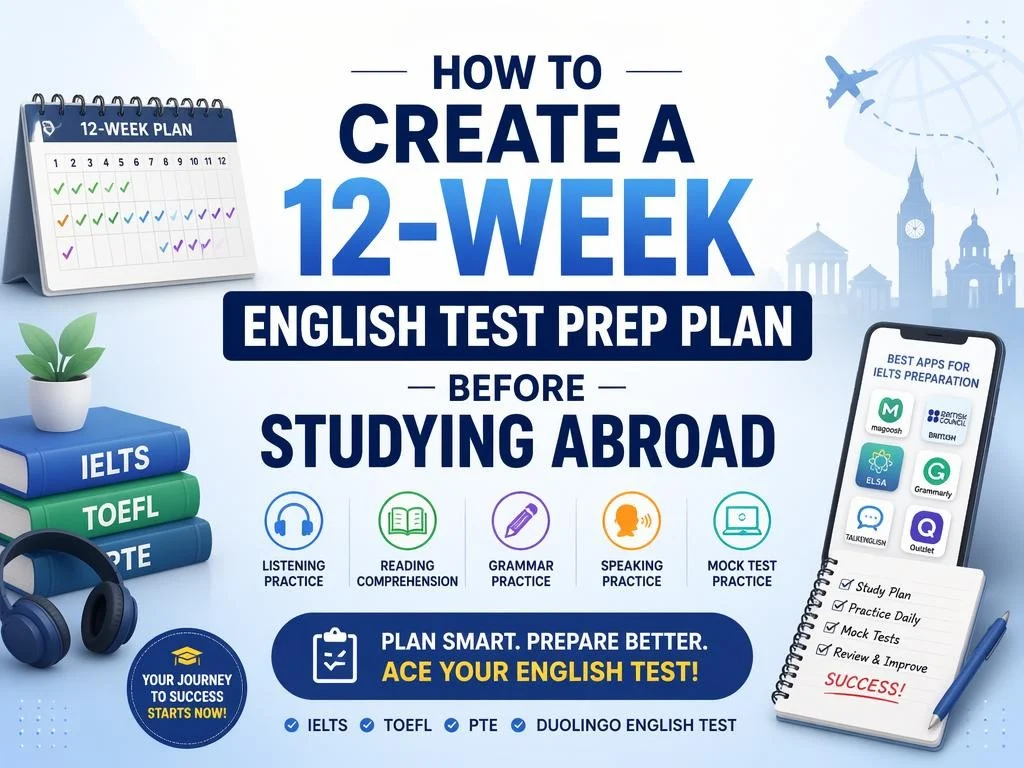
The good news is that three months is enough time to prepare seriously, provided you follow a clear structure. Many students ask, how to prepare for IELTS in 3 months or how to prepare for TOEFL without feeling lost. The answer is not to study randomly every day. The answer is to build a smart 12-week plan with diagnostics, skill-building, practice, mock tests, review, and exam day preparation.
This guide gives you a practical 12-week English proficiency test preparation plan before studying abroad.
Read More: Academic English vs Everyday English: What International Students Must Prepare For?
Why a 12-Week Plan Works
A 12-week timeline is ideal because it gives students enough time to understand the exam format, strengthen weak areas, build academic English skills, practise regularly, and take mock tests before the real exam.
Many students make the mistake of beginning with full-length tests immediately. Others spend weeks watching videos without tracking improvement. Some focus only on grammar practice or vocabulary improvement and ignore speaking practice or listening practice. A structured plan prevents these mistakes.
A good IELTS preparation plan, TOEFL study plan, PTE preparation plan, or Duolingo English Test preparation schedule should answer five questions:
Where do I stand today?
Which test do I need for my target university?
Which skills are weak?
How many mock tests should I take?
What should I do in the final week before the exam?
Before you begin, always check your target university admission requirements. Some institutions accept IELTS, TOEFL, PTE, and Duolingo, while others may prefer specific tests or ask for minimum section scores. Your plan should begin with the score you need, not just the score you hope to get.
Week 1: Understand the Test and Take a Diagnostic Mock
The first week is for clarity. Do not start by collecting too many resources. Start by understanding the exam you are taking.
If you are preparing for IELTS, understand the four sections: Listening, Reading, Writing, and Speaking. If you are preparing for TOEFL, understand its academic style, integrated tasks, and timing. For PTE, learn how the computer-based scoring pattern works. For Duolingo, understand the adaptive format and shorter test structure.
Students often compare Duolingo English Test vs IELTS at this stage. Duolingo is shorter, online, and accepted by many institutions, but IELTS is still widely recognized across countries and universities. Your choice should depend on your university requirements, comfort with the test format, and application deadlines.
At the end of Week 1, take a diagnostic test. This can be an IELTS mock test online, a TOEFL mock test, or a platform-based practice test. The purpose is not to get a perfect score. The purpose is to identify your starting point.
After the test, write down your weak areas. Did you lose marks in reading comprehension? Did you struggle with essay structure? Was speaking difficult? Did listening speed feel too fast? This diagnosis will guide the next 11 weeks.
Weeks 2 and 3: Build Your Foundation
The second and third weeks should focus on fundamentals. This is where you strengthen your base before attempting advanced practice.
Begin with grammar practice, but keep it practical. You do not need to memorize every grammar rule. Focus on sentence structure, tenses, articles, prepositions, subject-verb agreement, and connectors. These directly affect writing and speaking scores.
Next, work on vocabulary improvement. Build vocabulary around common academic themes such as education, technology, environment, health, work, culture, globalization, and social change. Do not simply memorize word lists. Learn how to use words in sentences.
Also begin daily listening practice. Listen to lectures, interviews, academic podcasts, and student discussions. International education environments expose students to different accents, so try to listen to British, American, Australian, Canadian, and non-native English speakers.
For speaking practice, begin small. Record yourself answering simple questions: “Why do you want to study abroad?” “What subject are you planning to study?” “What are your career goals?” Listening to your own recording may feel uncomfortable at first, but it is one of the fastest ways to improve fluency.
Weeks 4 and 5: Focus on Reading and Listening
By Week 4, you should start building test-specific skills. Reading and listening are often underestimated because students assume they can “understand English.” But exam English is different. It tests speed, concentration, detail, inference, and accuracy.
For reading comprehension, practise skimming and scanning. Skimming helps you understand the general meaning quickly. Scanning helps you find specific information. In IELTS, you may face True/False/Not Given questions, matching headings, sentence completion, and multiple-choice questions. In TOEFL, reading passages are more academic and may include vocabulary-in-context and inference questions.
Set a daily reading target. Read one passage and review every wrong answer. The review is more important than the attempt. Ask yourself: Did I misunderstand the question? Did I miss a keyword? Did I assume too much?
For listening practice, use timed exercises. Many students understand audio when they listen casually but lose marks during the test because they cannot process information quickly. Practise note-taking, especially if you are following a TOEFL preparation for beginners plan. TOEFL listening often requires students to remember lecture structure, examples, and speaker attitude.
At the end of Week 5, take a section-wise mock test for reading and listening.
Weeks 6 and 7: Strengthen Writing and Speaking
Writing and speaking are the sections where many students need the most guided practice. These are also the sections where self-confidence matters.
For IELTS writing, practise Task 1 and Task 2 separately. Learn how to describe charts, trends, comparisons, processes, or maps. For Task 2, focus on essay structure: introduction, clear opinion, body paragraphs, examples, and conclusion.
For TOEFL writing, understand integrated and academic discussion-style tasks. You need to summarize, compare, respond, and support your ideas clearly. The goal is not to sound complicated. The goal is to sound clear, organized, and relevant.
Speaking practice should become daily by this stage. If you are wondering how to prepare for IELTS speaking, start with familiar topics such as family, studies, hobbies, travel, technology, and future plans. For TOEFL, practise timed responses. TOEFL speaking practice is especially useful because it trains you to think, structure, and speak within a short time.
You can also explore IELTS preparation with AI during this phase. AI tools can help generate speaking questions, review grammar, suggest vocabulary, and simulate interview-style practice. However, do not depend only on AI. Human review, teacher feedback, or expert evaluation can help you understand tone, clarity, and naturalness better.
Week 8: Take Your First Full-Length Mock Test
Week 8 is the right time to take your first complete mock test under exam-like conditions. Choose a reliable IELTS mock test, TOEFL mock test, PTE mock, or Duolingo practice test depending on your exam.
Do not pause between sections unless the real test allows it. Use the correct timing. Avoid distractions. Sit at a desk. Keep your phone away. Treat it like the real exam.
After the test, spend more time reviewing than testing. This is where serious improvement happens. Divide mistakes into categories:
Content mistakes
Time management mistakes
Vocabulary mistakes
Grammar mistakes
Misread questions
Weak structure
Loss of concentration
This review will tell you what to fix in Weeks 9 and 10.
Weeks 9 and 10: Repair Weak Areas
These two weeks are your improvement zone. Do not study everything equally. Focus on the areas where you are losing the most marks.
If reading is weak, practise two passages daily and review wrong answers carefully. If listening is weak, increase audio practice and work on note-taking. If writing is weak, write at least three essays per week and get feedback. If speaking is weak, practise every day with timed answers.
Students searching for the best apps for IELTS preparation should choose tools that provide timed practice, vocabulary support, sample answers, and performance tracking. Apps can be helpful, but they should not replace full-length mock tests or expert feedback.
This is also a good time to try an online IELTS mock test free if you are still exploring your level. However, for serious preparation, use high-quality mock tests that closely match the real exam pattern. Free resources are useful, but not all free tests are accurate.
Week 11: Final Mock Test and Score Strategy
In Week 11, take another full-length mock test. This time, your goal is not only practice. Your goal is score strategy.
Check whether you are close to your target score. Are you meeting the minimum university admission requirements? Are you weak in one section? Do you need a higher writing or speaking score for a specific university?
For example, some universities may require an overall IELTS score but also a minimum score in each band. A student with a strong overall score may still face difficulty if one section is below the required minimum.
This is why mock testing matters. It reduces surprises. A good mock test shows whether you are ready to book the actual exam or whether you need more practice.
Week 12: Exam Day Preparation
The final week is not for panic studying. It is for exam day preparation.
Review test rules, documents, reporting time, identification requirements, and test centre location. For online tests, check your internet, laptop, camera, microphone, room setup, and test environment.
Revise templates, common vocabulary, speaking structures, and writing formats. But avoid learning too many new things at the last moment. Sleep properly. Eat well. Keep your mind calm.
On the day before the exam, do light revision. Listen to English, speak for a few minutes, review common errors, and stop. Confidence matters. A tired brain performs poorly even when it knows the content.
A Simple Weekly IELTS Preparation Schedule
A practical IELTS preparation schedule or English test plan could look like this:
Monday: Reading comprehension and vocabulary
Tuesday: Listening practice and grammar practice
Wednesday: Writing task practice
Thursday: Speaking practice and pronunciation
Friday: Mixed section practice
Saturday: Timed section test or mock test
Sunday: Review mistakes and plan the next week
The same structure can be adapted for TOEFL, PTE, or Duolingo English Test preparation. The key is consistency.
Final Thought: Prepare for the Test, But Also Prepare for Life Abroad
English proficiency test preparation should not be seen only as a score-building exercise. It is preparation for the classroom, friendships, presentations, internships, interviews, and student life abroad.
When you practise listening, you are preparing to understand professors. When you practise speaking, you are preparing to join discussions. When you practise writing, you are preparing for assignments and emails. When you improve vocabulary, you are preparing to think and express yourself better.
A strong 12-week plan can turn anxiety into direction. And regular mock tests can show you exactly where you stand before the real exam.
Before you apply, before you fly, and before you sit in your first international classroom, give yourself the advantage of structured preparation. Start with a mock test, follow a plan, and build the confidence to use English not just in the exam—but in the life that comes after it.
FAQs
1. How do I prepare for IELTS in 3 months?
To prepare for IELTS in 3 months, start with a diagnostic IELTS mock test, then divide your preparation across listening, reading, writing, and speaking. Spend the first few weeks building grammar, vocabulary, and academic English skills. Use the middle weeks for section-wise practice and the final weeks for full-length mock tests and exam day preparation.
2. How should beginners prepare for TOEFL?
TOEFL preparation for beginners should start with understanding the test format and practising academic listening, reading, speaking, and writing. A good TOEFL study plan should include note-taking practice, timed speaking responses, vocabulary improvement, and regular TOEFL mock test attempts.
3. Is Duolingo English Test easier than IELTS?
The answer depends on the student. When comparing Duolingo English Test vs IELTS, Duolingo is shorter and can be taken online, while IELTS has a more traditional format and is accepted by many universities worldwide. Students should choose based on university admission requirements and their comfort with the test format.
4. Are free online IELTS mock tests useful?
Yes, a free online IELTS mock test can be useful for initial practice and understanding the exam pattern. However, students should also take high-quality paid or expert-reviewed IELTS mock tests because not all free tests accurately reflect the real exam level or scoring system.
5. Can AI help in IELTS preparation?
Yes, IELTS preparation with AI can help students practise speaking questions, improve grammar, generate writing topics, review vocabulary, and create study schedules. However, AI should be used along with proper mock tests, expert feedback, and consistent human-led practice for best results.




Leave a Reply