

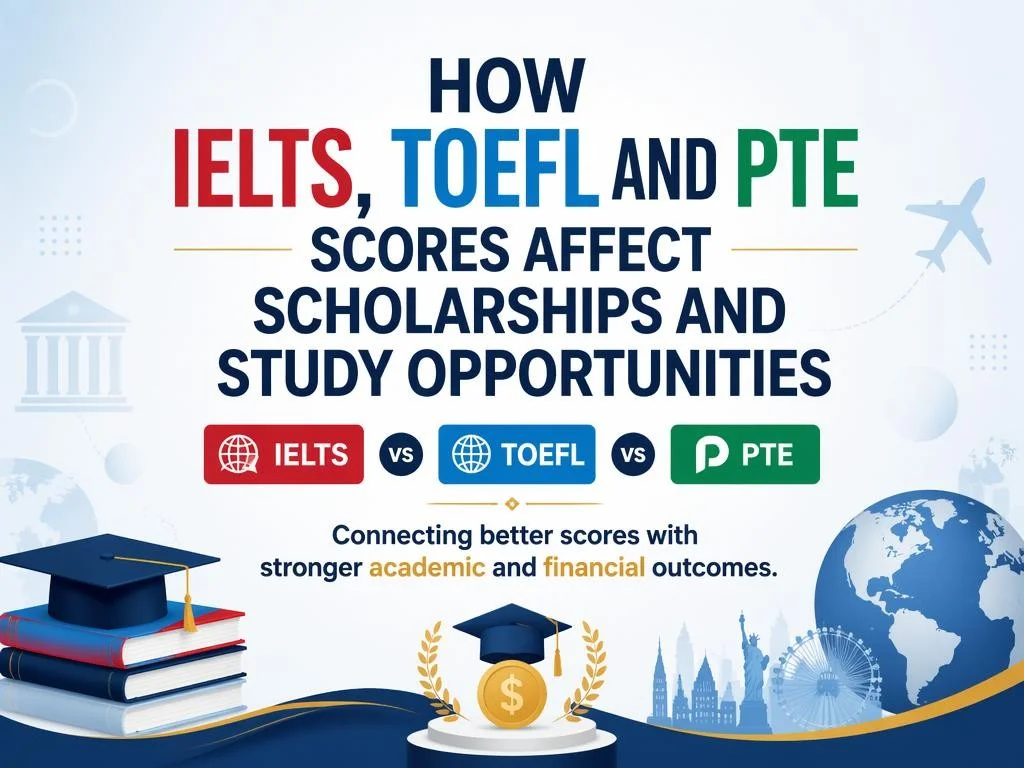
When students think about English tests, they usually think about admission first. They ask, “What IELTS score do I need?” or “Is TOEFL accepted by this university?” or “Which is better in IELTS vs TOEFL vs PTE?”
These are important questions. But English test scores do more than help you meet basic admission requirements.
A strong IELTS, TOEFL, or PTE score can also improve your chances of scholarships, competitive programmes, assistantships, visa confidence, and better study opportunities. It may not guarantee funding, but it can make your application look more prepared, reliable, and academically ready.
For international students, English proficiency is not just a number. It is a signal. It tells universities and scholarship committees that you can handle lectures, essays, research, presentations, interviews, and daily academic communication.
That is why students should not aim only for the minimum required score. A stronger score can create stronger outcomes.
Read More: Academic English vs Everyday English: What International Students Must Prepare For?
Why English Test Scores Matter Beyond Admission
Universities use English test scores to check whether international students can study successfully in an English-speaking academic environment. Tests like IELTS, TOEFL, and PTE measure reading, listening, speaking, and writing skills.
These skills are directly connected to university life. You need reading skills for textbooks and research papers. You need listening skills for lectures. You need writing skills for essays, reports, and exams. You need speaking skills for seminars, interviews, presentations, and group work.

A student who barely meets the minimum score may still be accepted by some universities. But a student with a stronger score may appear more confident and academically ready.
This matters even more when scholarships are involved. Scholarship committees often look for students who are likely to succeed, represent the institution well, and complete their course without major academic difficulty. A strong English score can support that impression.
Scholarships Based on IELTS Score: What Students Should Understand
Many students search for scholarships based on IELTS score, hoping that a high IELTS band will automatically bring financial support. The reality is slightly more complex.
Most scholarships are not given only because of an IELTS score. They usually consider academic performance, leadership, financial need, personal statements, recommendation letters, extracurricular achievements, research potential, and career goals.
However, IELTS can still play an important role.
A strong IELTS score may help you qualify for scholarships where English proficiency is part of the eligibility criteria. It may also strengthen your overall profile when scholarship committees compare candidates. Some scholarship or university funding schemes ask students to show proof of English ability, especially for programmes taught in English. The British Council’s Study UK guidance notes that international students have many UK funding and scholarship options, while IELTS guidance also explains that English ability may be needed for university, scholarship, or visa applications. (study-uk.britishcouncil.org)
So, IELTS may not be the only reason you receive a scholarship, but a high score can help your application look stronger.
IELTS Scholarship for Indian Students
Many Indian students search for IELTS scholarship for Indian students because the cost of studying abroad can be high. Scholarships may come from universities, governments, private organisations, or test-related award schemes.
Students should be careful here. Some scholarships may require IELTS as proof of English proficiency, while others may consider IELTS as one part of a larger application. IELTS itself also lists awards and scholarships connected to the wider English language testing and education sector. (IELTS)
For Indian students, a strong IELTS score can be useful when applying to universities in the UK, Canada, Australia, the USA, and Europe. But it should be combined with strong academics, a clear SOP, good references, and a realistic scholarship strategy.
A good approach is to shortlist universities first, then check their scholarship pages. Some scholarships are automatic based on academic merit. Others require a separate application. Some may have early deadlines. Some may ask for admission first before scholarship consideration.
The key message is simple: do not treat IELTS as a scholarship shortcut. Treat it as one strong part of your full profile.
TOEFL Scores and Scholarship Opportunities
TOEFL is widely used for university admission, especially in the USA, though it is accepted in many other countries too. Like IELTS, TOEFL can also support scholarship and funding applications.
Students often search for TOEFL scholarship requirements, but there is no single universal TOEFL score for all scholarships. Each university, department, or funding body sets its own rules.
For example, one university may require a certain TOEFL score for admission, while a scholarship committee may simply expect that the student already meets the university’s English requirement. Another scholarship may be more competitive and prefer applicants with stronger communication skills.
A higher TOEFL score can be especially useful for programmes where students need strong academic communication, such as teaching assistantships, research assistantships, graduate study, public policy, law, journalism, education, and business.
In simple terms, TOEFL can help show that you are not only eligible to study, but ready to participate actively in academic life.
PTE Scores and Study Opportunities
PTE has become increasingly popular among students who prefer a computer-based English test. Many students search for PTE accepted universities because they want to know whether PTE can support their admission and scholarship goals.
PTE Academic is accepted by thousands of institutions worldwide, and Pearson states that PTE Academic is accepted by more than 4,000 institutions, including well-known universities and business schools. Pearson also says PTE tests are accepted for visa applications by the Australian, Canadian, UK, and New Zealand governments. (pearsonpte.com)
This makes PTE a useful option for many students, especially those applying to countries where PTE is widely recognised.
However, students should still check the exact course and scholarship requirements. A university may accept PTE for admission, but a specific scholarship, professional programme, or visa pathway may have additional rules.
PTE can be a strong choice if it is accepted by your target universities and if its test format matches your strengths.
IELTS vs TOEFL vs PTE: Which Score Helps Most?
The question IELTS vs TOEFL vs PTE does not have one answer for every student.
IELTS may be a strong choice if you are applying to the UK, Australia, Canada, Europe, or universities where IELTS is clearly listed. It may also suit students who prefer a more traditional test structure and, in many test formats, a speaking test with a human examiner.
TOEFL may be a strong choice if you are applying mainly to the USA or if you are comfortable with academic computer-based tasks. Many IELTS accepted universities in USA also accept TOEFL, so students applying to America often have more than one option.
PTE may be a good choice if you prefer a fully computer-based test and your universities accept it. It is also popular among students applying to Australia and other countries where PTE recognition is strong.
The best test is not simply the one that sounds easier. It is the one accepted by your target universities, scholarship bodies, and visa route.
English Scores and Fully Funded Scholarships
Students often dream of fully funded scholarships for international students, and rightly so. These scholarships can cover tuition, living costs, travel, health insurance, or other expenses, depending on the programme.
For fully funded scholarships, competition is usually very high. Committees often review the full student profile, including grades, leadership, research potential, work experience, essays, recommendations, interviews, and future goals.
In this situation, English test scores can matter because they reduce doubt. A strong IELTS, TOEFL, or PTE score shows that the student is ready for academic study in English.
For example, if two students have similar grades and achievements, the one with stronger English communication evidence may appear better prepared for an international classroom. This is especially true for scholarships that involve leadership, public speaking, research, or ambassadorial roles.
A high English score will not replace a weak academic record, but it can strengthen a good application.
English Scores and Visa Confidence
English test scores may also affect visa-related planning, depending on the country and route.
For example, students often search for IELTS score for Canada study visa, IELTS band score for Canada student visa, or similar terms. For Canada, the official study permit requirements focus on admission to a designated learning institution, proof of funds, legal and health requirements, and proving that the student will leave Canada when the permit expires. (Canada) However, English scores may still be important because universities and colleges set their own language requirements, and some visa or post-study pathways may have separate language rules.
This is why students should not rely only on general online advice. A test score may be enough for admission but not enough for a particular visa, immigration, or post-study route.
Always check both the university requirement and the official government requirement.
IELTS Accepted Universities in USA
Many students think IELTS is only for the UK, Canada, or Australia. That is not true. Many universities in the USA accept IELTS for admission, including undergraduate and postgraduate programmes.
However, IELTS accepted universities in USA may have different score expectations. Some may require a certain overall band, while others may also require minimum scores in writing, speaking, reading, and listening.
Highly competitive universities or graduate programmes may expect stronger scores. For example, one major US university lists English proficiency expectations that include IELTS, TOEFL, Cambridge English, and PTE options, with specific minimum scores for each test. (Undergraduate Admission)
This shows why students should not depend on one general score number. Always check the exact university and programme page.
How Better Scores Create Better Study Opportunities
A better English test score can create opportunities in several ways.
First, it may allow you to apply to more universities. If your score is only at the minimum level, some higher-ranked or more competitive universities may remain out of reach.
Second, it may help you avoid conditional admission or extra language courses. These courses can add cost and time.
Third, it may make your scholarship profile stronger. A high score shows preparation, discipline, and communication readiness.
Fourth, it may help with interviews. Students with stronger speaking and listening skills often feel more confident in admission or scholarship interviews.
Fifth, it may help after admission. Strong English skills make it easier to handle lectures, assignments, presentations, internships, and networking.
So, the benefit of a strong IELTS, TOEFL, or PTE score does not stop when the admission letter arrives. It continues into your academic life.
Minimum Score vs Strong Score
One of the biggest mistakes students make is aiming only for the minimum score.
If a university asks for IELTS 6.5, the student may aim only for 6.5. If a TOEFL requirement is listed, the student may stop at the lowest acceptable number. If a PTE score is accepted, they may prepare just enough to cross the line.
But scholarships and competitive opportunities often require more than basic eligibility.
A minimum score says, “I meet the requirement.”
A strong score says, “I am ready to compete.”
This difference matters when universities have limited scholarships, popular courses, or many qualified applicants.
A realistic target should usually be higher than the minimum requirement, especially if you are applying for funding.
How to Use Your Score Strategically
Your English test score should be part of a larger admission and scholarship strategy.
Start by checking admission requirements for each university. Then check scholarship requirements and deadlines. After that, compare IELTS, TOEFL, and PTE acceptance across your target list.
Choose the test that gives you the best combination of acceptance, comfort, timing, and score potential.
If you are applying for scholarships, do not wait until the last minute to take your test. Scholarship deadlines can be earlier than normal admission deadlines. You may also need time to send official scores.
Also, use your English preparation to improve your SOP, essays, and interviews. The same language skills that help you score well can also help you write better scholarship essays and speak more confidently in interviews.
Common Mistakes Students Should Avoid
One common mistake is assuming that any accepted English score is enough for scholarships. It may be enough for admission, but scholarship competition may be much stronger.
Another mistake is not checking whether IELTS, TOEFL, or PTE is accepted by the scholarship provider. A university may accept a test for admission, but a specific scholarship may have its own conditions.
Some students also take the test too late. This can be dangerous if scholarship deadlines are early.
Another mistake is ignoring section scores. A strong overall score with a weak writing or speaking section may still create problems for certain programmes.
Finally, some students focus only on the test and ignore the rest of the scholarship profile. A strong score helps, but scholarships also need strong academics, essays, recommendations, and clear goals.
Final Thoughts
Your IELTS, TOEFL, or PTE score can do more than satisfy an admission requirement. It can support your scholarship application, strengthen your academic profile, improve your confidence, and open more study opportunities.
When comparing IELTS vs TOEFL vs PTE, do not ask only which test is easier. Ask which test is accepted by your universities, suitable for your country, useful for your visa pathway, and strongest for your scholarship goals.
Students applying for fully funded scholarships for international students should aim beyond the minimum. A better score can help show that you are serious, prepared, and ready for academic success.
In the end, English proficiency is not just about getting into university.
It is about being ready to make the most of the opportunity once you get there.
FAQs
1. Can I get scholarships based on IELTS score?
Some scholarships may consider IELTS as part of the eligibility or selection process, but most scholarships are not based only on IELTS. They usually also consider academics, SOP, recommendations, leadership, financial need, and future goals.
2. Do TOEFL scores help with scholarships?
Yes, TOEFL scores can support scholarship applications, especially when English proficiency is required. However, TOEFL scholarship requirements vary by university, department, and funding body, so students should check each scholarship page carefully.
3. Is PTE accepted for scholarships and university admission?
Many universities accept PTE for admission, and it may be accepted for some scholarship applications if the university recognises it as proof of English proficiency. Students should always check the specific scholarship and programme requirements.
4. What IELTS score is needed for Canada study visa?
Canada study planning can involve both university admission requirements and government visa requirements. The official study permit process requires admission to a designated learning institution and other eligibility conditions, while colleges set their own English score requirements. Students should check both the institution and official government guidance.
5. Which is better for scholarships: IELTS, TOEFL, or PTE?
There is no single best test for all scholarships. The best choice is the test accepted by your target universities and scholarship providers. IELTS, TOEFL, and PTE can all support scholarship applications when recognised by the institution.




Leave a Reply