
Every admission season, many students ask the same question: “What is the minimum score I need?”
It is a fair question. When you are preparing for university admission, IELTS, SAT, entrance tests, or Government Exams, you naturally want to know the cut-off. You want a clear target. You want to feel that if you cross that number, everything will be fine.
But this is where many students get caught.
The minimum score is not always the score that gets you selected. In many cases, it only keeps you in the race.
That is why understanding Minimum Score vs Competitive Score is so important. A minimum score tells you whether you are eligible. A competitive score tells you whether you have a real chance.
This small difference can change the way you prepare, the universities you apply to, and the expectations you set for yourself.

What Does a Minimum Score Actually Mean?
A minimum score is the lowest score a college, university, exam board, or selection authority will accept. It may be called minimum marks, qualifying marks, eligibility marks, or cut-off marks.
For example, a university may say that applicants need at least IELTS 6.5. Another college may say students need 60% in their previous qualification. A competitive exam may say candidates must score 40% to qualify for the next stage.
These numbers matter because they decide whether your application will even be considered.
However, this does not mean you are selected.
Think of the minimum score as the entry gate. If you do not reach it, you cannot enter. But once you enter, you still have to compete with everyone else inside.
This is the part many students misunderstand.
Read More: How to Build a Strong Admissions Profile Alongside Your English Test Score
What Is a Competitive Score?
A competitive score is the score that makes your application strong compared with other applicants.
It is usually higher than the minimum score.
Let us say a course lists 65% as the Minimum Marks for Admission. A student may think, “Great, I just need 65%.” But if the course is popular and most selected students have 80% or above, then 65% is only technically acceptable. It is not competitive.
The same happens in entrance exams and Government Exams. A student may meet the qualifying marks, but the final merit list may include only candidates with much higher marks.
This is the real difference between Qualifying Marks vs Competitive marks. Qualifying marks help you pass the first barrier. Competitive marks help you move closer to actual selection.
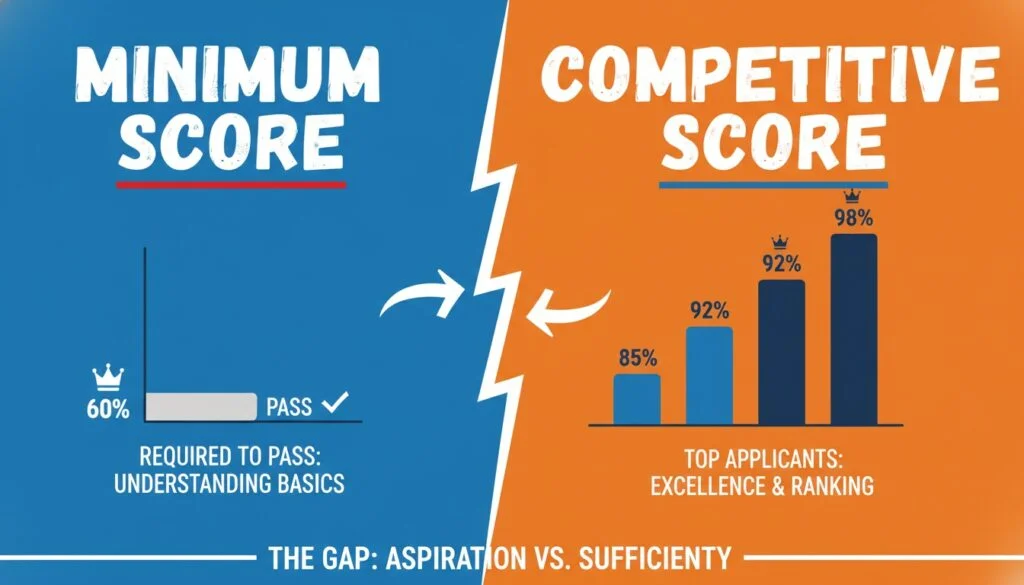
Minimum Score vs Competitive Score: The Simple Difference
The difference between Minimum Score vs Competitive Score can be understood through two questions.
A minimum score answers: “Am I allowed to apply?”
A competitive score answers: “Am I likely to be selected?”
That is why students should never build their entire plan around the minimum requirement alone.
For example, if a university requires IELTS 6.5, that score may satisfy the official English requirement. But for a demanding postgraduate course, an IELTS 7.0 or 7.5 may look stronger, especially if the programme involves essays, presentations, research, or classroom discussion.
Similarly, in SAT-based admissions, a college may publish a broad score range or minimum expectation. But successful applicants may often have scores well above that level. This is where understanding college admission score trends becomes useful.
The minimum score is the beginning of the story. The competitive score is much closer to the real target.
Admission Cut Off Explained in Plain English
Students often hear the word “cut-off” and assume it means guaranteed admission. That is not always true.
So here is Admission Cut off Explained simply.
A cut-off may mean different things depending on the exam or admission system. Sometimes it means the minimum score needed to apply. Sometimes it means the score needed to move to the next round. Sometimes it means the lowest score achieved by the last selected candidate.
These are very different things.
For example, an entrance exam may have a qualifying cut-off. If you cross it, you are allowed to take part in counselling or the next stage. But the actual seat may go to students with much higher ranks or marks.
In another case, a university may say the minimum admission requirement is 70%. But because there are limited seats, the actual selected students may have 85% or more.
This is why students should always ask: Is this cut-off just for eligibility, or is it the actual selection score?
Merit List vs Cut Off
Another point that causes confusion is merit list vs cut off.
A cut-off is a number. A merit list is a ranking.
You may cross the cut-off and still not be high enough on the merit list. This happens when many students meet the minimum requirement but only a limited number of seats are available.
Imagine a course has 100 seats. Now imagine 2,000 students meet the minimum eligibility marks. The university cannot take all 2,000 students. It will rank applicants based on marks, entrance scores, category rules, subject requirements, interviews, or other criteria.
So, even if you are eligible, your position on the merit list decides whether you are selected.
This is why simply saying “I cleared the cut-off” is not always enough. The better question is, “Is my score high enough for the merit list?”
Why Meeting the Cut-Off May Not Be Enough
Meeting the cut-off may not be enough because admissions are often comparative.
Colleges and exam authorities are not only checking whether you are good enough. They are also checking how you compare with other applicants.
This is especially true for competitive courses, limited seats, scholarships, Competitive Exam Scores, and public sector recruitment. When thousands of students meet the basic requirement, final selection becomes much tougher.
A student may have the required Marks, but another student may have stronger marks, better subject scores, a higher entrance rank, a stronger profile, or a better interview.
That does not mean the first student failed. It means the competition was stronger than the minimum requirement suggested.
This is why the difference between Cut off vs Actual Selection Score is so important.
Why College Admission Score Trends Matter
One of the smartest things a student can do is study college admission score trends before setting a target.
Minimum requirements tell you what the university will accept. Score trends tell you what successful applicants usually achieve.
For example, if the official minimum is 60%, but students admitted in recent years usually had 78% to 85%, then aiming for 60% is risky. You may be eligible, but not competitive.
Trends can also change from year to year. A course may become more popular. Seats may decrease. More high-scoring students may apply. The exam may be easier, causing scores to rise. Or admission rules may change.
That is why students should avoid relying on just one number. It is better to look at a range of information: previous cut-offs, closing ranks, admitted student averages, subject requirements, and competition level.
What Is a Safe Score for University Admission?
A safe score for university admission is not the same as the minimum score.
A safe score is the score that gives you a stronger and more comfortable chance. It is usually above the minimum requirement and closer to the scores of previously admitted students.
For example, if a university asks for IELTS 6.5, a safer target may be IELTS 7.0 or higher. If a college lists 65% as the minimum academic requirement, a safer target might be 75% or 80%, depending on the course.
Of course, no score can guarantee admission in every situation. Universities may also consider personal statements, references, interviews, portfolios, work experience, extracurricular achievements, or subject combinations.
But a stronger score gives your application more breathing room.
It also gives you more options. You may qualify for better courses, more universities, or even scholarships.
Entrance Exam Competitive Score
An entrance exam competitive score is the score that puts you in a strong position for actual selection.
This is different from simply qualifying.
In many entrance exams, qualifying means you have reached the basic standard. But selection depends on rank, seat availability, category, course preference, and the number of high-scoring candidates.
For example, an exam may say the qualifying mark is 45%. But if top colleges or departments select students who scored 75% and above, then 45% is not enough for a good chance.
This is common in professional courses, public sector jobs, management entrance tests, law admissions, medical admissions, engineering exams, and other competitive systems.
So, when preparing, students should not ask only, “How much do I need to pass?”
They should ask, “What score do selected candidates usually have?”
Common Mistakes Students Make
One of the biggest mistakes students make is treating the minimum score as the final goal.
They see the official requirement and stop there. They think, “I only need this much.” But later, they discover that the real competition was much higher.
Another common mistake is ignoring section-wise requirements. This is especially important for tests like IELTS, where a university may require not only an overall band score but also minimum scores in writing, speaking, reading, and listening.
Students also misunderstand the word “qualified”. In many exams, qualified does not mean selected. It only means you are allowed to move forward.
Another mistake is comparing scores without context. A score that is safe for one course may be weak for another. A score that works for one university may not work for a more competitive one.
Some students also set their target too close to last year’s cut-off. That is risky because cut-offs can rise. A smart target includes a safety margin.
How to Set a Realistic Admission Score Target
To set a realistic admission score target, start with the official minimum requirement. That is your first checkpoint.
Then look deeper.
Check previous admission data, if available. Look at past cut-offs, closing ranks, admitted student profiles, average scores, and score ranges. Try to understand what successful applicants usually achieve.
Next, consider the course itself. Is it popular? Are seats limited? Is the university highly ranked? Are scholarships involved? The more competitive the opportunity, the higher your target should be.
Then look honestly at your own profile. If your academic record is very strong, you may have some flexibility. If another part of your application is weaker, a stronger test score may help balance it.
Most importantly, do not aim for “just enough”. Aim for “comfortably strong”.
That is the mindset that helps students prepare better.
Final Thoughts
The difference between Minimum Score vs Competitive Score is one of the most important lessons students can learn during the admission journey.
Minimum scores matter because they decide eligibility. But competitive scores matter because they influence actual selection.
Whether you are applying to university, preparing for SAT, taking IELTS, sitting for entrance exams, or targeting Government Exams, remember this: the cut-off is not always the finish line. Very often, it is only the starting line.
A smart student looks beyond the minimum. They study college admission score trends, understand Qualifying Marks vs Competitive marks, compare Cut off vs Actual Selection Score, and set a realistic admission score target.
In simple words, do not prepare only to qualify.
Prepare to compete.
FAQs
1. What is the difference between minimum score and competitive score?
A minimum score is the lowest score needed to become eligible. A competitive score is the stronger score that gives you a realistic chance of selection. The minimum score lets you enter the process, but the competitive score helps you stand out.
2. Does meeting the cut-off guarantee admission?
No, meeting the cut-off does not always guarantee admission. In many cases, the cut-off only means you are eligible for consideration or the next stage. Final selection may depend on merit list ranking, available seats, course demand, and other applicants’ scores.
3. What is a safe score for university admission?
A safe score for university admission is usually higher than the official minimum requirement. It should be based on previous admission trends, actual selected student scores, and the competitiveness of the course or university.
4. What is the difference between merit list and cut-off?
A cut-off is a score or rank limit. A merit list is the ranking of candidates based on performance and admission rules. A student may meet the cut-off but still not rank high enough on the merit list for final selection.
5. Why should students look at past admission score trends?
Past admission score trends show what successful applicants usually achieved. They help students understand the real level of competition and set a realistic admission score target instead of aiming only for the minimum marks.





Leave a Reply