

For many students dreaming of studying abroad, English proficiency scores can feel like just another box to tick on a long admissions checklist. You prepare for the TOEFL, IELTS, or another recognised English test, submit your score, and hope it is high enough to meet the university’s minimum requirement. But in reality, English Proficiency Scores often matter far beyond basic eligibility.
Colleges and universities use these scores to understand whether an international student can succeed in an English-speaking academic environment. A good score does not only show that you can speak or understand English. It suggests that you can follow lectures, write essays, participate in discussions, complete research assignments, and communicate confidently with professors and classmates.
In today’s competitive International Student Admission process, your English test score can influence how admissions teams view your readiness, confidence, and overall academic potential.

Why English Proficiency Scores Matter
When universities review applications from international students, they are not only looking at grades, personal statements, recommendation letters, and extracurricular activities. They also want to know whether the student can handle the language demands of the course.
Academic English is different from casual English. A student may be able to hold everyday conversations but still struggle with writing a research paper, understanding complex lectures, or presenting ideas clearly in seminars. This is where English Proficiency Scores become important.
Tests like the TOEFL English Test and IELTS measure different language skills: reading, listening, speaking, and writing. These sections help universities judge whether a student is prepared for real academic situations.
For example, a strong listening score may suggest that the student can follow lectures without constantly needing support. A good writing score shows that the student may be able to structure essays, explain arguments, and use academic vocabulary. Speaking scores help universities understand whether the student can take part in class discussions, group projects, and presentations.
So, while the score may look like a number, it tells admissions officers a lot about a student’s ability to survive and succeed in college.
Read More: How English Proficiency Scores Influence College Admissions Decisions
Beyond Basic Eligibility
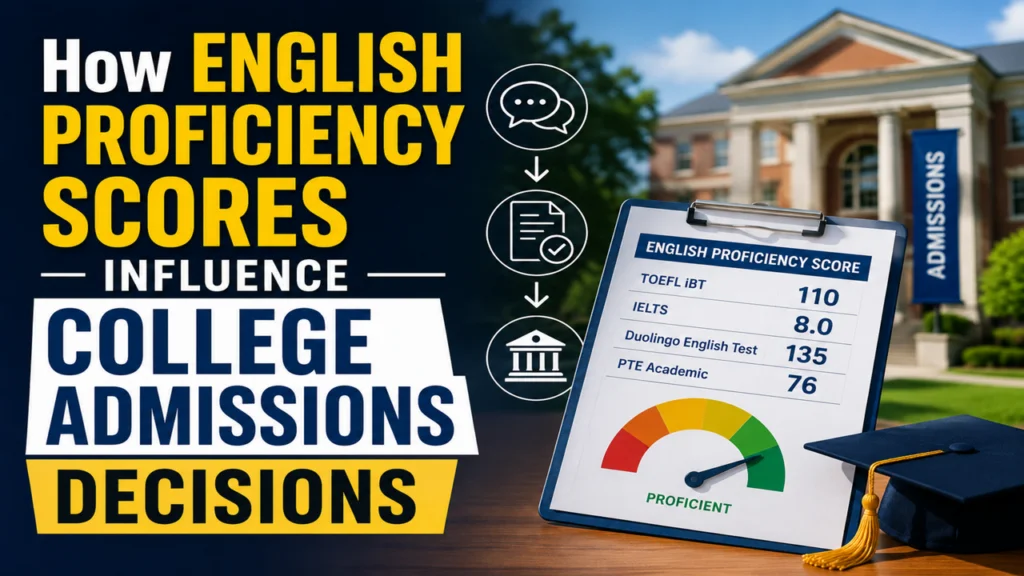
Most universities publish minimum English language requirements. These are often listed under TOEFL Requirements for Colleges or English language entry requirements on admission pages. For example, a university may ask for a minimum TOEFL score of 80 or an IELTS score of 6.5.
Many students assume that meeting this minimum is enough. Technically, it may make your application eligible. However, in competitive admissions, minimum eligibility does not always mean a strong application.
If two international students have similar academic records, but one has a much stronger English proficiency score, the university may see that student as better prepared for academic life. A higher score can create a positive impression because it reduces the risk that the student will struggle with coursework due to language barriers.
This does not mean that English scores are more important than grades or achievements. But they can strengthen your application, especially when you are applying to competitive programmes, scholarships, or universities where communication skills are highly valued.
How TOEFL and IELTS Scores Affect Admissions Decisions
Both TOEFL and IELTS are widely accepted by colleges and universities around the world. These tests help admissions teams compare students from different education systems fairly.
A high score can support your application in several ways. First, it proves that you are ready to study in English. Second, it may help you avoid additional language courses after admission. Third, it can improve your chances for certain scholarships or assistantship opportunities. Finally, it may make your student visa process smoother because language ability is often part of the overall study abroad profile.
For TOEFL Admission, universities usually look at both the total score and section scores. Some colleges may require a minimum total score but also ask for specific scores in writing or speaking. This is common for courses where communication is especially important, such as education, law, business, medicine, nursing, or social sciences.
Similarly, with IELTS, universities may ask for an overall band score as well as minimum band scores in each section. A student with an overall 7.0 but a low writing score may still face difficulty if the programme requires strong academic writing.
This is why students should not only aim to “pass” the test. They should aim for balanced scores across all sections.
IELTS vs TOEFL Comparison: Which One Should You Choose?
Students often ask about IELTS vs TOEFL Comparison when planning their Study Abroad journey. The better test depends on your strengths, comfort level, and university requirements.
The TOEFL English Test is often preferred by students who are comfortable with computer-based testing and academic-style tasks. It is commonly accepted in the United States, Canada, and many other countries. TOEFL tends to focus strongly on academic English, with integrated tasks that combine reading, listening, speaking, and writing.
IELTS, on the other hand, is accepted widely in the UK, Australia, Canada, Europe, and many other destinations. Some students prefer IELTS because the speaking section is conducted like a real conversation with an examiner. IELTS also has two versions: Academic and General Training. For university admission, students usually need IELTS Academic.
In simple terms, TOEFL may suit students who prefer typing, listening to academic lectures, and responding into a microphone. IELTS may suit students who prefer face-to-face speaking and a mix of question types.
However, the most important rule is this: always check the exact test requirements of your target colleges. Some universities accept both TOEFL and IELTS, while others may have specific preferences or score conditions.
English Scores and Course Difficulty
Not all college courses demand the same level of English. A student applying for engineering may need strong reading and listening skills to understand technical lectures and textbooks. A student applying for law, journalism, psychology, or business may need excellent writing and speaking skills because these subjects involve essays, debates, case studies, and presentations.
Admissions teams understand this. That is why some departments set higher English requirements than the general university minimum. A university may require IELTS 6.5 overall for most courses but IELTS 7.0 for nursing, teaching, or law.
This shows that English proficiency is not only about admission. It is about whether the student can genuinely perform well after entering the classroom.
English Proficiency and Scholarships
Strong English Proficiency Scores can also support scholarship applications. Many scholarships are highly competitive, and committees want to invest in students who are likely to succeed.
A high TOEFL or IELTS score can show that you are ready to communicate well, participate actively, and represent the university confidently. For teaching assistantships, research assistantships, or public-facing academic roles, speaking and writing scores may be especially important.
While a high score does not guarantee a scholarship, it can make your profile stronger and more reliable.
Common Mistakes Students Make
There are several Common Mistakes Students Make when dealing with TOEFL, IELTS, and other English proficiency tests.
One common mistake is checking the minimum score too late. Some students prepare their entire application and only later realise that their score does not meet the programme requirement. This can delay admission or force them to retake the test under pressure.
Another mistake is focusing only on the total score. Universities may reject or conditionally accept students if one section score is too low, even when the overall score looks acceptable.
A third mistake is choosing a test without checking university acceptance rules. A student may prepare for IELTS, only to discover that a specific programme prefers TOEFL, or vice versa.
Many students also underestimate the writing section. Academic writing is often the area where students lose marks because they struggle with structure, grammar, argument development, or time management.
Finally, some students aim only for the minimum requirement. This may be risky for competitive programmes. A stronger score can make the application more convincing.
Conditional Admission and Language Support
Some universities offer conditional admission to students whose academic profile is strong but whose English score is slightly below the requirement. In such cases, the student may need to complete an English language course before starting the main degree.
This can be helpful, but it may also increase cost and study time. Students should carefully check whether conditional admission affects visa timelines, tuition fees, or course start dates.
A stronger English score from the beginning can help students avoid these complications and begin their degree with more confidence.
Final Thoughts
English proficiency tests are not just admission formalities. TOEFL, IELTS, and similar exams help colleges understand whether international students are prepared for the academic, social, and communication challenges of studying abroad.
Your score can influence admission decisions, scholarship opportunities, course placement, and even your confidence after arriving on campus. Meeting the minimum requirement is important, but aiming higher can give you a stronger advantage.
For students planning an international education journey, the best approach is simple: research your target universities early, understand their exact TOEFL Requirements for Colleges, compare IELTS and TOEFL carefully, prepare for all four skills, and aim for a score that reflects your real academic potential.
A good English score does not just help you enter college. It helps you belong there, participate fully, and make the most of your study abroad experience.
FAQs
1. Why do colleges require English Proficiency Scores?
Colleges require English Proficiency Scores to make sure international students can understand lectures, write assignments, read academic material, and communicate effectively in class. These scores help universities judge whether a student is ready for an English-speaking academic environment.
2. Is TOEFL better than IELTS for college admissions?
Neither test is universally better. The choice depends on the university, country, and student preference. TOEFL is often popular for US admissions, while IELTS is widely used in the UK, Australia, Canada, and other countries. Students should always check the exact requirements of their target colleges.
3. Do higher TOEFL or IELTS scores improve admission chances?
Yes, higher scores can strengthen an application, especially for competitive programmes. While grades and other documents are also important, strong English scores show that the student is academically prepared and less likely to struggle with language barriers.
4. What are common mistakes students make with TOEFL and IELTS?
Common mistakes include checking requirements too late, focusing only on the total score, ignoring section-wise requirements, choosing the wrong test, and aiming only for the minimum score. Students should research early and prepare carefully for all sections.
5. Can I get admission if my English score is below the requirement?
Some universities offer conditional admission if the student’s academic profile is strong but the English score is slightly low. However, the student may need to complete an English language course before starting the degree. It is better to meet or exceed the required score whenever possible.




Leave a Reply