
Prepare for the post-August 2025 test
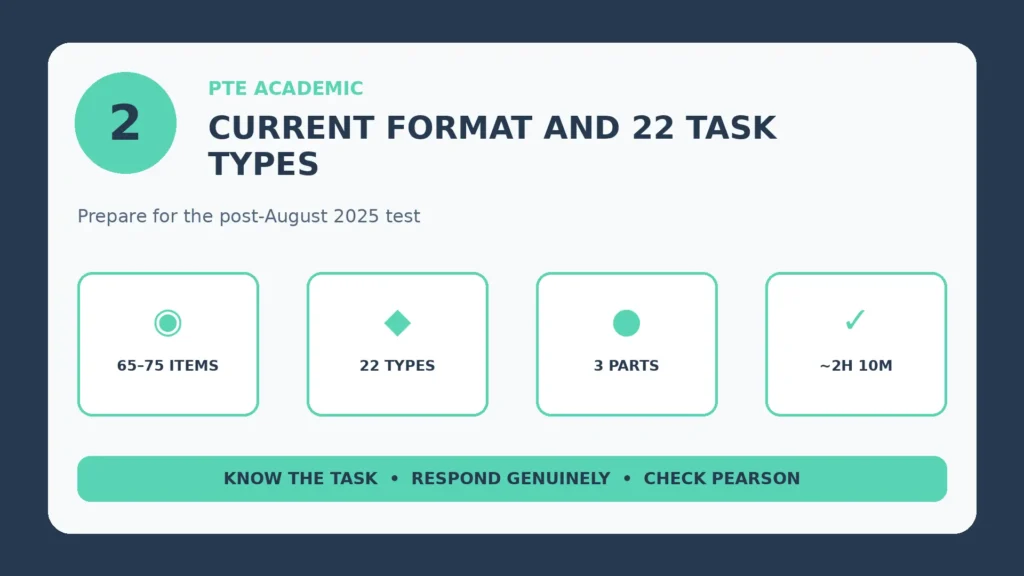
The current PTE Academic format is divided into three parts. Speaking and Writing lasts approximately 76–84 minutes and contains nine question types. Reading lasts about 23–30 minutes with five types. Listening lasts roughly 31–39 minutes and contains eight types. Combined ranges place the active testing time at approximately two hours ten minutes to two hours thirty-three minutes.
Speaking and Writing includes Read Aloud, Repeat Sentence, Describe Image, Retell Lecture, Answer Short Question, Summarize Group Discussion, Respond to a Situation, Summarize Written Text and Write Essay. The two group-and-situation tasks were added to PTE Academic and PTE Academic UKVI for tests taken after 7 August 2025.
Read More: What PTE Academic Is?
Reading uses Reading and Writing: Fill in the Blanks, Multiple Choice Multiple Answers, Re-order Paragraphs, Reading: Fill in the Blanks and Multiple Choice Single Answer. Listening includes Summarize Spoken Text, Multiple Choice Multiple Answers, Fill in the Blanks, Highlight Correct Summary, Multiple Choice Single Answer, Select Missing Word, Highlight Incorrect Words and Write from Dictation.
Some tasks are integrated, so performance can provide evidence for more than one skill. This is why a preparation plan should not treat every task as belonging to only one isolated section. Read Aloud, for example, combines written input with spoken production; Write from Dictation combines listening, sentence memory and accurate writing.
Pearson reports that seven productive task types use double marking by AI and human expertise for content: Describe Image, Retell Lecture, Summarize Written Text, Write Essay, Summarize Spoken Text, Summarize Group Discussion and Respond to a Situation. Genuine, relevant responses matter more than gaming a machine with recycled language.
Create a one-page format map showing input, response, timing, scoring features and personal risk for every type. Then practise transitions. The challenge is not only performing one familiar task; it is resetting quickly when the screen changes from speaking to summarising, ordering, selecting or typing.
A practical preparation method
Start with the current official format and a diagnostic test. Record the score, but also label each weakness: content selection, vocabulary, grammar, pronunciation, oral fluency, spelling, lost attention, time management or interface error. Because integrated tasks can contribute evidence to more than one communicative skill, diagnose the underlying language behaviour rather than assuming every low score belongs to the section heading.
Use five focused sessions each week. Rotate Speaking and Writing, Reading, Listening and a mixed computer session. Include ten minutes of vocabulary, collocations or sentence construction on most days. Work with a headset and keyboard from the beginning. Save recordings and written responses with dates so that changes in clarity, completion, pace and accuracy are visible.
Review is where improvement becomes specific. For selected-response items, prove why the answer is correct and why distractors fail. For productive tasks, compare the response with Pearson’s instructions and scoring information. Identify one change, repeat a similar item and check whether the correction survives under time pressure. Avoid relying on rigid templates that can produce irrelevant, copied or unnatural language.
Complete a realistic full simulation regularly. Reproduce the current section order, automatic audio, one-hearing rule, microphone behaviour and limited breaks. Afterward, separate language problems from test-interface problems. In the final week, revisit proven routines, confirm booking and identification details and protect sleep. Official Pearson instructions override social-media shortcuts whenever advice conflicts.

Track progress through evidence: task completion, error frequency, timed accuracy, intelligibility and dated samples. A difficult session is useful when it reveals a repeatable pattern and creates a clear next action. Simply completing more questions without analysis may rehearse the same mistake.
Keep the process calm, measurable and centred on real communication.
Quick FAQ
Do I need a particular accent?
No. Aim for clear, intelligible speech, natural rhythm and accurate content.
Should I memorise universal templates?
Flexible structures can help planning, but copied or irrelevant language can damage performance. Respond genuinely to the item.
Is the overall score an average of four skills?
No. Pearson states that the overall 10–90 score is based on performance across the test and is not a simple average of the four communicative-skill scores.