
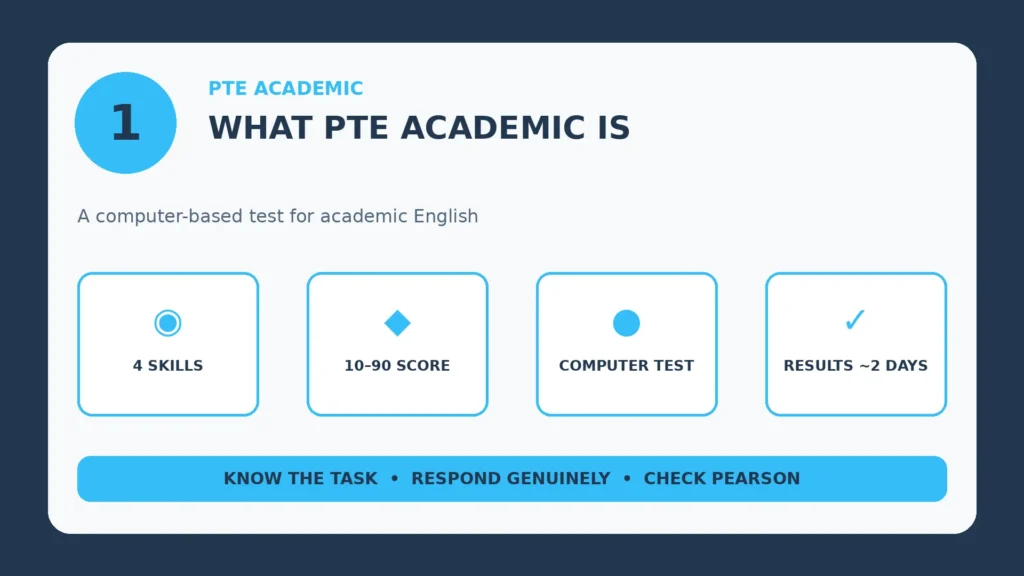
A computer-based test for academic English
PTE Academic is Pearson’s computer-based English proficiency test for academic study and other approved purposes. It assesses Speaking, Writing, Reading and Listening through separate and integrated tasks. Candidates speak into a microphone, type written responses and answer questions based on text, audio, video and images in a secure test-centre environment.
The current test has three timed parts: Speaking and Writing, Reading, and Listening. Pearson’s present format includes 22 question types and approximately 65–75 questions in a given test. The exact number varies. The 2025 update added Summarize Group Discussion and Respond to a Situation, so preparation based only on the older 20-type format is incomplete.
Read More: Current Format and 22 Task Types
Scores range from 10 to 90. The report includes an overall score plus communicative-skill scores for Listening, Reading, Speaking and Writing. Pearson also provides a Skills Profile with more detailed performance information. Results are typically available within 48 hours, although Pearson advises that additional review can sometimes take longer.
PTE Academic is accepted by many universities and by specified authorities, but acceptance is purpose-specific. PTE Academic, PTE Academic UKVI, PTE Core and PTE Home are not interchangeable names. PTE Core is associated particularly with Canadian immigration uses, while UK visa routes may specify Academic UKVI or a PTE Home level. Always verify the exact product, required score and individual-skill thresholds.
The test suits candidates comfortable with computers, headsets, rapid task changes and speaking into a microphone while others may be testing nearby. It also rewards integrated language control: reading may support speaking, or listening may support writing. This makes broad English development important alongside task familiarity.
Before booking, create a requirement sheet containing the institution or visa route, accepted test title, overall target, skill minimums, deadline, score-validity rule and official evidence link. Do not choose PTE merely because it is described as fast or automated. The correct test is the one officially accepted for the precise goal and suited to the candidate’s demonstrated performance.
A practical preparation method
Start with the current official format and a diagnostic test. Record the score, but also label each weakness: content selection, vocabulary, grammar, pronunciation, oral fluency, spelling, lost attention, time management or interface error. Because integrated tasks can contribute evidence to more than one communicative skill, diagnose the underlying language behaviour rather than assuming every low score belongs to the section heading.
Use five focused sessions each week. Rotate Speaking and Writing, Reading, Listening and a mixed computer session. Include ten minutes of vocabulary, collocations or sentence construction on most days. Work with a headset and keyboard from the beginning. Save recordings and written responses with dates so that changes in clarity, completion, pace and accuracy are visible.
Review is where improvement becomes specific. For selected-response items, prove why the answer is correct and why distractors fail. For productive tasks, compare the response with Pearson’s instructions and scoring information. Identify one change, repeat a similar item and check whether the correction survives under time pressure. Avoid relying on rigid templates that can produce irrelevant, copied or unnatural language.
Complete a realistic full simulation regularly. Reproduce the current section order, automatic audio, one-hearing rule, microphone behaviour and limited breaks. Afterward, separate language problems from test-interface problems. In the final week, revisit proven routines, confirm booking and identification details and protect sleep. Official Pearson instructions override social-media shortcuts whenever advice conflicts.

Track progress through evidence: task completion, error frequency, timed accuracy, intelligibility and dated samples. A difficult session is useful when it reveals a repeatable pattern and creates a clear next action. Simply completing more questions without analysis may rehearse the same mistake.
Keep the process calm, measurable and centred on real communication.
Quick FAQ
Do I need a particular accent?
No. Aim for clear, intelligible speech, natural rhythm and accurate content.
Should I memorise universal templates?
Flexible structures can help planning, but copied or irrelevant language can damage performance. Respond genuinely to the item.
Is the overall score an average of four skills?
No. Pearson states that the overall 10–90 score is based on performance across the test and is not a simple average of the four communicative-skill scores.
Official Pearson sources
– Current PTE Academic test format
Accuracy note (20 August 2026): fees, acceptance, visa rules, appointment availability and operational policies can change. Confirm the correct PTE product and current requirements with Pearson, the receiving institution and the relevant government authority before booking.