

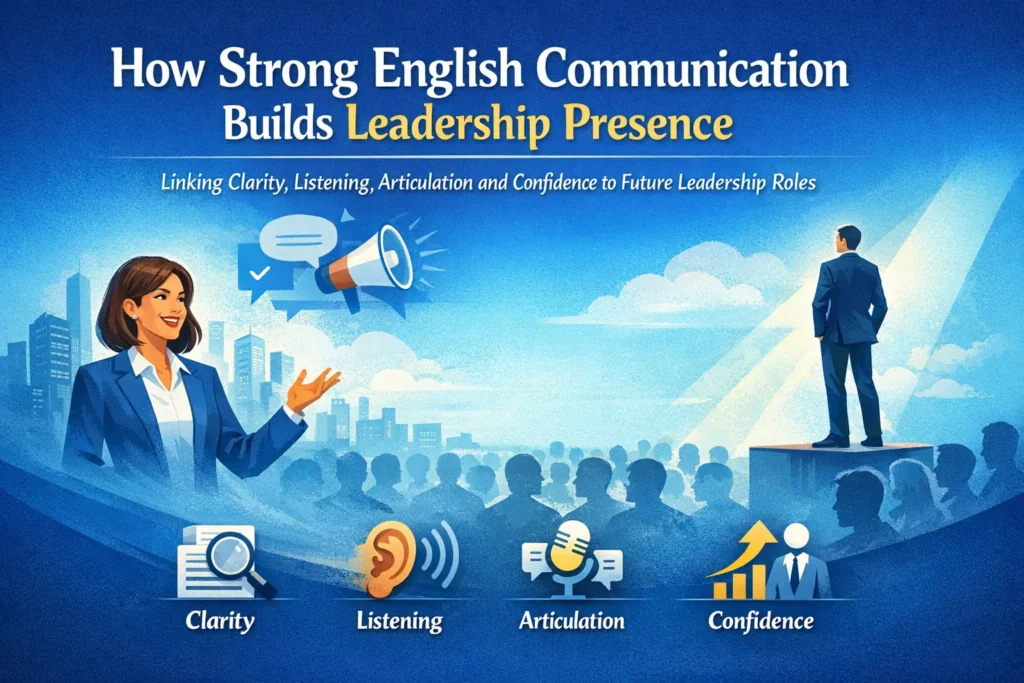
Leadership does not begin only when someone receives a title. It begins much earlier—in classrooms, group projects, interviews, presentations, internships, hospital rounds, office meetings, and everyday conversations. For global students, one of the strongest foundations of future leadership is the ability to communicate clearly in English.
Strong English communication is not just about speaking fluently. It is about making people understand you, trust you, listen to you, and feel confident in your ideas. This is why communication and leadership are closely connected. A student may have intelligence, ambition, and technical knowledge, but if they cannot express ideas clearly, listen carefully, and respond with maturity, their leadership potential may remain hidden.

For students preparing for international education and global careers, English becomes more than a language. It becomes a tool for leadership presence. It helps them show clarity, confidence, empathy, and credibility—qualities that matter in future leadership roles.
Read More: What Is Leadership Language and Why Does It Matter for Global Students?
Leadership presence is the impression a person creates when they communicate. It is not about being loud, dominant, or overly polished. It is about being clear, calm, thoughtful, and reliable.
What Is Leadership Presence?
A person with leadership presence makes others feel that they are prepared, aware, and trustworthy. They know how to speak, but they also know how to listen. They can explain complex ideas simply. They can disagree respectfully. They can ask meaningful questions. They can influence people without forcing their opinion.
For global students, leadership presence can begin in small moments: answering a question in class, leading a group assignment, presenting a project, participating in a scholarship interview, or communicating during an internship. Each moment becomes a chance to practise communication and leadership development.
Communication Confidence Builds Leadership Confidence
Many students have good ideas but hesitate to speak. They worry about grammar, pronunciation, accent, or making mistakes. This hesitation can make them appear less confident than they actually are.
Communication confidence is the ability to speak despite imperfection. It does not mean every sentence is flawless. It means the student can express a thought, clarify when needed, and continue the conversation without fear.
This is closely linked to leadership confidence. Leaders are often expected to speak during uncertain situations. They may not always have perfect answers, but they must communicate direction, ask questions, and keep people aligned.
Students can build confident communication skills through regular speaking practice. IELTS speaking confidence, TOEFL speaking skills, classroom presentations, group discussions, and mock interviews all help. These activities train students to think and speak under pressure.
A student who practises speaking often becomes more comfortable with their own voice. Over time, that comfort becomes presence.
Clarity: The First Step Towards Influence
Clear communication is one of the most important leadership communication skills. If people do not understand what you mean, they cannot follow your thinking.
Clarity begins with simple choices: use direct sentences, organize ideas, avoid unnecessary jargon, and explain the main point early. In academic and professional settings, clarity saves time and reduces confusion.
For example, instead of saying, “There are many things that are creating issues in the project and we should think about them,” a clearer version would be, “The project has three main challenges: timeline, budget, and role clarity.”
This kind of communication effectiveness is valuable in university projects, internships, workplace meetings, and future leadership roles. It shows that the speaker can identify what matters.
Clarity also supports leadership influence. People are more likely to support an idea when they understand it. A clear speaker sounds prepared. A confused speaker may have a good idea, but the idea can get lost.
Active Listening Skills: The Leadership Skill Students Often Ignore
Many students think leadership communication means speaking well. But strong leaders listen well. Active listening skills are essential because leadership is not only about expressing your own ideas. It is also about understanding others.
Active listening means paying attention, not interrupting, noticing tone, asking clarifying questions, and responding to what the other person actually said. It shows respect and emotional maturity.
For example, in a group project, a student with poor listening may simply push their own point. A student with active listening skills may say, “I understand your concern about the deadline. Can we divide the work differently so that the pressure is reduced?”
This kind of response shows emotional intelligence. It also improves team communication because people feel heard.
In healthcare communication skills, active listening is especially important. A doctor, nurse, or healthcare student must listen carefully to patients and families. In business communication skills, listening helps professionals understand client needs, team concerns, and stakeholder expectations.
Leadership presence grows when people feel that you are not just waiting to speak—you are genuinely understanding.
Articulation: Turning Thoughts into Strong Messages
Articulation is the ability to express ideas in a clear, structured, and meaningful way. Students often know what they want to say, but struggle to frame it well. This affects interviews, presentations, speaking tests, and workplace communication skills.
Good articulation uses structure. For example:
“My main point is…”
“There are two reasons for this…”
“Let me give an example…”
“The key implication is…”
“To summarize…”
These phrases help students present ideas logically. They also improve verbal communication skills, professional english fluency, and professional communication skills.
Articulation is especially important for presentation skills. A presentation is not just a collection of slides. It is a guided explanation. The speaker must help the audience move from one point to the next.
Students who develop strong articulation become more effective in academic seminars, job interviews, scholarship panels, business meetings, and leadership discussions.
Persuasive Communication: Influencing Without Pushing
Leadership is often about influence. But influence does not mean pressure. Good leaders persuade by explaining value, using evidence, understanding people’s concerns, and presenting ideas respectfully.
Persuasive communication helps students move from saying “I think this is right” to saying “This approach may work better because it solves the main problem and creates a clearer outcome.”
For example, in a group discussion, a student may say, “We should choose my topic.” That sounds self-focused. A more persuasive version would be, “This topic may be stronger because it allows us to include research, real examples, and a clear conclusion.”
The second version gives reasons. It invites agreement. It shows leadership.
Persuasion is useful in many areas: business communication skills, professional networking skills, interviews, presentations, workplace leadership, and even academic debates. It helps students express ideas in a way that others can engage with.
Interpersonal Communication and Emotional Intelligence
Leadership presence is not created only in formal speaking situations. It is also built through daily interactions. This is where interpersonal communication matters.
Interpersonal communication includes how students speak with classmates, professors, colleagues, patients, clients, and team members. It includes tone, empathy, respect, patience, and awareness.
A student who communicates politely, listens carefully, and responds thoughtfully builds trust. This trust becomes the foundation of future leadership.
Emotional intelligence plays an important role here. A person with emotional intelligence can notice when someone is confused, uncomfortable, or upset. They can adjust their tone. They can manage disagreement without making the situation worse.
For example, in a workplace setting, instead of saying, “You did not do your part,” a more emotionally intelligent response would be, “I think we may be falling behind on this section. How can we support each other and complete it on time?”
This kind of language protects relationships while solving problems.
Professional English Communication for Future Careers
Students studying abroad often move into internships, part-time roles, graduate jobs, and professional environments. In these spaces, professional english communication becomes a career advantage.
Strong workplace communication skills include writing clear emails, giving updates, asking for help, sharing feedback, presenting ideas, and participating in meetings. These skills are part of leadership development skills because future leaders must communicate across teams and levels.
For example, a student intern who can write a clear project update appears organized. A graduate employee who can explain a problem and suggest a solution appears proactive. A young professional who can present confidently appears ready for responsibility.
This is why english communication skills and english speaking skills should be developed early. They are not only useful for exams. They are useful for employability and career progression.
Executive Communication Skills Begin Early
Many students think executive communication skills are only needed by senior managers. In reality, the habits begin much earlier.
Executive communication is about being concise, structured, and outcome-focused. It means respecting people’s time and communicating what matters.
For example:
“The key issue is…”
“My recommendation is…”
“The risk is…”
“The next step should be…”
“We need a decision on…”
These phrases are useful in business schools, internships, consulting projects, research teams, and workplace meetings. They train students to think like future professionals.
Strong executive communication also builds leadership presence because it shows maturity. The speaker does not wander. They organize.
Professional Networking and Leadership Presence
Leadership presence is also visible in networking situations. Students often meet professors, alumni, recruiters, mentors, and professionals. Strong professional networking skills help them start conversations, ask intelligent questions, and follow up respectfully.
Networking does not require perfect English. It requires clarity, confidence, and courtesy.
Useful phrases include:
“I found your session very insightful.”
“Could I ask one question about your field?”
“I am interested in learning more about this area.”
“May I connect with you professionally?”
“Thank you for your time and guidance.”
These simple lines can create opportunities. They also help students practise professional communication in real situations.
How Students Can Build Leadership Presence Through English
Students can begin with small, consistent habits.
First, practise speaking every day. Choose one topic and explain it for two minutes. Focus on clarity, not perfection.
Second, build active listening skills. In every discussion, try to summarize what someone else said before giving your own opinion.
Third, practise presentations. Record yourself and check whether your opening, structure, and conclusion are clear.
Fourth, read and listen to strong communicators: interviews, speeches, panel discussions, podcasts, and academic talks.
Fifth, take mock speaking tests. IELTS speaking confidence and TOEFL speaking skills improve when students practise under timed conditions.
Finally, ask for feedback. Leadership presence grows faster when students know how others experience their communication.
Final Thought
Strong English communication builds leadership presence because it helps students become clear, confident, thoughtful, and credible. It connects language with influence, listening with trust, and articulation with opportunity.
For global students, communication is not only an exam skill. It is a future leadership skill. It prepares them for classrooms, internships, interviews, healthcare settings, business meetings, presentations, and workplaces.
The students who learn to communicate well do more than speak English. They learn to lead conversations, shape ideas, build trust, and create impact.
That is where communication becomes leadership.
FAQs
1. How does strong English communication build leadership presence?
Strong English communication builds leadership presence by helping students express ideas clearly, listen actively, speak with confidence, and influence others respectfully. These qualities make them appear more prepared, credible, and trustworthy.
2. Why are active listening skills important for leadership?
Active listening skills are important because leaders need to understand people before guiding them. Listening carefully helps build trust, reduce misunderstanding, improve team communication, and show emotional intelligence.
3. What is the link between communication and leadership development?
Communication and leadership development are closely linked because future leaders must explain ideas, motivate teams, solve problems, manage conflict, and make decisions. Strong communication skills help students prepare for these responsibilities early.
4. Can IELTS speaking confidence and TOEFL speaking skills help in leadership?
Yes. IELTS speaking confidence and TOEFL speaking skills help students practise fluency, structure, pronunciation, and quick thinking. These abilities are useful not only in exams but also in interviews, presentations, meetings, and leadership situations.
5. How can students improve workplace leadership communication?
Students can improve workplace leadership communication by practising clear updates, active listening, professional emails, concise presentations, respectful disagreement, and solution-focused conversations. Regular feedback and mock practice can also help build confidence.




Leave a Reply