

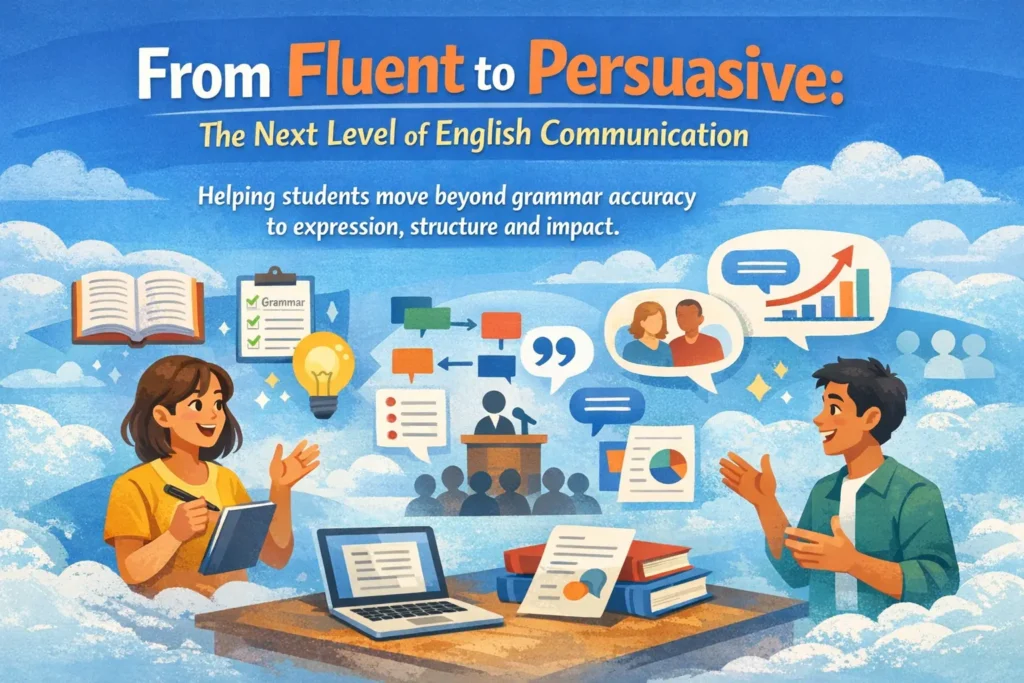
Many students preparing for global education believe that the main goal is to become fluent in English. Fluency is certainly important. It helps students speak without long pauses, understand classroom discussions, write assignments, and manage everyday conversations. But once students enter international universities, professional interviews, internships, healthcare settings, legal environments, or business workplaces, they realize something important: fluency is not the final destination.
The next level is persuasion.
Persuasive communication is not about being aggressive, overly confident, or using complicated vocabulary. It is about expressing ideas with clarity, structure, emotion, and purpose. This is where advanced English communication skills become essential. Students need to move beyond grammar accuracy and develop advanced English expression that helps them explain, influence, present, negotiate, and create impact.
For global students, this shift matters deeply. They are not only preparing for English tests. They are preparing for classrooms, careers, interviews, presentations, group projects, client conversations, patient interactions, legal arguments, and leadership roles. In all these situations, English must do more than sound correct. It must work.
Read More: What Is Leadership Language and Why Does It Matter for Global Students?
Fluency Is Good. Impact Is Better.
A student may speak English fluently and still fail to convince an audience. Another student may know grammar rules well but struggle to organize ideas in a presentation. Someone else may have a strong opinion but express it in a way that sounds unclear or weak.
This is the difference between basic fluency and Effective English Communication.
Fluency means you can speak. Persuasion means people listen, understand, and respond. Fluency helps you participate. Persuasion helps you create influence.

For example, a fluent student might say, “I think this topic is important because many people are affected.” That is correct. But a more persuasive version would be, “This issue deserves attention because it affects not only individual students, but also universities, employers, and future global mobility.” The second version has structure, scale, and impact.
This is why students must build communication skills in English that go beyond vocabulary and grammar. They must learn how to frame ideas, support arguments, use examples, and speak with confidence.
Why Grammar Accuracy Is Not Enough
Grammar is the foundation of good English. Without grammar, communication becomes confusing. But grammar alone does not create powerful communication.
Many students spend years correcting tenses, articles, prepositions, and sentence patterns. This is useful, but it does not automatically build persuasive speaking skills or strong writing. A grammatically correct answer may still be boring, flat, repetitive, or poorly structured.
In IELTS, for example, students are not judged only on grammar. They are also evaluated on fluency, coherence, vocabulary, pronunciation, and task response. This is why IELTS Speaking Fluency and Coherence matter so much. A student must not only speak correctly, but also organize thoughts logically.
Similarly, in TOEFL, students need TOEFL Integrated Speaking skills. They may have to read a passage, listen to a lecture, and then speak in a structured response. This requires understanding, selection, summarization, and expression. It is not just “speaking English.” It is thinking in English under pressure.
In PTE, tasks such as Repeat Sentence, Describe Image, and Retell Lecture require speed, clarity, memory, and structure. Students searching for PTE Speaking Practice, PTE Repeat Sentence Practice, PTE Describe Image Tips, and PTE Speaking Strategies must focus not only on pronunciation but also on rhythm, content selection, and response format.
Expression: Saying More with Better Language
The first step from fluent to persuasive is expression. Expression means choosing words and phrases that make your meaning sharper.
Instead of saying, “This is good,” a student can say, “This is valuable because it offers a practical solution.” Instead of saying, “I disagree,” they can say, “I understand the point, but I see the issue differently.” Instead of saying, “The graph is increasing,” they can say, “The graph shows a steady upward trend over the period.”
This kind of advanced English expression helps students sound more mature and credible. It is especially useful for english presentation skills, academic discussions, scholarship interviews, and professional meetings.
Students preparing for IELTS should pay attention to IELTS Speaking Vocabulary. But vocabulary should not be memorized artificially. It should be learned in useful contexts: giving opinions, comparing ideas, explaining causes, describing trends, making recommendations, and evaluating consequences.
Students preparing for CAE should also build expression. CAE Advanced English, CAE Speaking Practice, and Cambridge English Speaking tasks require candidates to express opinions, compare images, discuss ideas, speculate, negotiate, and reach decisions. These are not mechanical tasks. They test mature communication.
Structure: The Secret Behind Confident Speaking
Many students lose confidence not because they lack English, but because they do not know what to say first, what to say next, and how to end. Structure solves this problem.
A simple structure can transform an average answer into a strong one.
For opinion-based answers, students can use:
- Point
- Reason
- Example
- Conclusion
For comparison answers, they can use:
- Similarity
- Difference
- Personal view
- Final judgement
For presentations, they can use:
- Opening
- Context
- Main points
- Evidence
- Recommendation
- Closing
These structures help improve IELTS Speaking Coherence, IELTS Speaking Confidence, and IELTS Speaking Fluency. They also help with TOEFL Speaking Practice, TOEFL Speaking Strategies, and TOEFL Writing Skills, because the same thinking pattern applies to both speaking and writing.
For example, if asked, “Should students study abroad?” a weak answer may become a long, unorganized speech. A structured answer would be:
“I believe studying abroad can be valuable for three reasons. First, it exposes students to global academic standards. Second, it improves independence and confidence. Third, it builds international career opportunities. However, students must prepare financially and emotionally before making the decision.”
This answer is simple, but it feels controlled. That is the power of structure.
Business English Communication: Speaking for the Workplace
Students who want global careers need business english communication. This includes emails, meetings, presentations, interviews, negotiations, reports, and everyday workplace conversations.
In professional environments, communication must be clear, polite, concise, and purposeful. Students must learn how to make requests, give updates, ask questions, share disagreement, and present recommendations.
For example, instead of saying, “I cannot do this,” a professional version would be, “I may need more time to complete this properly. Could we review the deadline?” Instead of saying, “Your idea is not good,” one could say, “There are some strengths in this idea, but we may need to consider the cost implications.”
This is where professional english communication, professional english communication skills, and english communication skills for professionals become career-building assets. The ability to communicate well at work can affect internships, promotions, leadership opportunities, and client trust.
Persuasion in Specific Fields
Persuasive communication looks different across different careers.
For healthcare students, communication is not only about accuracy. It is about empathy. In OET Speaking Role Play, candidates must interact with patients or caregivers in a way that shows clarity, reassurance, and professionalism. A healthcare worker must explain medical information in simple language while maintaining trust.
For law students, persuasion depends on precision. Strong legal writing skills require clear arguments, careful wording, logical flow, and evidence-based reasoning. Legal communication must avoid ambiguity because one unclear sentence can change meaning.
For business and management students, persuasion often happens in presentations, meetings, and strategy discussions. Strong business english communication helps them present ideas, influence decisions, and build credibility.
For students in any field, persuasive English creates professional presence.
Conversation Skills Still Matter
While presentations and exams are important, students should not ignore english conversation skills. Many opportunities begin through conversations: networking events, classroom discussions, internships, interviews, and group assignments.
Good conversation is not about speaking continuously. It involves listening, responding, asking follow-up questions, and showing interest. Students with strong english speaking skills for students know how to enter a conversation, continue it naturally, and close it politely.
For example:
“That’s an interesting point. Could you explain it a little more?”
“I had a similar experience, but in a different context.”
“Can I add something to that?”
“I see what you mean. My view is slightly different.”
These lines help students sound engaged, thoughtful, and confident.
Mock Tests Help Convert Practice into Performance
Students often practise speaking alone but do not know whether they are improving. This is where mock tests are useful.
An IELTS Speaking Mock Test can show whether a student is speaking fluently, using enough vocabulary, answering directly, and maintaining coherence. A TOEFL mock can reveal whether responses are structured within the time limit. PTE practice can show whether pronunciation, fluency, and content are working together.
Mock tests are valuable because they create exam-like pressure. They also help students identify patterns. Maybe they repeat the same words. Maybe they speak too fast. Maybe they give examples that are too general. Maybe they pause too much after every sentence.
Once students understand these issues, preparation becomes more focused.
How to Build Advanced English Communication Skills
Students can start with a simple weekly plan.
Three days a week, practise speaking on academic or professional topics. Record your answers and review structure, clarity, and confidence.
Two days a week, practise writing short opinion paragraphs. Focus on clear introductions, logical reasons, and strong examples.
Every day, build vocabulary through context. Learn phrases for agreement, disagreement, comparison, recommendation, and conclusion.
Once a week, take a speaking or writing mock test. Use feedback to correct mistakes.
Also, watch good speakers. Observe how they open, pause, emphasize, and explain. Good communication is learned not only by studying, but also by noticing.
Final Thought
The journey from fluent to persuasive is the journey from speaking English to using English with purpose. It is the difference between answering and influencing, between participating and contributing, between being understood and being remembered.
For global students, this next level of communication can shape academic success, career readiness, and personal confidence. Whether they are preparing for IELTS, TOEFL, PTE, CAE, OET, or a future workplace, the goal should not be perfect English. The goal should be effective English.
Because in the real world, the most successful communicators are not always the ones who use the biggest words. They are the ones who make their ideas clear, structured, and meaningful.
FAQs
1. What are advanced English communication skills?
Advanced English communication skills are the ability to express ideas clearly, structure thoughts logically, use appropriate vocabulary, speak confidently, and adapt language for academic, professional, or social situations. They go beyond grammar accuracy and help students communicate with impact.
2. How can students improve persuasive speaking skills?
Students can improve persuasive speaking skills by using clear structures, giving reasons and examples, practising opinion-based responses, recording themselves, joining discussions, and taking mock speaking tests. Persuasion improves when ideas are organized and supported with evidence.
3. Why is IELTS Speaking Fluency and Coherence important?
IELTS Speaking Fluency and Coherence are important because students must speak smoothly and organize their answers logically. A good answer should not sound memorized or scattered. It should flow naturally from one idea to the next.
4. How does TOEFL Integrated Speaking help students?
TOEFL Integrated Speaking helps students practise reading, listening, summarizing, and speaking together. This is useful not only for the TOEFL test but also for university classrooms, where students often need to understand information quickly and explain it clearly.
5. Is business English communication useful for students?
Yes, business English communication is very useful for students, especially those planning international careers. It helps them write professional emails, attend interviews, participate in meetings, give presentations, and communicate confidently in workplace situations.




Leave a Reply