
The TOEIC, or Test of English for International Communication, is one of the world’s best-known assessments of English used in professional and workplace contexts. Unlike examinations that concentrate mainly on university study, TOEIC is designed around the kinds of English people encounter at work and in everyday international communication.
For students, graduates and professionals hoping to demonstrate practical English ability, understanding exactly what TOEIC measures is the first step towards preparing effectively.
Read More:TOEIC Speaking Test: Format, Question Types and High-Score Strategies
What does TOEIC measure?
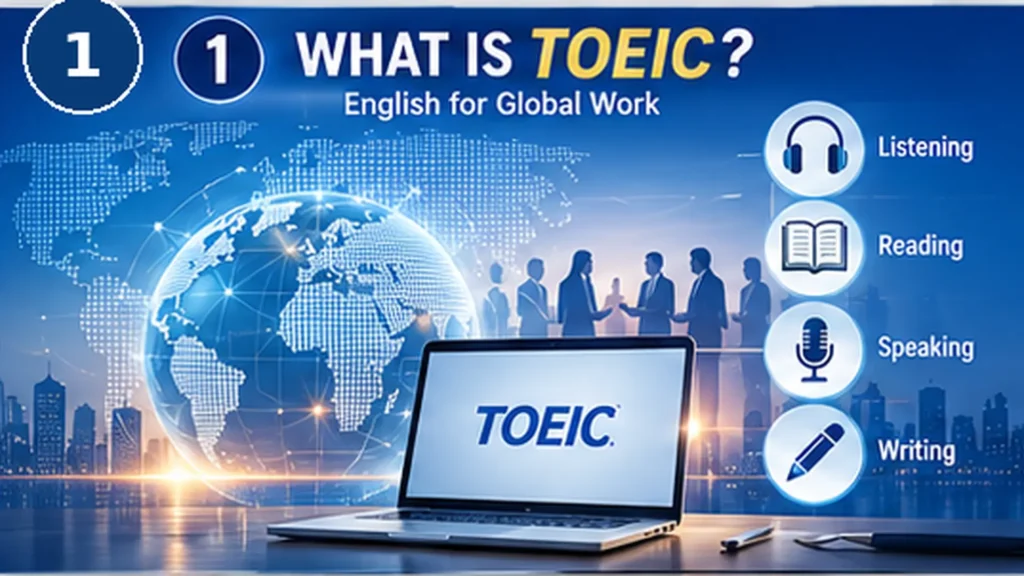
TOEIC is not simply one examination. The main TOEIC programme measures four communication skills:
– Listening
– Reading
– Speaking
– Writing
The best-known examination is the **TOEIC Listening and Reading Test**. It contains 200 multiple-choice questions: 100 Listening questions and 100 Reading questions. The Listening section takes approximately 45 minutes and the Reading section 75 minutes.
The TOEIC Speaking and Writing Tests assess productive English. The Speaking test contains 11 questions and lasts approximately 20 minutes, while the Writing test contains eight questions and takes approximately 60 minutes. They may be taken together or separately.
Together, these assessments provide evidence of proficiency across all four language skills.
Is TOEIC a business-English examination?
It is often described as a business-English test, but this can be misleading.
You are not expected to be an accountant, manager or international trade expert. TOEIC tests your ability to understand and communicate English in realistic contexts.
Typical situations may involve offices, travel, meetings, schedules, hotels, purchases, training, customer service, announcements and workplace correspondence.
For example, you might hear a conversation about rescheduling a meeting or read an email concerning a delivery. The challenge is understanding the English, not knowing specialist business theory.
Who uses TOEIC?
TOEIC scores can be used by employers, educational institutions and English-language programmes. Organisations may use them when recruiting employees, evaluating workplace communication ability or identifying training needs. Educational institutions may use TOEIC to measure students’ progress or readiness for employment.
This makes TOEIC particularly relevant to candidates who want evidence that their English can function in an international professional environment.
However, individual universities, companies and organisations establish their own score requirements. TOEIC itself is not a simple pass-or-fail examination.

What is the TOEIC score?
Listening and Reading are each scored from 5 to 495, producing a combined score from 10 to 990.
Speaking and Writing use separate scales from 0 to 200.
A candidate should therefore avoid asking only, “What is a good TOEIC score?”
The more useful question is:
What TOEIC score does my employer, university or professional programme require?
Someone applying for an internationally focused role may need a substantially higher level of English than somebody using TOEIC simply to document improvement during a language course.
Is TOEIC related to CEFR levels?
Yes. TOEIC scores can be mapped approximately to levels of the Common European Framework of Reference for Languages, or CEFR.
Current ETS mapping places a combined Listening and Reading score of approximately 785 at the B2 threshold and 945 at the C1 threshold. Candidates should still look at Listening and Reading separately because performance may differ substantially across skills.
These mappings are guidelines rather than rigid pass marks.
How should a beginner start preparing?
Do not begin by completing endless practice tests.
Start by learning the examination format, taking one diagnostic test, identifying your weakest question types, building workplace vocabulary, reviewing essential grammar and practising Listening and Reading under time pressure.
If taking Speaking and Writing, begin producing spoken and written English early rather than postponing those skills until the final week.
TOEIC rewards both English proficiency and familiarity with the examination. A candidate with reasonable English but poor timing may underperform. Equally, memorising examination tricks cannot compensate for weak vocabulary, listening comprehension or grammar.
The strongest preparation combines real English development, knowledge of TOEIC question types and regular timed practice.