
Receiving a TOEIC score can be confusing because TOEIC does not operate like a school examination with a universal pass mark.
There is no single score that automatically means “pass” or “fail”. The score must be interpreted in relation to the English ability required by an employer, educational institution or other organisation.
Read More: TOEIC Writing Test: How to Master Sentences, Emails and the Opinion Essay
TOEIC Listening and Reading scores
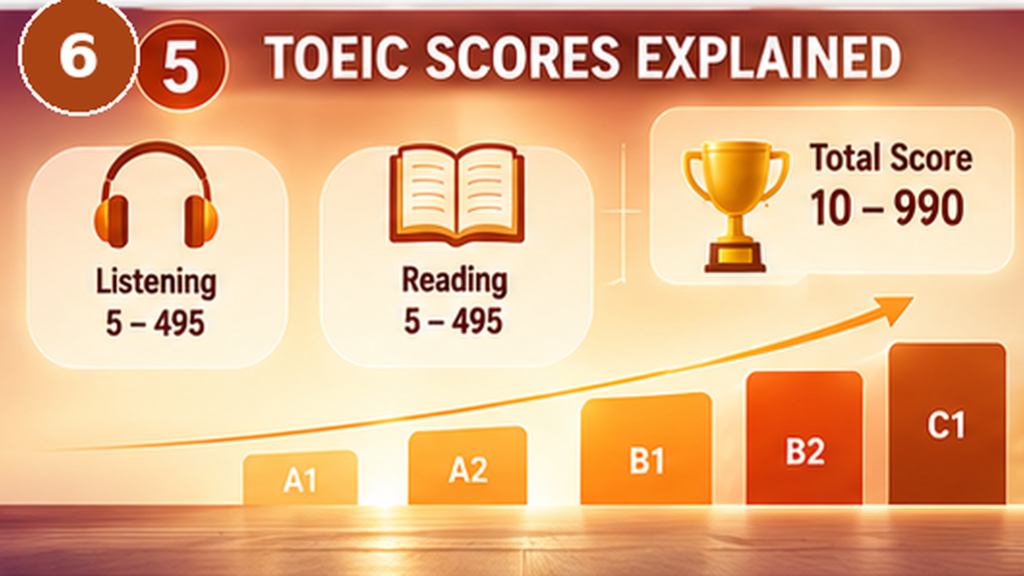
The Listening and Reading sections each use a scale from **5 to 495**.
Together they produce a total score between 10 and 990.
This means a candidate might receive:
Listening: 420
Reading: 360
Total: 780
The total is useful, but it does not tell the entire story.
That candidate is noticeably stronger in Listening than Reading. A preparation programme based only on increasing the overall score could therefore miss the obvious priority: improving reading performance.
Candidates should consider the two skills separately when interpreting their profile because ability may vary between them.
Speaking and Writing scores
TOEIC Speaking and Writing are scored independently on scales from **0 to 200**.
There is no single combined Speaking and Writing total.
This is useful because productive language skills can differ significantly.
A candidate may speak confidently but have difficulty structuring formal written communication. Another candidate may produce accurate written English while struggling to respond spontaneously in speech.
Separate scores make these differences visible.
TOEIC and CEFR
The Common European Framework of Reference for Languages describes language proficiency using levels from A1 through C2.
ETS publishes mappings between TOEIC results and CEFR thresholds.
Approximate combined Listening and Reading thresholds include:
A1 — 120
A2 — 225
B1 — 550
B2 — 785
C1 — 945
These are useful guidelines rather than rigid pass marks.
For Speaking and Writing, approximate ETS mappings include:
B1 — Speaking 120 / Writing 120
B2 — Speaking 160 / Writing 150
C1 — Speaking 180 / Writing 180
Again, these values should not be treated as universal admission or employment requirements.

What is a “good” TOEIC score?
The answer depends entirely on purpose.
Imagine three candidates.
The first is enrolled in an English course and wants evidence of improvement.
The second is applying for a job involving occasional written communication in English.
The third hopes to work in an international role requiring daily meetings, reports and negotiations.
All three may reasonably require different target scores.
Therefore, start with the institution’s requirement rather than an arbitrary internet definition of “good TOEIC”.
Are TOEIC scores permanent?
TOEIC scores are generally considered valid for two years because language ability can change over time.
Candidates should still check whether the organisation receiving the result has additional rules regarding how recent a score must be.
Use scores diagnostically
A TOEIC score should not simply be celebrated or rejected.
Analyse it.
If Reading is much weaker than Listening, investigate whether grammar, vocabulary or reading speed is responsible.
If Speaking is weaker than receptive skills, increase active communication practice.
Set the next goal skill by skill.
Ultimately, the most valuable question is not:
“Is my TOEIC score good?”
It is:
“Does my TOEIC score demonstrate the English ability I need for my next academic or professional objective?”
That shift turns a number into a practical learning target.