
From quick replies to academic talks
The TOEFL iBT Listening section has about 47 items in about 29 minutes, across four task types. It measures how well you understand spoken English in academic and campus situations, from a single spoken prompt to a short academic talk. Like Reading, it adapts to your level.
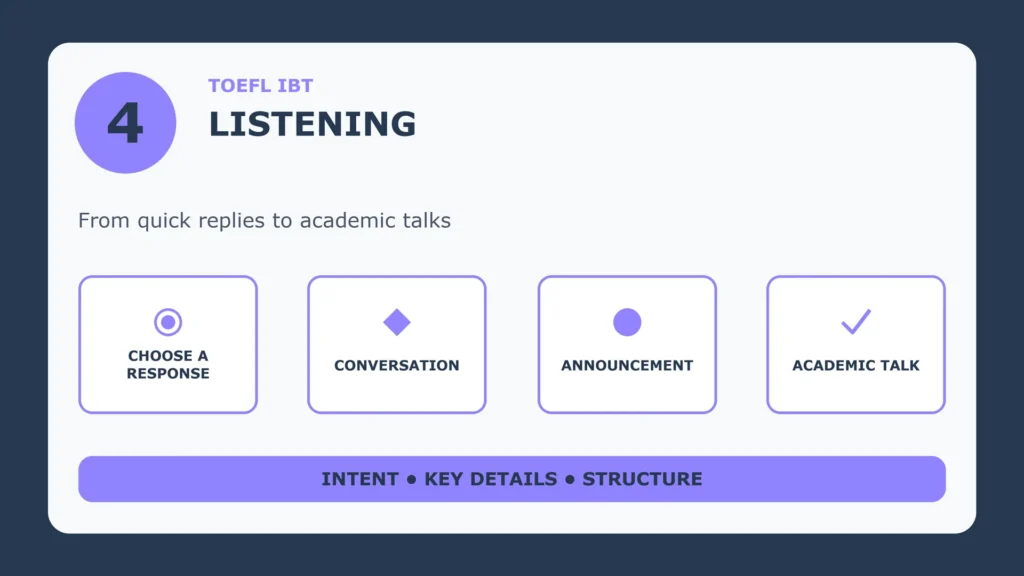
Task 1: Listen and Choose a Response
You hear a short spoken prompt and choose the most appropriate response. ETS says this measures understanding of meaning, intent and common patterns of spoken English.
- Listen for the purpose of what is said: a request, an offer, a complaint, a question.
- Be careful with options that repeat words from the prompt; the best reply often uses different words.
- Practise with everyday exchanges: say the most natural reply before looking at options.
Task 2: Listen to a Conversation
Conversations are mainly about campus life. Questions test main ideas, key details, speaker intent and implied meaning.
- Note three things: the problem, the options discussed, and the decision or feeling at the end.
- Notice tone and hesitation, which often signal what a speaker really thinks.
Task 3: Listen to an Announcement
Announcements are set in academic or campus situations. Questions test the speaker’s purpose, key information, implied meaning and likely next actions.
- Listen for changes, deadlines and instructions.
- Ask what listeners should do next, because that is often what the questions target.
Task 4: Listen to an Academic Talk
A professor or expert gives a short academic talk. Questions test main ideas, supporting details, organisation, inferences, and sometimes uncommon or idiomatic vocabulary.
- Take brief, structured notes: topic, main point, examples, contrasts.
- Follow signal words (first, however, as a result, for example) to track organisation.
- Don’t write everything. Structure matters more than every detail.
Building listening skill
- Daily short listening: campus podcasts, lecture clips and announcements, five to ten minutes at a time.
- Summarise aloud in two sentences after each clip.
- Shadow short sections to become familiar with natural speed, linking and reduced forms.
- Build vocabulary from what you hear, including phrasal verbs and common idioms.
Common mistakes
- Picking an answer because it contains a word you heard.
- Losing the main point while writing down a detail.
- Missing implied meaning, such as a speaker’s doubt or reluctance.

Quick FAQ
Can I take notes? Note-taking can help with conversations and talks. For the at-home test, ETS requires an erasable whiteboard or a blank sheet inside a transparent sheet protector, which you erase on camera at the end.
How is Listening scored? Listening receives a section score on the 1–6 scale, which feeds into your overall score.
Official ETS sources
Accuracy note (15 September 2026): this article reflects the TOEFL iBT format introduced in January 2026.
Ready for structured practice? See the TOEFL iBT course.